
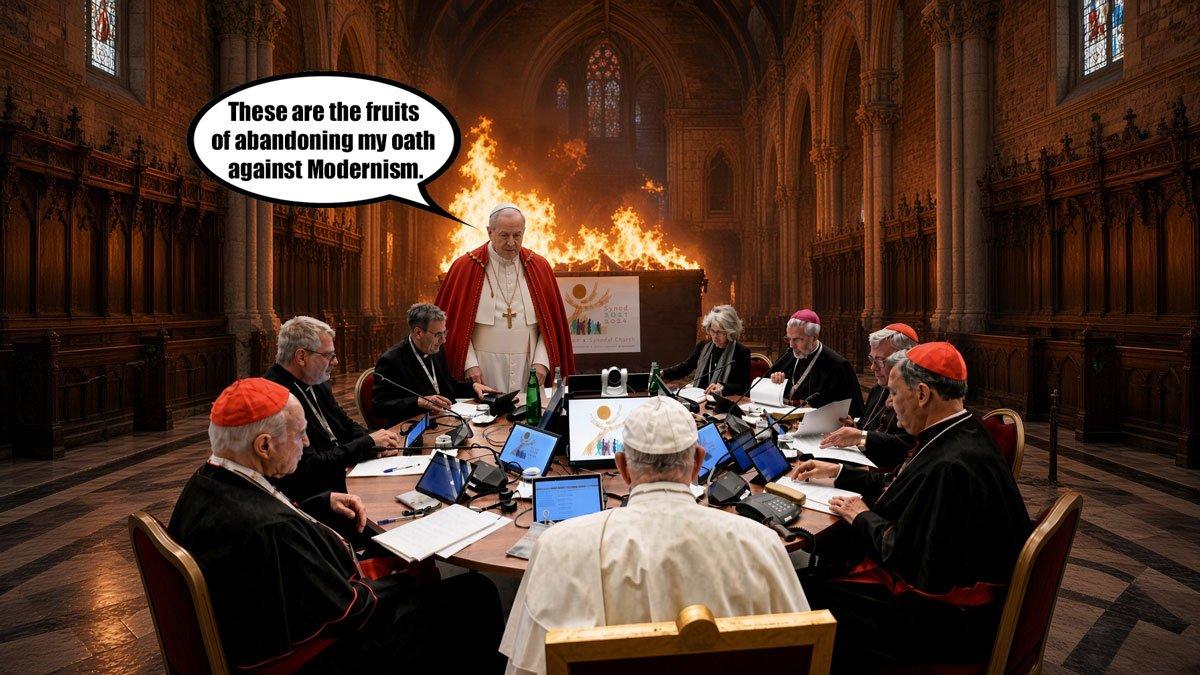
Pope Pius X’s Oath Against Modernism was required to be taken by clergy, pastors, confessors, preachers, religious superiors, and seminary professors of philosophy and theology from 1910 until it was abandoned by Pope Paul VI in 1967.
It is an evident fact that Pope Leo XIV has made his own the synodal process initiated by Francis. It is also a fact that synodality worries many of the baptized: the vagueness of the concept, the insistence from the ecclesiastical hierarchy, the contradictions with previous magisterial teaching, and other causes provoke the rejection of synodality by the sensus fidei fidelium. That is why articles continue to appear on this topic, which has unfortunately become the protagonist in a self-referential Church focused on these issues that are, at best, sterile and, at worst, harmful.
Regarding the “synodal path” developed by the German episcopate with the intention of applying it to the universal Church, Cardinal Raymond L. Burke stated in 2023: “We are told that the Church we profess, in communion with our ancestors in the faith since the time of the Apostles, to be One, Holy, Catholic, and Apostolic, must now be defined by synodality, a term that has no history in the doctrine of the Church and for which no reasonable definition exists. Synodality and its adjective, synodal, have become slogans behind which hides a revolution to radically change the self-understanding of the Church, in accordance with a contemporary ideology that denies much of what the Church has always taught and practiced. This is not a purely theoretical question, for the ideology has already been put into practice, for some years now, in the Church in Germany, spreading confusion and error and their fruit, division, with grave harm to many souls. With the imminent Synod on Synodality, it is rightly to be feared that the same confusion, the same error, and the same division will reach the universal Church.” Also in 2023, Cardinal Müller described synodality as a hostile takeover of the Catholic Church, and the late Cardinal Pell called it a “toxic nightmare.”
More recently, Fr. Jorge González Guadalix said on InfoCatólica with his usual clarity what many of us think: “the invention of the synod on synodality always seemed to me a joke.” And he quoted the words of Bishop Rob Mutsaerts, Auxiliary Bishop of ’s-Hertogenbosch: “My question is simple and serious: is the synodal process really helping to bring souls closer to Christ and to eternal salvation?” Has the faith been strengthened? Has Christ been proclaimed with greater clarity? Has Catholic identity been deepened? Have conversions, Mass attendance, and priestly vocations increased? Has Eucharistic reverence grown? Has the moral teaching of the Church been clarified? Because, in the current synodal discourse – Fr. Jorge González affirms –, synodality threatens to become an end in itself. And there begins, from a traditional Catholic perspective, the problem”.
Continue reading at Infovaticana