
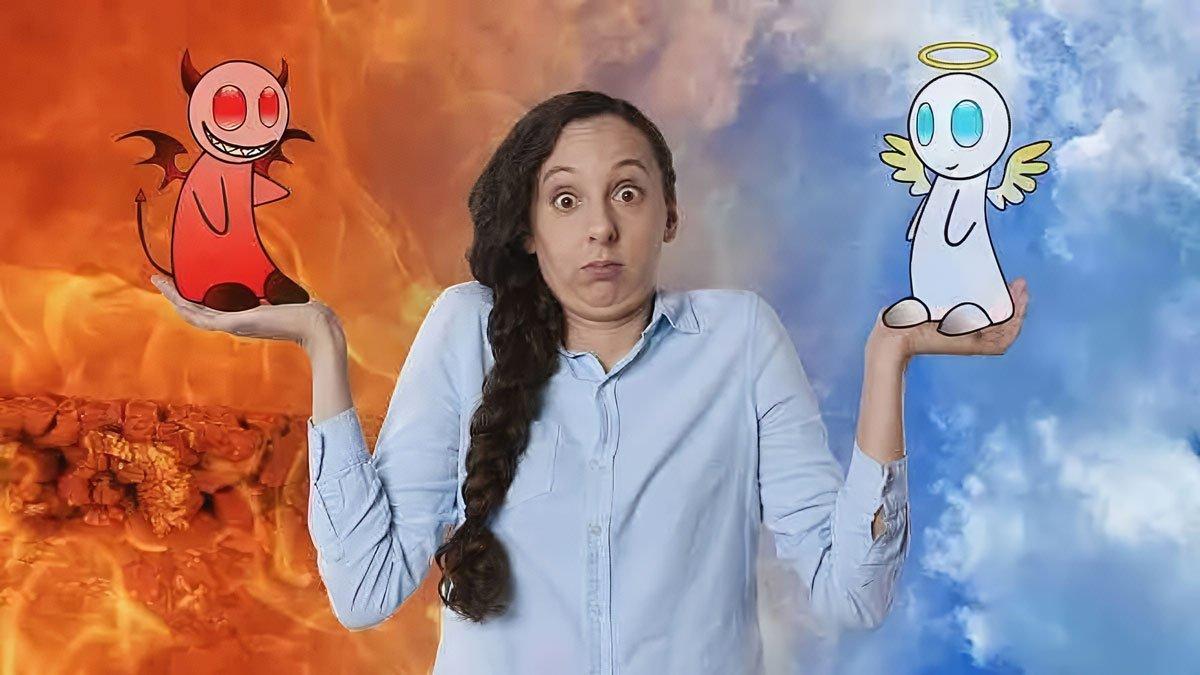
The biblical narrative of redemption is rendered pointless and ultimately incomprehensible in a culture that has been bleached of a real sense of the importance of moral agency—the ability to choose freely right and wrong, and be responsible for those choices. The biblical story of Fall-Redemption-Glory makes little sense if human moral choice loses its purchase as the central defining aspect of what it means to be a person at all.
In fact, and as we now see in many “academic” treatises, once the importance of moral agency as the gravitational center that coalesces dust into rocky density is removed, the very notion of a real “self” evaporates as the core around which a spiritual destiny is forged.
This is what is at stake today: the true “humanism” of the Gospel versus the destruction of the human in modern “humanitarianism”.
The former understands that we are either moving upwards towards our final fulfillment in God or we are moving downwards towards an ultimately deadly apotheosis of the visceral and the genital. By contrast, modern humanitarianism views such moral and spiritual construals of the human as potentially fascistic and thereby, in Gramscian fashion, creates a new reductionistic ideology for the bourgeois masses that celebrates the destruction of moral agency as the only true liberation.
The Church, in this view, is the enemy of real freedom. Christians are a dangerous social contagion, successful for a long while, but against whom society is now happily inoculated with the MNRA vaccine of modern enlightenment. Thus, the central message of Christianity concerning moral agency and regeneration is used by secularists against it. The very terms of the debate—that is, “freedom”—are stolen from Christianity and transformed into synthetic secular spike proteins that invade the social genome, creating an immunity against any renewed assaults from the Christian virus.
This loss of a sense of the moral self as constitutive of my dignity as a spiritual person made in the image and likeness of God makes the Theo-dramatic interplay of divine and human freedoms in the biblical narrative seem like a fanciful and quaint mythology from an ancient era of prescientific naivete. In this view, there is no spiritual person, no gravitational center of consciousness that we label a “self”. There is only a mélange of neuronal experiences that excrete consciousness like the liver excretes bile. Therefore, this epiphenomenal thing we call “consciousness” is the product of a series of competing subterranean biological forces that were forged over the eons of evolutionary time.
Continue reading at Catholic World Report