
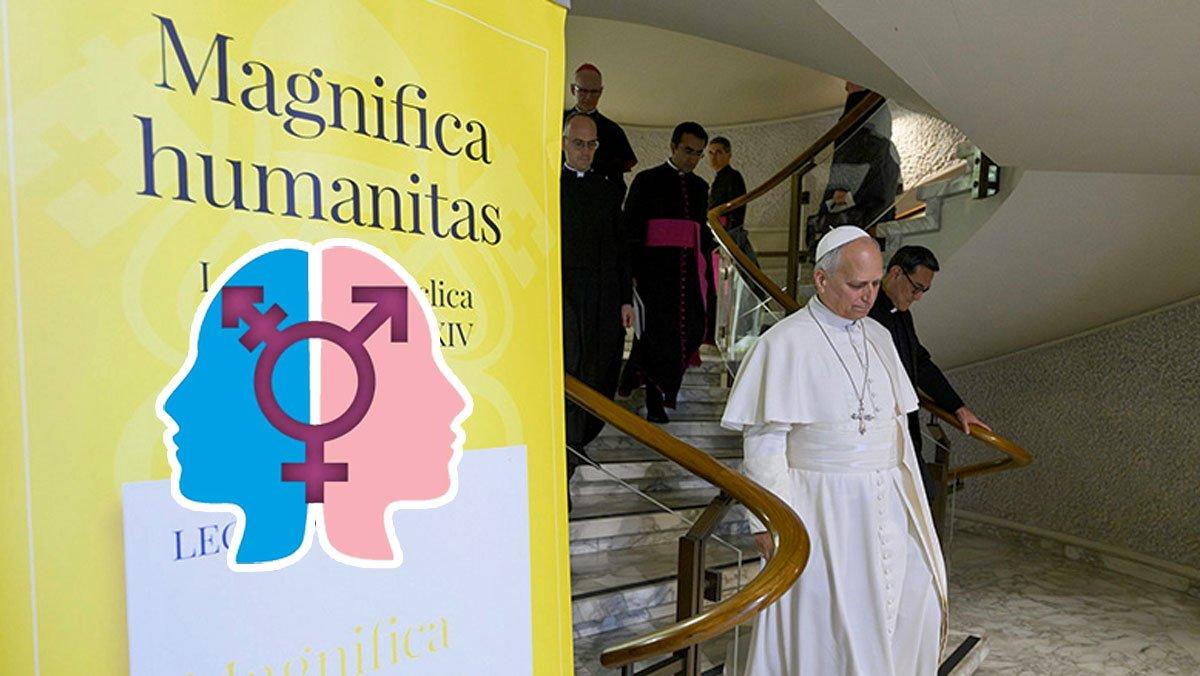
The first encyclical of Leo XIV, Magnifica humanitas, signed on May 15 and published on the 25th, incorporates the term “gender” in its development on social justice. In paragraph 79, when describing the wounds that restorative justice must heal, the text lists «wars, colonialism, racial or gender discrimination, violence against entire peoples, and exploitation.» This is the fact, and it is worth noting before any reading: the word appears in the official Spanish document published by the Holy See.
Its relevance lies not in what the paragraph says in addition, but in what the vocabulary introduces. The distinction between “sex” and “gender” is not a neutral synonymy: it is the foundational operation of gender theories, which separate the sexed condition—given, biological—from a cultural and self-attributed category. Outside that theoretical framework, there is no “gender” independent of sex. The Church’s anthropology has been built on the opposite premise: «male and female he created them,» sexual difference as a received gift and not as a construct. By speaking of “gender discrimination” where previous magisterial language said «sex» or «women,» Magnifica humanitas incorporates the category that the same magisterium had treated as ideological.
The contrast with previous texts is precise. In Amoris laetitia (2016, n. 56), Pope Francis used the word «gender,» but in quotation marks and as the name of what he rejected: «an ideology, generically called gender, which denies the difference and natural reciprocity of man and woman.» The term entered the text under quarantine, as the subject of condemnation, not as an assumed concept. In 2024, the Declaration Dignitas infinita of the Dicastery for the Doctrine of the Faith expressly condemned “gender theory” (nn. 55-59) and, when listing violations of dignity, titled the corresponding section «violence against women,» not «gender-based violence.» Having the noun at hand, it deliberately chose the unmarked formula.
Continue reading at Infovaticana