
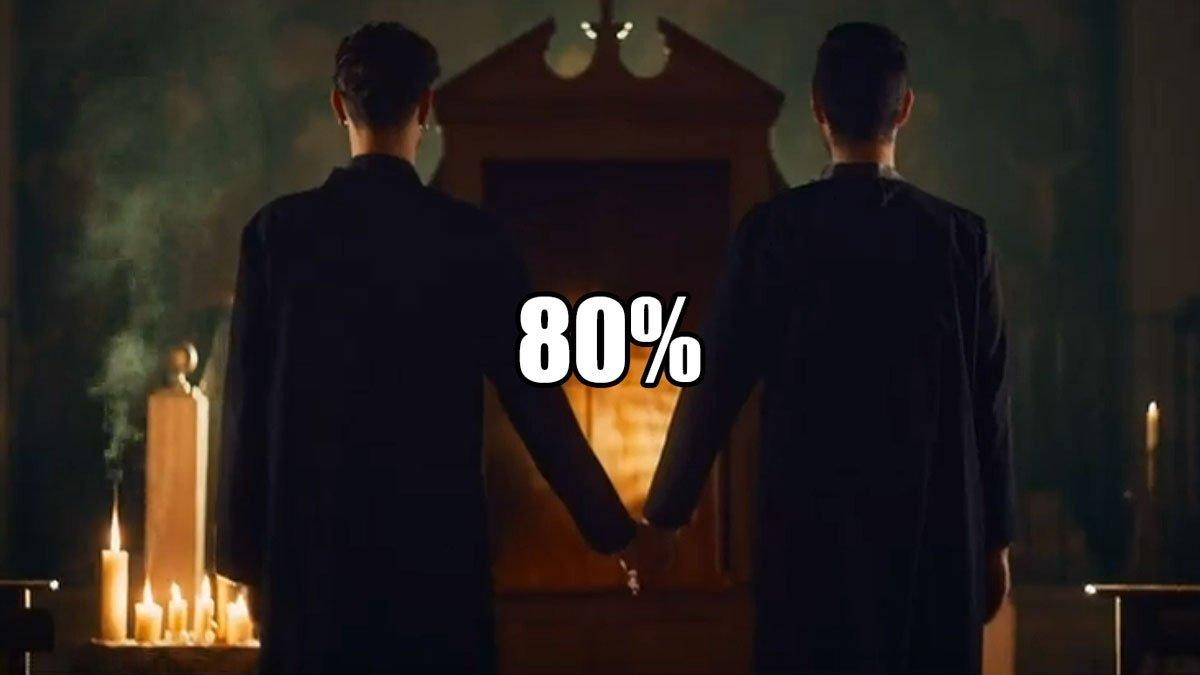
The documentary aired yesterday on Cuatro «Proyecto Sistiaga» was dedicated to homosexuality in the Catholic clergy. Sistiaga’s investigation is presented as a human approach to the experience of homosexuality in Catholicism through the suffering and contradictions of a series of specific individuals. However, beyond its empathetic tone, the program articulates from the outset a very specific thesis: chastity would be a form of harmful repression, and the only honest way to live sexuality—including in the priesthood—would be to embrace an active homosexual life. That is the interpretive key that runs through the entire narrative and conditions both the selection of testimonies and the conceptual framework from which they are read.
One of the central testimonies is that of the British theologian and priest James Alison, who claims that between 70 and 80% of the clergy would be homosexual and describes an ecclesial structure practically dominated by a normalized homosexual subculture. In his intervention, he not only speaks of orientation but of environments, shared codes, and a systemic reality that, according to his approach, clashes head-on with the Church’s official moral discipline. The conflict, in his narrative, does not arise from personal incoherence but from an institution that demands something impossible to live.
The priest Jesús Donaire, excluded from the clerical state, also appears, reinforcing that vision from personal experience. He recounts sexual relations with fellow priests during his ministerial stage and presents these behaviors as something widely extended and almost inevitable. The responsibility is once again shifted to the norm: the problem would not be the double life, but the obligation to hide what should be integrated. The implicit message is always that chastity would not be a realistic proposal, but a structural source of lies and weariness.
The documentary’s harshest focus is the testimony of the Canary Islands priest Cristóbal José Rodríguez, who speaks openly about the suicides of priests and the extreme psychological suffering that can generate living for years a deeply dissociated life. Rodríguez, controversial for proposing a pastoral approach alien to the chastity proposal, describes in this case a real human drama that must be addressed. But even at this point, the program insists on the same interpretive framework: the root of the problem would be the repression of sexuality, not the sustained incoherence or the lack of vocational discernment.
The documentary also includes the voice of the controversial group CRISMHOM. The intervention of its volunteers reinforces the reading of the entire program: for them, the Church should review its sexual morality and abandon what is presented as an obsession with «repressing» sexuality, replacing it with an uncritical integration of active homosexual relationships.
And here lies the underlying dialectical trap. Throughout the documentary, the term «repression» is used as a synonym for self-control, renunciation, and inner discipline. It is taken for granted that containing sexual impulses is something pathological and that happiness necessarily passes through their active exercise. This premise is not discussed: it is assumed. But that premise is incompatible with Christian anthropology. For Catholics, homosexual or heterosexual, sexuality is not an end in itself or an absolute right, but a dimension of the person with an objective meaning. Sex has a unitive and procreative purpose, and outside of that framework, it can become, for anyone, a source of inner disorder.
Continue reading at Infovaticana