
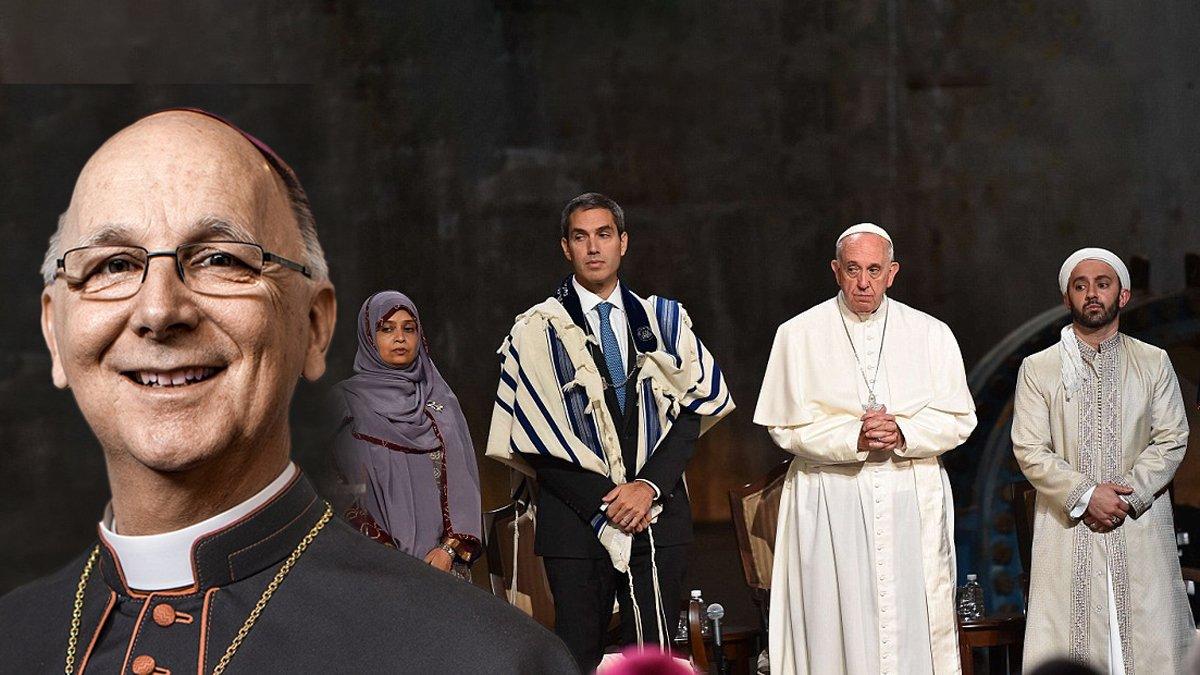
The idea of brotherhood among all, regardless of their beliefs, as long as they are people of good will, has become established in the Church, not only between Catholics and Protestants, but also between Catholics and Protestants and followers of other religions. I find this very questionable, not to say wrong! I would prefer to speak of friendship if, in individual cases, these relationships deserve the name, which is not generally the case. I would rather speak of our neighbors, whom the Gospel commands us to love (even if we are enemies). But of brothers and sisters? Of siblings? What kind of brotherhood is this, for example, between Christianity and Islam, which persecutes or suppresses the Christian faith in most of the countries where it prevails? It is proven that Christians are most persecuted in Islamic countries. But things are not much better in communist China. The so-called “patriotic unification” under Xi Jinping in China is the successful attempt to subjugate and sinicize (reinterpret and reshape) the Catholic Church, which many blind people still see as a gain. How unfortunate! Do you really believe in the benevolence of the Chinese Communist Party, Islam, or Orthodox Judaism towards Christianity in general and Catholicism in particular? Hinduism, too, has recently become much more aggressive towards Christians. How many Catholic churches have been set on fire by our so-called “brothers” in France, for example? How many Catholic priests have been murdered? This happens every year. How many believers have been accused and sentenced to death, or simply massacred by Islamic terrorist gangs, for example, in African countries? In Jerusalem, it can happen that, as a Christian, you are treated with open contempt by Orthodox Jews. The list is long. I am only giving a few examples here. In which bubble or parallel world does the talk of universal brotherhood move, measured against the global facts in interreligious relations?
How can we, Catholics, in this context, speak indiscriminately of our “brothers and sisters,” among them militant exponents of their religion or ideology? They do not believe in Jesus Christ, the Son of God, the Way, the Truth, and the Life, the only door to the Father. They fight against this creed and all who adhere to it. In any case, the number of Christian martyrs is not diminishing. How can their persecutors be my brothers and sisters, my brothers and sisters? They cannot. In doing so, I am not undermining the Gospel of the Good Samaritan. Nor am I limiting charity, which even includes enemies. But I also do not call the latter my brothers and sisters, at least not as long as they do not fulfill the criteria of faith, reject it, fight it—sometimes to the point of bloodshed—or merely tolerate it at the price of massive discrimination and oppression. Moreover, John states quite explicitly in the prologue to his Gospel that Jesus Christ has given us the power to become children of God, and that this requires conception from above: in spirit and in truth. So we are not so by nature, but because of faith in Jesus Christ and baptism, which He made the condition of salvation.
Talk of universal brotherhood is unrealistic, not to say sentimental. In our mouths, it’s a kind of naive and well-intentioned capatatio benevolentiae of those of other faiths, but the facts speak against it. Any error on their part thus becomes “socially acceptable.” In any case, this talk is rarely heard in the interreligious context, or only sporadically, at least in my perception. I would add, however, that I have Muslim relatives and friends, and have had them since my youth.
The situation is different between the baptized. I needn’t elaborate on that. But even in this relationship, there is no real unity except in the truth. And the latter is Roman Catholic. This must be stated quite clearly. This does not arise from my arrogance, my conceit, my psyche, or any extremism I may be accused of, but from the faith of the Roman Catholic Church, in which we, as we know, believe and which we confess in the Creed. With that, we have called the problem by its name, something that is generally avoided. If it is excluded, the much-vaunted unity is nothing more than a discord, contradiction, and hopeless heterogeneity of beliefs, beautifully glossed over as supposed “diversity.” On closer inspection, and structurally, this ecumenical mode is anything but a unity in truth. I do not believe in love without truth. It is not love, but truth that unites us, just as it is not love, but truth that divides us.
All this talk of fraternity and diversity is therefore based on the exclusion of the question of truth in order to achieve better relationships. In relation to those of other faiths, this means the relativization of Jesus’ claim to absoluteness, the exclusion of his uniqueness and normativeness for all people; and in relation to other Christians, it means the relativization of the salvific necessity of the Roman Catholic Church, its visibility, its universal salvific significance and mediation, its sacraments, and, last but not least, the relativization or downgrading of its papacy to a primacy of honor with maximum accommodation.
I repeat my thesis: Those who have no truth can merge with everyone and be kind to everyone without it hurting. They can include everything and anything. Exclusivity and uniqueness are then a thing of the past. This is what one desires. But as soon as the question of truth is posed in its full scope and breadth, polarization, distancing, rejection, and martyrdom ensue, or conversion in the best sense of the word: the acceptance of the Catholic faith, baptism, the Roman Catholic Church in its visibility, uniqueness, catholicity, and apostolicity, its sacraments, its apostolic succession, and its unity sub Petro et cum Petro (papacy). The divisive sword of truth, which Jesus Christ claimed for Himself and identified with Himself, according to His words, cuts through families. We do not accuse Jesus of being unkind. We agree that He is the truth, and that this is rejected by many. Hence the talk of the sword. Unlike Mohammed, Jesus does not recognize a violent one. Of this sword, He said that it should be put back in its sheath (and this to Peter, of all people, who is supposed to vouch for the truth of the traditional faith). In this regard, no concessions or consent can be expected from other religions unless they convert to the revealed, divine truth as revealed in Jesus Christ.
But even with Christians separated from us, there is no true unity unless they convert to the Roman Catholic Church—as converts have always done—and return to unity with Peter and his successor. On this rock, Christ founded His Church. His power of the keys means, in the biblical sense, authority over the entire house—jurisdiction in Latin—not just honorary presidency, nor just first in love, but rock and binding guarantor of unity in the full truth of the traditional faith. For separated Christians, this is also about regaining the sacraments they have lost, apostolic succession, and true unity in the faith, which they cannot find even among themselves. Come, Holy Spirit! Consensus talks will not fix it.
Translated and reposted from Stilum Curiae