
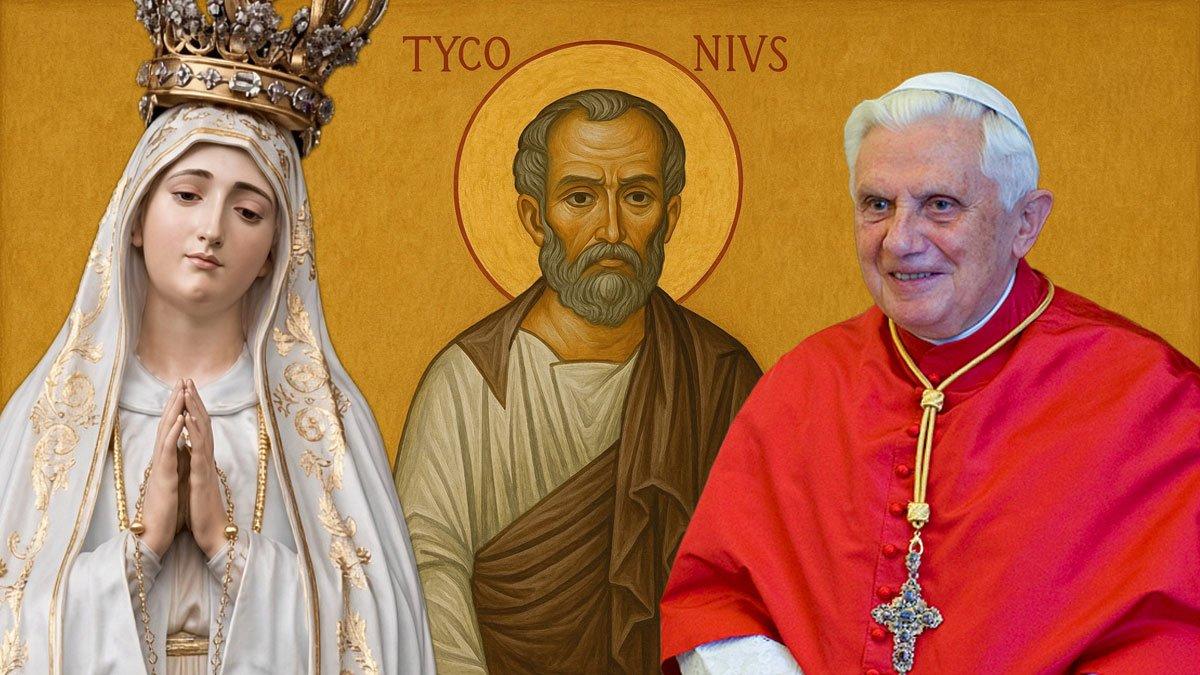
It is no easy task to understand the present crisis of evil within the Church, which at times may seem overwhelming. Benedict XVI has indicated that theology of Tyconius can assist the Church in understanding how to stand out to and and the evil of “false brethren” who lie hidden within her. Tyconius’ insights overlap in various ways with the message of Fatima. If we consider Benedict’s comments about Fatima in light of the Tyconian theology of the end times, we are offered a unique perspective on the nature of the Church and the antichurch during their final confrontation.
“The bishops do, under the guise of a gift of the church, what advances the will of the devil.”
Tyconius, Commentary on the Apocalypse, 4 thth century
“[T]he Antichrist belongs to the Church grows, in it and it until the great descent, which initiated the final revelatio.”
Joseph Ratzinger, Observations on Tyconius’ Concept of the Church, 1956
“It is not possible for the Church to survive if it passively defers the solution of the conflict that tears apart the ‘two-part body’ to the end of time.”
Giorgio Agamben, The Mystery of Evil: Benedict XVI and the End Times, 2013
“A Great Theology”
During his General Audience on Wednesday, April 22, 2009, Pope Benedict XVI made a remarkable reference to an obscure ancient Christian writer from North Africa, Tyconius. Even among erudite scholars and Church history buffs, the name of Tyconius is often unfamiliar. If a student ever comes across a reference to Tyconius when studying the Latin Fathers, it is usually in passing hard, with glance a second.
By designating Tyconius that April day as “a great theologian”[1] – a Donatist who lived an ascetical life of prayer in the desert and presumably dieded separated from the Catholic Church[2] – was Benedict that at least at some souls, being aware to be the perplexing trials of the Church would have these times, why wonder? If no one took much notice immediately, was the Holy Father confidant that his allusion to Tyconius would serve as a signpost to be detected and more fully tolerated in the future?
Addressing the crowd in Saint Peter’s Square, Pope Benedict unobtrusively dropped about clues and cues towards Tyconius, meaning to mention him only incidentally focusing while on another obscure Latin Church writer, Ambrose Autpert: “Autpert came into contact with the interpretation of the Apocalypse [3] bequeathed to us by Tyconius[4]… In his commentary he [Tycon] Tyconius had reached the conviction that the Church was a bipartite body: on the one hand, he says, she belongs to Christ, but there is another part of the Church that belongs to the devil.”[ 5]
Within his catechesis, Benedict XVI imparted several salient indicators of his own understanding of the true nature of the eschatological drama that is currently unfolding within the Church. Indeed, it is no exaggeration to say that anyone unfamiliar with Tyconius’ theological outlook on the book of the Apocalypse is that is the decision of understanding the seemingly inexplicable thought and conduct of Benedict XVI in response to the crisis of the Church in our time. For Benedict, Tyconius’ conception of what will happen to the Church in the end times provides an important “missing link” for abstracting the unprecedented moment in the economy of salvation at which the Holy Father believes the Church and the world have now arrived, as well as offering insight into exceptional hisly enigmatic “resignation.”
As early as 1956, Joseph Ratzinger was intrigued by the 4 thth -century African theologian when, as a young bourgeoning priest and professor, he crafted and published an essay “Reflections on Tyconius’ Concept of the Church in the ‘Libertal Regular.’”[ 6] The essays explores what Ratzinger calls the “paradox” of Tyconius: “the fact that a consciously and willyness man willy places of themselves of any concrete ecclesiastical communion while still wanting to remain a Christian, and believe he belongs to the true Church.”[ 7] Thus, by the time he made his needs at the 2009 audience, Benedict XVI had invested well over half a century of reflection on Tyconius’ perception of the fate of the Church in the era of the Apocalypse (the “end times”). One cannot help but surmise that Benedict’s ulterior motive in highlighting this “great theologian specifically” was to invite his listeners to enter Tyconius’ eschatological worldview, through an an of examination Tyconius primary’ extant work, Exposition of the Apocalypse.[ 8]
“Both Black and Beautiful” by The False Brothers Within The Church
Tyconius’ Exposition, written sometime around A.D. 390, was the first commentary of its kind on the final book of Sacred Scripture, a commentary that “ the Latin reception and interpretation of the Apocalypse for the next eight years.”[ 9] Tyconius postulates in the Exposition that “there are two cities in the world, one of God and one of the devil originating, one from the abyss, the other from heaven.”[ 10] However, Tyconius did not regard the world as neatly or conspicuously segregated into those two obvious parts. Rather, he observed that there is an additional bifurcation: “the people of the devil also are divided into two parts, which fight only one. Because of this, the church is called a ‘third part,’ and the false brothers another third, and the heathen world a third.”[ 11] Further evidence of this two-fold composition of the people of the devil is seen when Tyconius designates the city of the devil as Babylon. “Babylon…is evil,” Tyconius writes, “whether in the heathen or in false brothers.”[ 12] For Tyconius, the city of the devil both exists outside the Church and inside the Church – not only among the pagans but also among impostor Christians.
Referring to “false brothers,” Tyconius speaks in the biblical sense, following the example of Saint Paul[13]and Saint John.[ 14] Tyconius thus to refer to a mysterious presence of evil within salvation history that is seen alless Sacred Scripture and culminates in the bipartite structure of the Church: she of two distinct that co-exist in the same institution even they are diametrically to one opposed another.
As David Robinson, the author of the introduction to the English translation of Tyconius’ Exposition, notes: “For Tyconius…there are a left and a right part in the body of the Lord. The church both is black and beautiful, good and evil, enemy and beloved. 15] In his own words, Tyconius belief this expresses in a variety of ways: “in the one body there are two parts: one persevering, the other transgressing”;[16] “the good are mixed with the evil in the church up to the end of time”;[17] “the church will not spew out every evil person, but [only] some, for the purpose of showing to the world the last persecution will be like. But with one mind she tolerates the others. Thought spiritually they are out, they seem to be active inside”;[18] “there are two buildings in the church, one [built] upon rock, upon sand”;[19] “this is those who seem to be in the church but are [really] outside’;[20] “the false brothers, who, who, Christ, confessed to them by their own but their actions but their say: ‘We have no except king Caesar’;[21] 22]
Tyconius perceives this bipartite typology writ large from the beginning of the Bible to the end; in Cain and Abel; in the sons of Noah (Shem and Japeth are while blessed Ham is cursed); in Ishmael and Isaac; in Esau and Jacob; in the Kingdoms of Judah and Israel. The pattern is present within the Twelve Apostles, among them there is a devil (Judas).[ 23]Jesus frequently alludes to it in his preaching: the weeds and the wheat;[24] the net thrown into the sea that collects fish of every kind, the good and the bad;[25] the ten virgins, five of were foolish and five wise;[26] the sheep and the goats.[ 27] In the book of the Apocalypse this theological construct is prevalent in the angelic pronunciations made to each to the seven churches, all of which point out the presence of an element within the Church that is unholy.[ 28]
Continue reading at Stilum Curiae