
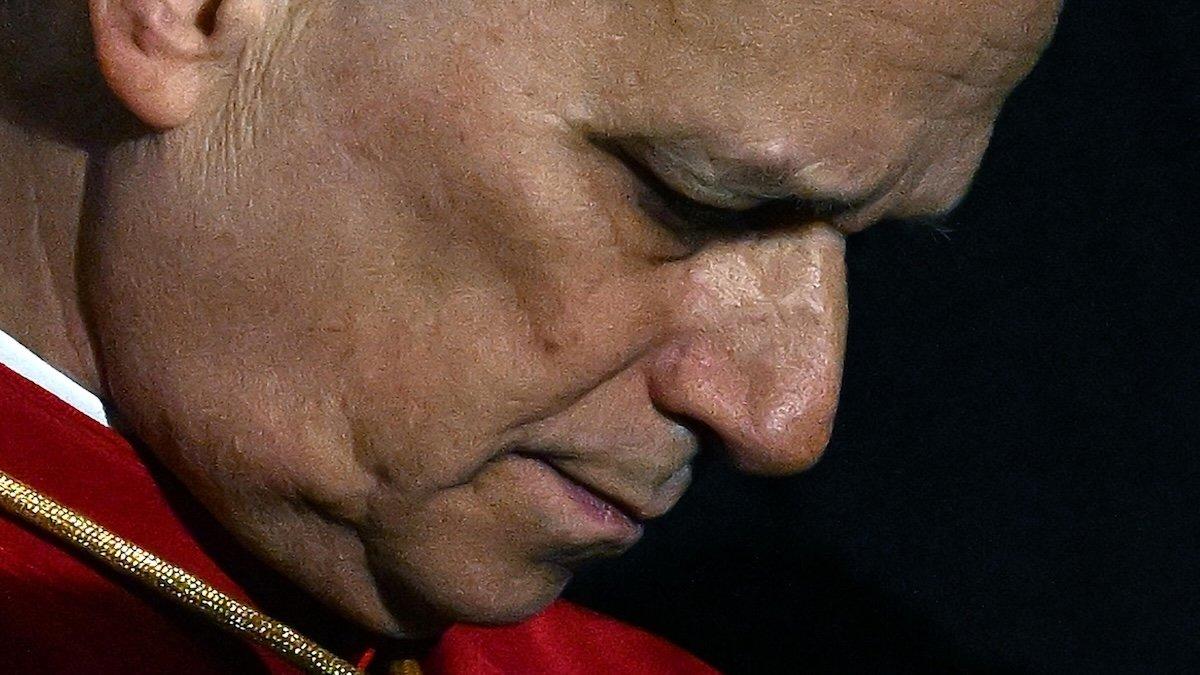
Showing the muscle of power is easy, but it does not seem the best way to recover authority.
There was a time when excommunication could bring an emperor to his knees or cause an entire nation to apostatize. But excommunication is no longer what it once was, and that is the work of the very Church that today wields it against the FSSPX. History knows these diminished echoes, those tragedies that repeat themselves as farces, as Marx described when he identified Napoleon III as a ridiculous imitation of his uncle. Nor is Leo XIV Gregory VII.
But if farce is already a fairly appropriate term to describe this case, with Tucho Fernández, carrying all his record of absurdities, leading the excommunication, we have an even more fitting term for it. It was given to us by the great Valle-Inclán, and as you may have guessed, the term is esperpento. With the aforementioned cardinal, and with the brand-new pontiff who backs him, Canon Law has gone for a stroll down Callejón del Gato. Yes, there we have the guardian (sic) of the Doctrine of the Faith turned into a grotesque distortion of his own office. The image of the censor of Écône appears at the bottom of the glass, brandishing the Code, after having turned doctrine into something viscous, adaptable, sentimental, contextual, liquid… Such a scarecrow dressed in purple would have delighted Valle-Inclán, who would have known how to make the most of the theatrical effect of that excommunication.
Taking oneself so tragically seriously when one has long since lost all composure provokes an emotion composed of several ingredients, among them astonishment and laughter, even second-hand embarrassment, but certainly not reverential fear. That such a figure should promote an excommunication in the name of the purity of ecclesial communion is simply the height of it all. It is the height of it because one of the aspects that most separates the excommunicated from the excommunicators is that the former denounce, precisely, the extent to which the latter have emptied their acts of meaning.
Doctrine is little more than the report of a working group, always dependent on context; morality has dissolved into that mercy without judgment that accompanies the sinner while trying not to inconvenience him; the liturgy has for decades suffered from parochial creativity; Germany has for years been rehearsing schism in installments, and the Communist Party of China has been ordaining bishops; the Curia appoints cardinals to serve under religious prefects, while homosexual couples are blessed as long as they do not pray in Latin; pastoral care no longer means leading souls toward the truth, but rather sugar-coating that pill until it is completely hidden, and synodality has managed to make old heresies re-emerge, shiny and fresh out of a brainstorming session. It is no surprise that with such an emptying-out, the Doctrine of the Faith has ended up in the hands of a cardinal who, without shame, disputes Ratzinger while flirting with contextual theology.
Yes, for this prefect, backed by the new Pope, ecclesial acts are nothing more than noise. So too is excommunication, despite being the Church’s gravest penalty, for even the most serious weapons become ridiculous when wielded by someone who has turned his own authority into a matter of opinion. How can Rome expect its excommunication to be taken seriously after having spent decades demonstrating that everything, or almost everything, could be nuanced, contextualized, negotiated, tolerated, reinterpreted, or blessed with a footnote? It is Rome itself that has devalued for decades the language with which it now seeks to judge. It should not be surprised that its liquid theology fails to impress. Or is not everyone good, excommunicated or not?
Continue reading at Infovaticana