
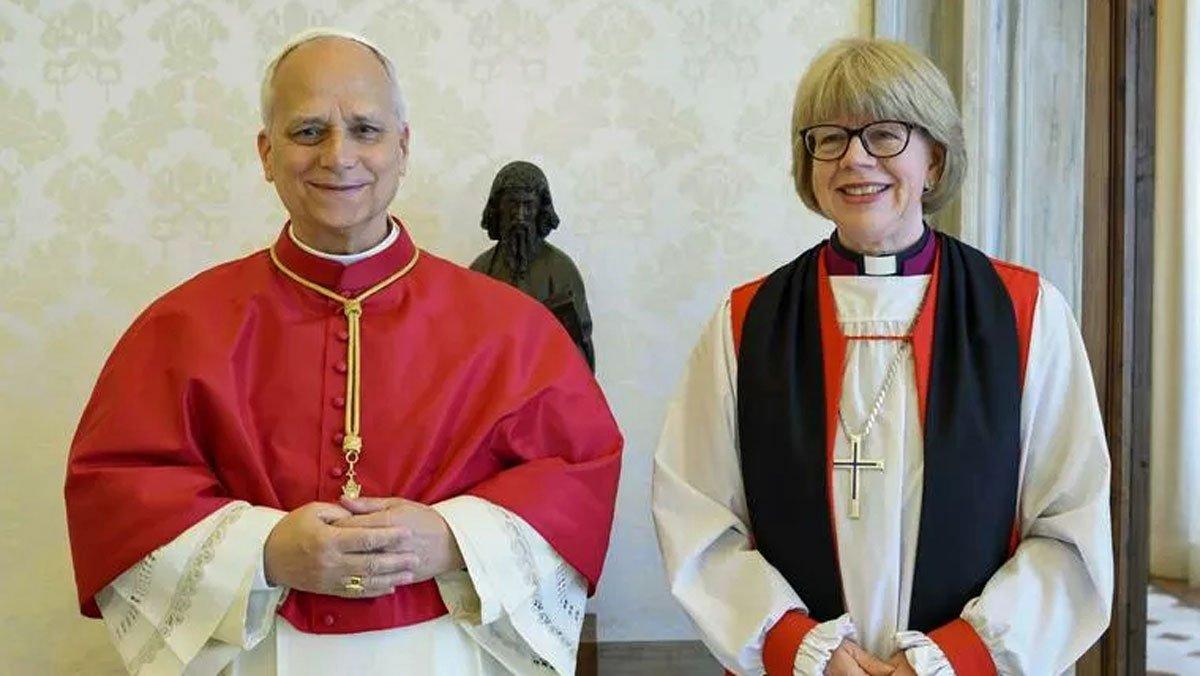
Last week, in his meeting with the Anglican Archbishop of Canterbury, Sarah Mullally, Pope Leo XIV said:
While much progress has been made on some historically divisive issues, new problems have arisen in recent decades, rendering the pathway to full communion more difficult to discern. I know that the Anglican Communion is also facing many of these same questions at this time. Nevertheless, we must not allow these continuing challenges to prevent us from using every possible opportunity to proclaim Christ to the world together.
Ever since the Church began engaging in ecumenical dialogue with “separated brethren” during the Second Vatican Council (1962-1965), we as a Church have refused to address the doctrinal disputes that actually divide us. Instead, greater emphasis is placed on matters that are beyond the competency of the Church, like global warming—now reworded climate change—or other ecological issues. Subsequently, it is as if “full communion” can be achieved in a distant future through a compromise among conflicting and even opposing views—the Catholic Church, which teaches that she possesses the fullness of divine revelation; the Anglicans (and other Protestants) who refute that.
For two millennia, the Catholic Church, which is the Mystical Body of Christ, has taught that she is the sole true religion founded by Jesus Christ after He fulfilled the Old Covenant; and only the Church possesses the fulness of the truth as revealed in Holy Writ. As noted by Pope Pius XII in his 1943 encyclical Mystici Corporis, this “was first taught by the Redeemer Himself” (1).
However, this long-standing teaching was modified during Vatican II with the Dogmatic Constitution Lumen Gentium, which equated Christ’s mystical body, which “subsists” within the Catholic Church, with the partial presence of “elements” in other Christian churches and ecclesial communities (8). This change laid the groundwork for the contemporary ecumenical movement, which, contrary to its name, is not genuinely ecumenical. Instead, it resembles what Pope Pius XI denounced in his Encyclical Mortalium Animos (1928): that of a federation of Christians where each individual maintains their own beliefs and personal judgment regarding matters of faith, even when these beliefs diverge from those of others.
Continue reading at Crisis Magazine