
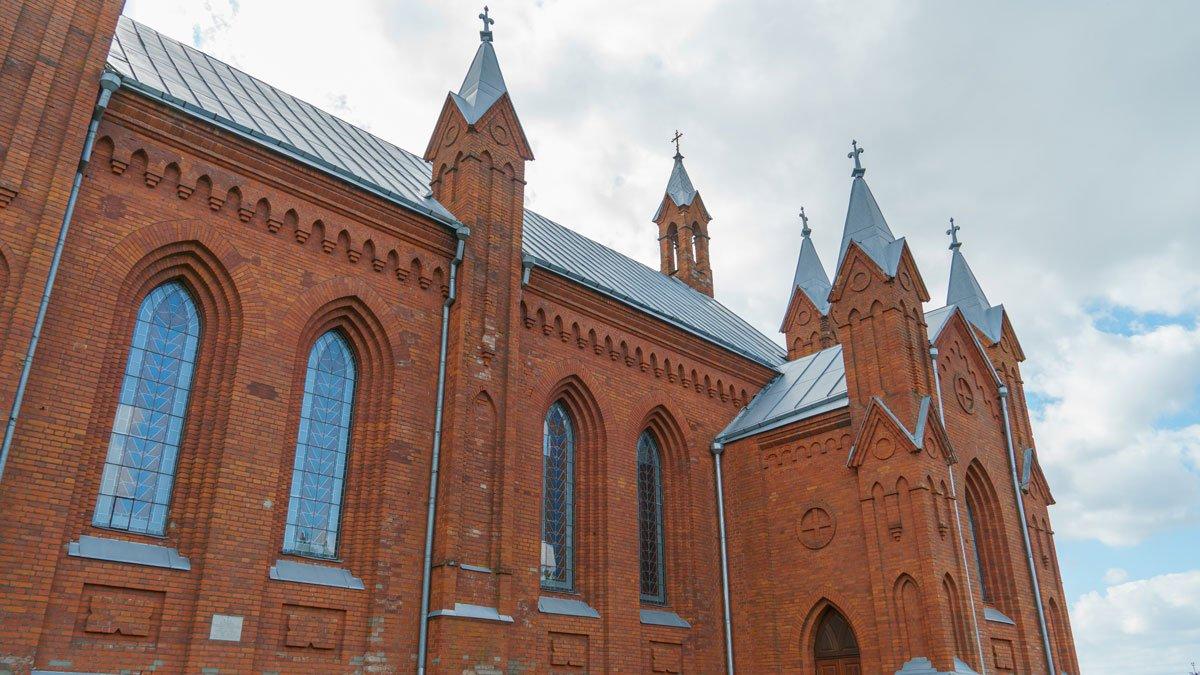
South of Minneapolis the Great Plains begin. One of our members once worked for a construction company there. The owner was a devout Catholic who had built a business repointing the mortar on old church buildings. The business thrived because the Plains are dotted with such churches: built, furnished, funded, founded, and shaped by Catholic Bohemian immigrants over one hundred and fifty years ago.
They are filled with memorials, intentional and otherwise, of the fact that these buildings were built and peopled by men and women who felt that this parish was the heart of their community, and that they had a meaningful kind of ownership in it.
Throughout the American Midwest, and every other part of America where Catholicism has roots and a history, churches are littered with physical evidence that reminds us of a time when parishioners were actively involved in shaping the parish. Not just the church ladies: the whole community shaped the parish into what it was.
There are plaques saying that this shrine to this saint with this statue was built by this patron in 1958. Photos of a Marian surplice bought for this priest by this patron in 1962. This organization (perhaps a choir or a sodality) founded by this layman in such and such a year. This replica of Brugel’s Mystic Lamb was paid for by one man sixty years ago, this organ bought for the parish by another a decade earlier. So on and so forth.
The plaques remain, the pictures remain, and the memory remains of a time when every parish was a home. The laity had put their livelihoods into beautifying their parishes. It was theirs.
To be at one of these parishes is to feel it palpably. It electrifies one, makes one feel pride in it even without knowing these names or recognizing these families. It makes one feel that this is soil worth building on, a place worth fighting for. If the parish has problems, you should stand your ground and fix them. You, like those who came before you, can fight the good fight, and change the parish into what it needs to be.
A few days ago, Patrick Neve published a Substack called “The Parish You Hate Might Need You,” calling on Catholics today to embrace this attitude. “Church hopping,” he says in the opening lines, “is killing our parishes.”
Contemporary Catholics tend to pick and choose among the parishes within driving distance, and for all but the most rural of Catholics, there are always at least four or five such options. And if the parish they currently attend becomes unacceptable, they leave and find a new one. Pat argues that this has had a acorrosive effect on the American Church. In his own words, “when faithful Catholics scatter across a diocese chasing the perfect parish, nobody builds anything.”
The article struck a chord among Catholics: Whether the reactions were positive or negative, they were strong. This is because they were reacting to more than a Substack article, or a “Comedian with a masters in Systematic Theology,” as Pat’s bio announces. Ultimately, the Substack had weight, and provoked such deep-rooted responses, because behind it lies a history, and a tradition (at least with a Lowercase T): a memory of times past which gives us a feeling that things ought to be that way still.
The reaction to Pat’s article, both for and against, was a reaction to a mode of Christian communal life which has mostly vanished but has left its relics to remind us of its beauty. It’s all around us, in the plaques below the stained-glass windows, on the doors to confessionals and the sides of pews, beneath the statues. There really was a time when standing your ground and investing your time and money in the parish in front of you (rather than seeking a more ideal one) could bear fruit.
It’s not a stupid conviction, this sense that we should put forth our hands to build up the parish in front of us, rather than roaming around in hopes of finding the parish we want already built for us. Any Catholic who can’t feel the pull of such a call has half a heart, or no eyes.
But it’s wrong.
A call for Catholics in 2026 to approach their parishes the way a Catholic could fifty, a hundred, a hundred fifty years ago is dangerously misguided, and the very beauty of the call only makes it a more enchanting siren song.
There was a time when the old way could work, and so long as it worked, it was a good and right thing to do.
We don’t live in that time anymore.
Continue reading at Christendom Quarterly