
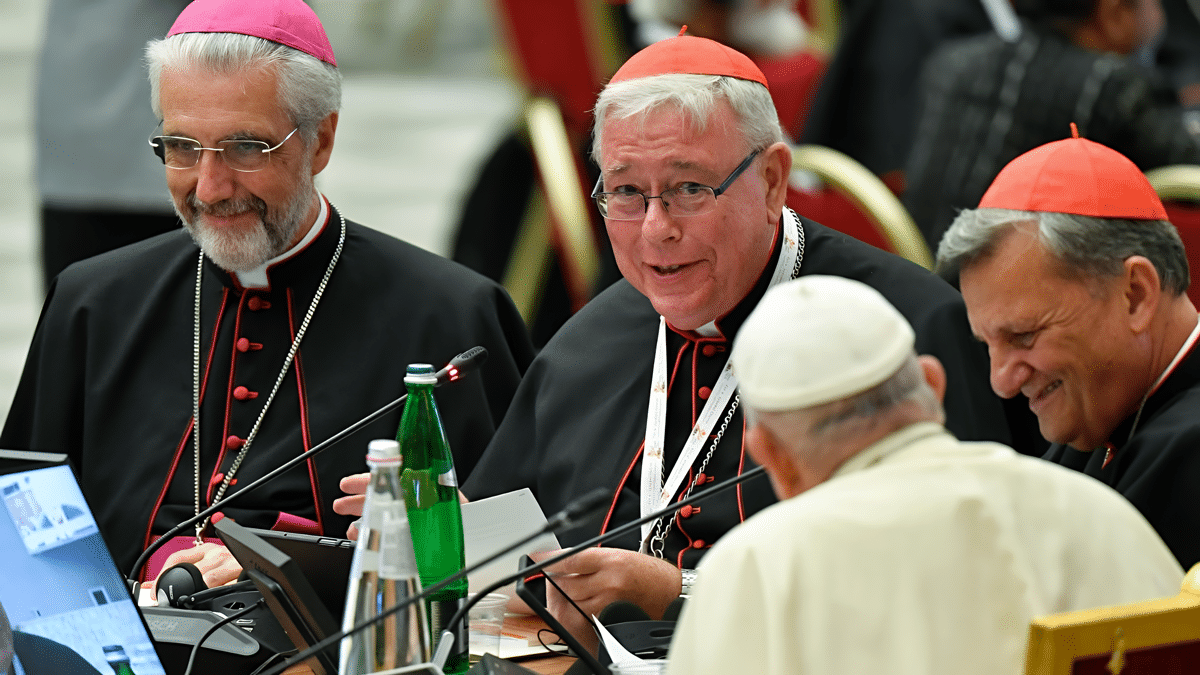
“No longer to undo”: With these words, Cardinal Jean-Claude Hollerich described the process of synodality initiated by Pope Francis in an address in October 2015: the completed fact of a church-political land grab. In an interview with the Courier of 20. September 2026 the Luxembourg Cardinal and former Jesuit declared that the process meant a long-term change of mentality in the Church. It is about getting from a church “from above” to a church in which Christians would take responsibility and be heard.
The sentence deserves more than a casual notice. Because “no longer to undo” is not a mere description of a historical fact. It contains a statement about the rank of a historical process within the Church. And this is where the real problem begins. Of course, no one can undo what happened. An eleven-year trial has been completed. Documents were published, meetings were held, terms were coined and certain forms of church action were established. In this purely historical sense, every process is irreversible. Nor is the Council of Trento undone, nor the Second Vatican Council, or the Pontificate of Paul VI. History cannot be erased. From this, however, something completely different from the assumption of a theological irreversibility. Between the sentence “It happened” and the sentence “It must not be corrected” lies an abyss. Even greater is the distance between “It has historically prevailed” and “It therefore belongs to the unavailable shape of the Church”. Whoever blurs these differences turns history into norm. Then the fact becomes a claim, from the process a commitment and from the duration a truth – quite in a Hegelian manner. It is precisely this shift that is in the word “irreversible.”
The crucial question, therefore, is not whether the synodal process could be reset exactly to its starting point. This is not possible for a historical process. The crucial question is: What theological authority does the result in this process have? Who or what makes a development in the Church irreversible? Christ? The apostolic tradition? A binding magisterial decision? The sacramental constitution of the Church? Or simply the fact that a certain generation has started a process, operated it long enough and is now proud of it in the name of the process? This distinction is of fundamental importance. The Catholic Church is not the result of its own history. She has history, but she didn’t come out of it. Their history is tradition. The Church is not an institution that is produced by progressive self-interpretation, but the reality established by Christ. Its origin lies neither in a historical decision of the faithful nor in a collective change of consciousness. Therefore, the Church cannot determine from her historical development what she has to be in her essence. If a church process is no longer allowed to be revised solely because of its duration or institutional establishment, the story would receive a normative violence that it does not theologically have. History would then no longer be the space in which the Church goes her way through time, but the producer of what is supposed to be Church. That would be a fundamental reversal.
It is precisely the Catholic doctrine of development that makes it clear that development and identity presuppose each other. Development does not mean that one subject becomes another through time. Rather, it presupposes that the same subject unfolds. This is the true meaning of the “Hermeneutics of Reform, the renewal in the continuity of the one subject Church” formulated by Benedict XVI in 2005, which he has opposed to the “hermeneutics of discontinuity and breakage.” The decisive factor is the formula of the “one subject church.” Only if the Church remains the same can one speak meaningfully of its development. Where, on the other hand, a historical novelty becomes the benchmark for how the Church has to understand its own nature from now on, the question arises: Does the Church still develop here – or is a new self-understanding set in the place of the previous one? This touches the core of ecclesiology.
Pius X already had in the encyclical Pascendi Dominici Gregis (8. September 1907 ) warned of an understanding of development in which religious consciousness and historical needs become the actual engine of religious truth. For him, the danger was not that the Church would develop historically, but that the unfolding in the end would decide for himself what was to be regarded as truth. Then it is no longer the story that is measured by the truth, but the truth is measured by history. What is the “no longer undoing” to start? On a revelation? A dogma? A final magisterial decision? The amendment of the sacramental constitution of the Church? Or just that a withdrawal has become politically, institutionally or psychologically difficult? That would be completely different things.
The Luxembourg Cardinal speaks of a transition to a church in which Christians take responsibility and are heard. Synodality should not only be a method, but must be adopted as a “form of the Church.” Thus, the decisive threshold is crossed: synodality no longer appears merely as a way the Church advises, listens or prepares decisions. It becomes a statement of what the Church is as such.
No one disputes that the church must listen. No one disputes the importance of synods, councils and consultations. The church has known synodal forms since its beginnings. Antiochs, Jerusalem, the Councils of the Old Church and the Synods of Bishops are not inventions of the present. The new lies not in Christians advising each other, but in trying to make “synodality” a comprehensive ecclesiological key concept – a cipher for how the Church should understand and organize himself. However, who explains that such a development is irreversible must explain why this should be so: is it unalterable because it is true – or is it considered true, because it should no longer be questioned?
The Catholic Church has no right to rebuild its Christ-received nature at will. The Magisterium is also not above revelation, but in its service. Neither a pope can reinvent the constitution of the Church by historical practicality by virtue of his office, nor can a worldwide consultation process create a new ecclesiological truth. The church is not a constituent assembly. She welcomes herself as the bride of Christ, as una, sancta, catholica et apostolica.
Their reason is not the result of human counseling. Her origin is Christ, her birthplace the Upper Room, her mother the God-born, her breath the Holy Spirit. That is why the real Catholic question is not: What can we change? It goes deeper: What can we even change without destroying the identity of what we call the Church?
Pope Leo XIII recalled in Annum sacrum (25. May 1899): “His dominion extends not only to the Catholic peoples, but also to those who belong by baptism by law because of the Church, may also keep away from erroneous views or disagree it from the communion of love, but it also includes those who do not possess the Christian faith; thus, in the fullest sense, the whole humanity is subject to the rule of Jesus Christ” (circular letter Annum sacrum, 25. May 1899). These words should be perceived, heard and known all the more vividly by those who count themselves as belonging to this “communion of love” instead of falling into a self-reflection instead of inland-centered. Pius XII has in his encyclical Mystici Corporis (29. June 1943) the Church described as the mystical body of Christ. Their visible and spiritual reality, their hierarchical order and their sacramental constitution are incessantly aggregated. The faithful are taken into an already existing body; the Church does not arise from the fact that its members establish a consensus on which Church they want to be in the future.
This does not mean that everything in the Church would be unchangeable. Forms can change, disciplines can be reformed, pastoral methods adapted. But changeability does not mean self-availability. A plant can grow without becoming a different species. A person matures without losing his identity. The Church can unfold without reinventing her constitutive identity. This is the point of genuine reform. In the Church, there must be not only progress, but always the willingness to correct. There may be erroneous developments, exaggerations and blurs. That something happened does not immunize it against testing. That something exists for a little ten years doesn’t make it true. And that a cardinal declares that it is “no longer to be reversed” does not give him a theological irreversibility. Here, a Catholic theology of tradition must raise its objection. Tradition does not mean that nothing new must ever happen. It means, however, that the new must answer to the received. The real contrast is not “tradition against development”, but: development from tradition or development from the breach. The first preserves the identity of the subject. The second makes the historical process itself a creative principle.
This is precisely why the assertion of a normative irreversibility is so theologically explosive: If history itself becomes the main argument, who still judges history? Who decides whether a development was an unfolding or a deformation? This test cannot be completed by explaining a process to be incontrovertible. That’s not how Catholic tradition works. The church is not a prisoner of its recent past. She has the freedom of truth. It can distinguish, test, correct and, if necessary, reject what proves to be incompatible with its essence.
The decisive touchstone is therefore: Irreversible – because of what truth? Not because of the chronology. Not because of institutional power. Not because of a change of mentality, but only where such irreversibility follows from the truth of what the Church is from Christ. Anything else would be a deification of history. A church that derived its identity from the irreversibility of its recent development would no longer live from the received origin, but from the power of what has already happened. Then Christ would no longer be the measure of the Church, but time. And it is precisely at this point that the objection must begin: not everything that you no longer want to undo, it becomes true. Some things simply remain an irreversible error.
Translated and republished from Kath.net