
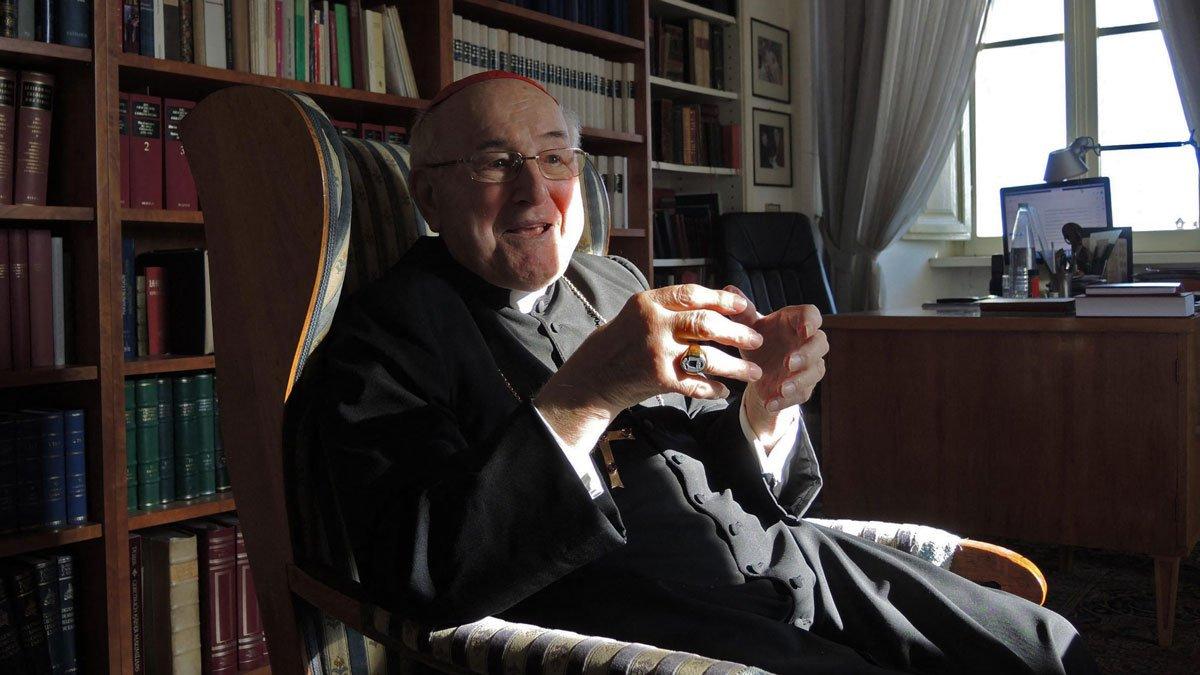
A prominent cardinal expert on Church history has warned that the current style of synod being promoted in the Church is partly inspired by Protestantism and is part of the “growing secularization of the understanding of the Church.”
Cardinal Walter Brandmüller has issued a new critique of the Synod on Synodality and the current structure of ecclesial governance. In an analysis published by veteran Vaticanist Sandro Magister, the 97-year-old German prelate outlined an authentic notion of a synod and warned about how easily the meeting can be corrupted.
He noted, as many analysts have done, that “a clear and unambiguous definition of this word [synodality] is still lacking.” Consequently, Brandmüller outlined that the Church’s traditional understanding of a synod is as “a meeting of bishops for the purpose of jointly exercising their magisterial and pastoral service.”
Created cardinal by Pope Benedict XVI in 2010, Brandmüller is a respected Church historian, having served an 11-year term as president of the Vatican’s Pontifical Committee for Historical Sciences.
Referencing the organisational style of the Synod on Synodality, which comprised both lay and clerical voters, Brandmüller stated that this could not be described as a synod. The reason being that “neither priests nor lay people can exercise the magisterial and pastoral ministry conferred only on bishops with the sacrament of orders.”
As a result, he warned that the proliferation of this kind of meeting in the Church – which has spread especially thanks to the multi-year Synod on Synodality – risks desacralising the Church. Such meetings stem “from the effort to more or less a-critically adopt secular structures and democratic procedures in ecclesial life, in order to stay in step with the times,” said the cardinal.
Brandmüller added that with the rise of this kind of meeting and organisation, the Church was straying from its own, well-established method of holding a synod and drawing from the Protestant style.
Continue reading at the Catholic Herald