
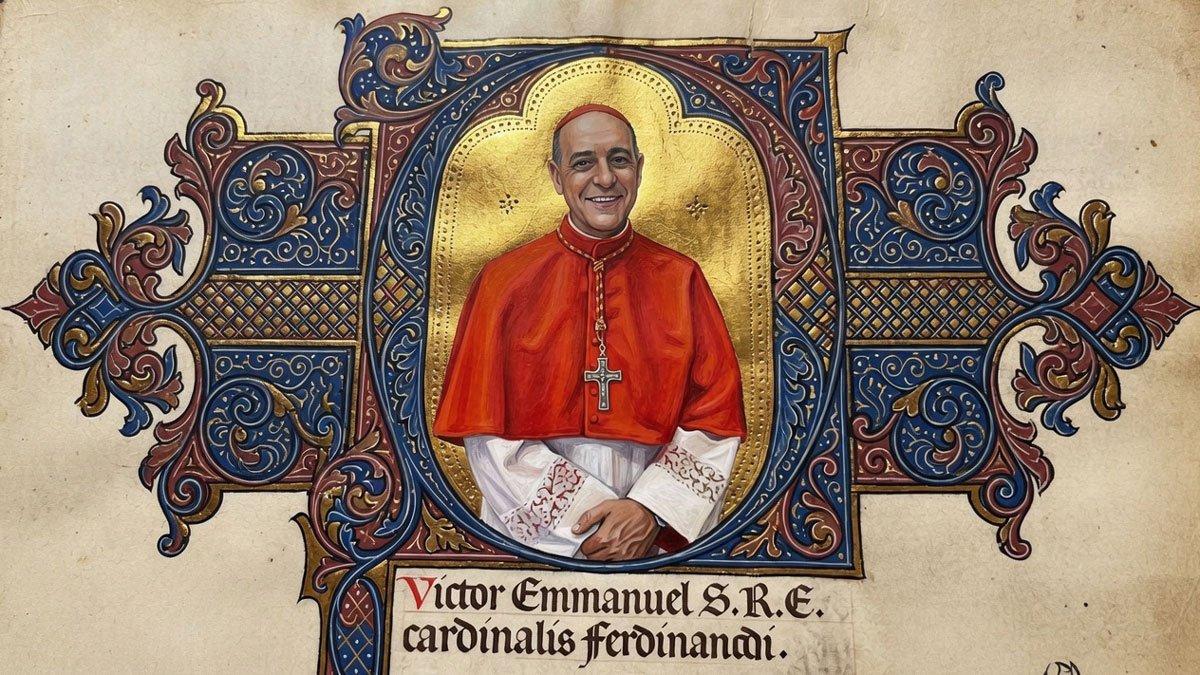
We already referred on this blog to the words of Pope Leo XIII in his first encyclical when he told us: “I also thank you for what you reveal about what is not working in the Church…”. And for this very reason, I would like to warn the Holy Father that one of the things that is not working in the Church is the Cardinal Prefect of the Dicastery for the Doctrine of the Faith. We are not telling him anything new. He undoubtedly already knows that Víctor Manuel Fernández had—we assume in the past—a strong inclination to write pornographic books, which he then concealed in his curriculum vitae, as we denounced on this blog. And that in his very high position as Prefect, he has sought to sow scandal, doubt, and confusion, and has also, whether he likes it or not , managed to undermine the advanced ecumenical relations that the Roman Catholic Church maintained with the Coptic Church. I don’t know how the pontiff will manage to keep the promise he made to Tawadros II, pope of the Coptic church, on May 15, that the Catholic church will not bless homosexual couples, if he has the “little house” where Cardinal Fernandez lives just a stone’s throw from the Apostolic Palace.
But Pope Leo already knows all this. What he probably doesn’t know are the grand theological aspirations of his prefect, and that’s what I want to dedicate this post to. Fernández published an article entitled “Romans 9-11. Grace and Predestination” in the journal Teología [65 (1995), 5-]. You can read it here . As the title indicates, the research deals with predestination, which Fernández considers one of the “heaviest crosses for theology” because, clearly, he doesn’t accept that divine predestination exists but rather affirms that all people will be saved. In other words, hell is empty . A kind of late and devalued Origenism.
At first glance, the second paragraph of the article caught my attention, where it says:
“After analyzing the theme of “hardening” in the Old Testament, we will consider particularly the text of Romans 9-11, extremely important in the elaboration of the patristic and scholastic doctrine on predestination. In fact, I believe that a proper exegesis of this text allows us to relativize the very basis from which questionable doctrines were developed.” (p. 5).
And it caught my attention because the theologian from Alcira Gigena begins by stating that the doctrines on predestination developed by the Church Fathers and the great medieval masters are “questionable.” “What confidence he has in his own knowledge!” I thought to myself. But that was nothing. At the end of his lengthy work, Father Tucho, as he was then known, writes:
“I firmly believe that everyone will be saved; a belief that is not based on wishful thinking, nor on my compassion for men, but on what I know about God and his concrete plans thanks to his Revelation.”
I understood then that, beyond what the Fathers and Doctors could say, the theological wisdom of the Prefect of the Congregation for the Doctrine of the Faith is based on what he knows of God, whose specific plans he also knows. And we thought that revelation had ended with the death of the last apostle!
Continue reading at El Wanderer