
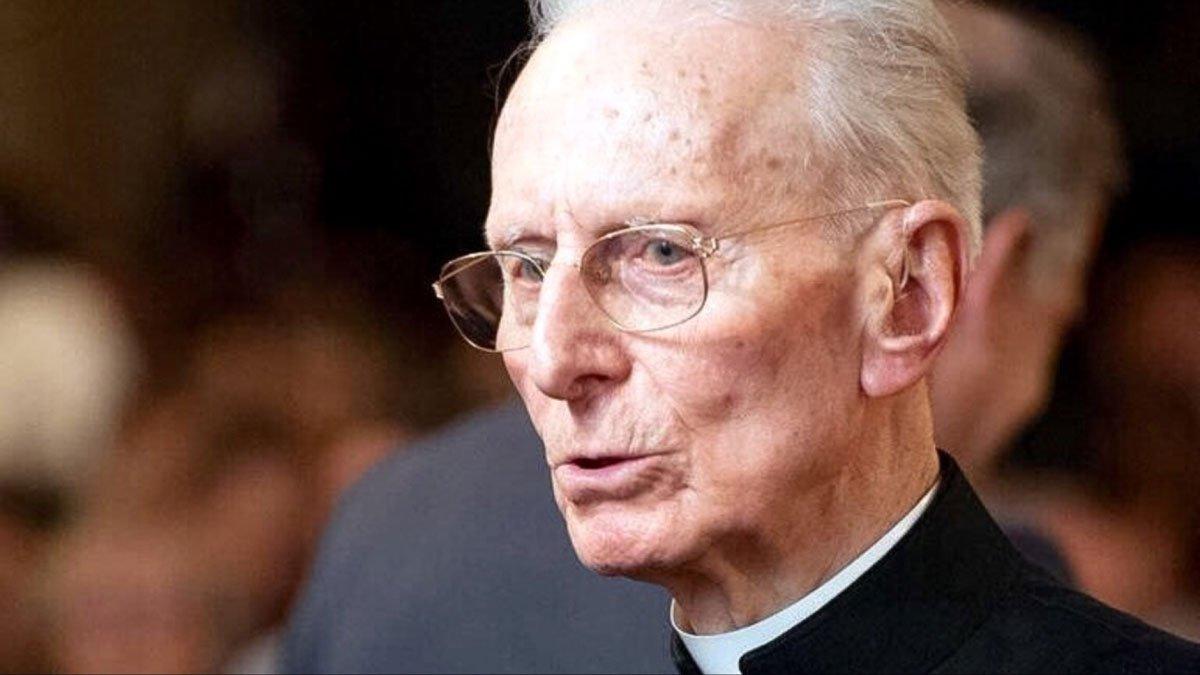
Following the debate reopened by the recent consecrations of the Priestly Fraternity of Saint Pius X and by the question of the adherence due to the Second Vatican Council, it seems opportune to recover this text by Monsignor Brunero Gherardini, originally published in 2011 by Disputationes Theologicae.
The great celebration of the fiftieth anniversary has begun. The beating of drums is not yet heard, but it can already be perceived in the atmosphere. The fiftieth anniversary of Vatican II will unleash all that is most superlative that can be imagined in terms of praise. Of the sobriety that had been requested, as an attitude and as an occasion for reflection and analysis for a more critical and profound evaluation of the conciliar event, not a trace remains. Already, without restraint, the same things that have been said and repeated for fifty years are being reiterated: Vatican II is the culminating point of Tradition and its very synthesis. International congresses on the greatest and most significant of all ecumenical Councils have already been scheduled; others, of greater or lesser scope, will be organized along the way. And the essayistic production on the subject grows richer day by day. L’Osservatore Romano, obviously, does its part and insists above all on the adherence due to the Magisterium (2/12/2011, p. 6): Vatican II is an act of the Magisterium, therefore… The reason given is that every act of the Magisterium must be received by Pastors who, by virtue of apostolic succession, speak with the charism of truth (DV 8), with the authority of Christ (LG 25), in the light of the Holy Spirit (ibid.).
Apart from the fact of demonstrating the Magisterium of Vatican II through Vatican II itself—what was formerly called petitio principii—it seems evident that such a procedure starts from the premise of the Magisterium as an absolute, an independent subject of everything and everyone, except for apostolic succession and the assistance of the Holy Spirit. Now, if apostolic succession guarantees the legitimacy of sacred ordination, it is difficult to establish who guarantees the intervention of the Holy Spirit in the terms in which it is spoken of.
There is, however, something beyond all discussion: nothing in the world, the receptacle of created things, possesses the attribute of the absolute. Everything is in motion, in a circuit of reciprocal interdependencies, and therefore everything depends, everything has a beginning and will have an end: “Mutantur enim —said the great Augustine— ergo creata sunt.” The Church constitutes no exception, nor does her Tradition or her Magisterium. These are sublime realities, situated at the summit of the scale of all created values, endowed with qualities that cause vertigo, but they remain penultimate realities. The eschaton, the ultimate reality, is only He, God. Language is frequently used that inverts this fact and attributes to these sublime realities a scope and meaning beyond and above their own limits; that is, they are absolutized. The consequence is that they are stripped of their ontological status, turning them into an unreal presupposition which, precisely for that reason, loses even the sublime greatnesses of their condition as penultimate reality.
Immersed in the trinitarian moment of her design, the Church is and acts in time as the sacrament of salvation. The theandrism that makes her a mysterious continuation of Christ is not in question, nor are her constitutive properties (unity, holiness, catholicity, and apostolicity), nor her structure or her service; but all this remains within a reality of this world, capable of sacramentally mediating the divine presence, though always as and insofar as a reality of this world, which by definition shuns the absolute.
Continue reading at Infovaticana