
My family and I spend a few months out of the year in Nova Scotia, in a part of the province that was once overwhelmingly Catholic. The congregations are aging, partly because a lot of young people leave the island for work far away, and partly, I think, because all the motions and accouterments at Mass say, “There is nothing for the mind to search out here.”
At Mass at one church, everybody stands after the Sanctus, but for just the first sentence of the ever-used second Eucharistic prayer. We are supposed to kneel once the priest calls down the Holy Spirit upon the gifts. What this means, in practice, is that the clomp-clomp of kneelers and the shifting of bodies breaks up the prayer and interrupts the priest.
Ideas about liturgical gestures, such as this one from the Canadian bishops, may sound good in the abstract, but gestures are not abstract. They derive most of their power from the realities of human bodies. Only someone insensible to human bodies in motion can have failed to predict what would happen, and only someone obtuse in the art of human gesture could fail to see that the physical interruption would confuse the prayer, separating one sentence from the next, when no such separation in meaning or action is called for.
Such obtuseness characterizes their approach to liturgical gesture generally. At the end of the consecration, everyone is supposed to stand, and again you have the rumbling and tumbling, just when the priest is saying, “The mystery of faith.” Again the disruption, the discontinuity, and again the likelihood that in the awkwardness you will not be paying close attention to your reply to the priest. If the Eucharist is a great mystery, we want then of all times to direct our attention wholly toward it. Nothing else should obtrude.
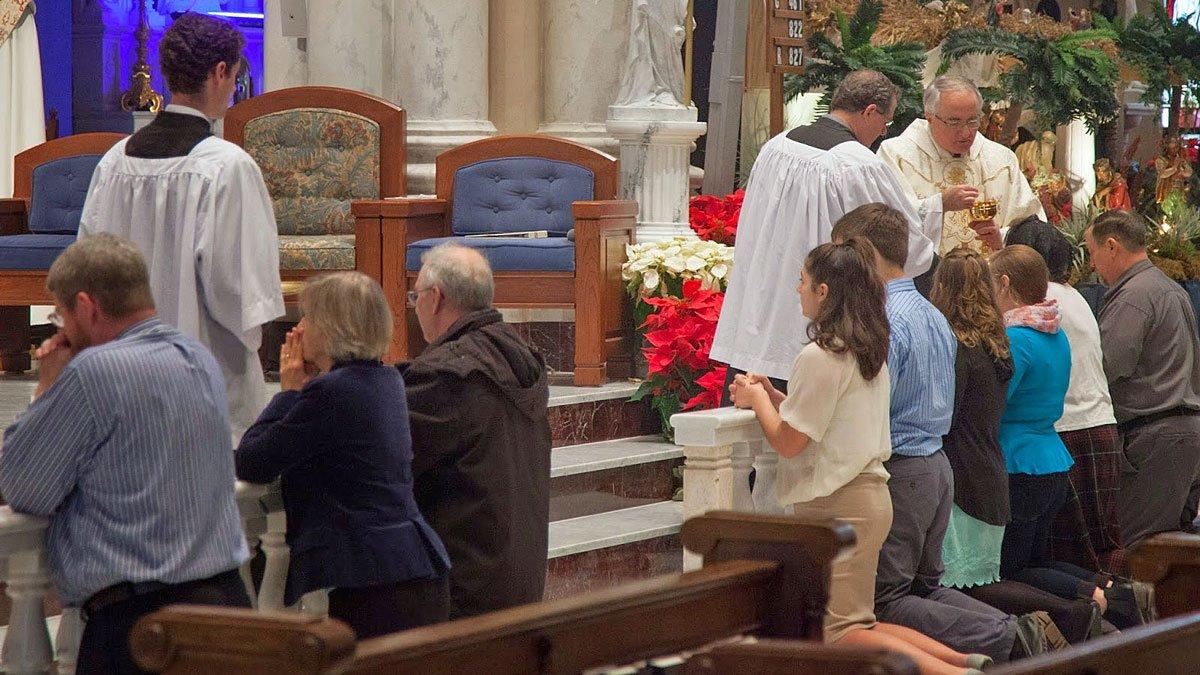
Communion is received standing up, as almost everywhere else in the world since the Great Liquidation. I suspect the posture is imposed not for what it is, but for what it is not: kneeling. Again, you cannot impose a meaning on a bodily gesture which it does not in itself possess, or which it does not lend itself to.
You wait in line, vaguely aware of the person behind you, and you cannot pause after you receive, as you cannot pause after you get your burgers at the fast-food counter, or after you load your luggage on the conveyor belt at the airport, or after any of the many things we stand in line for, usually with faint impatience or irritation. You get out of the way, and you return to your seat. Banal already, but the diocese of Antigonish, Nova Scotia, you remain standing until everyone else has received, thus prolonging the impatience.
Continue reading at the Catholic Thing