
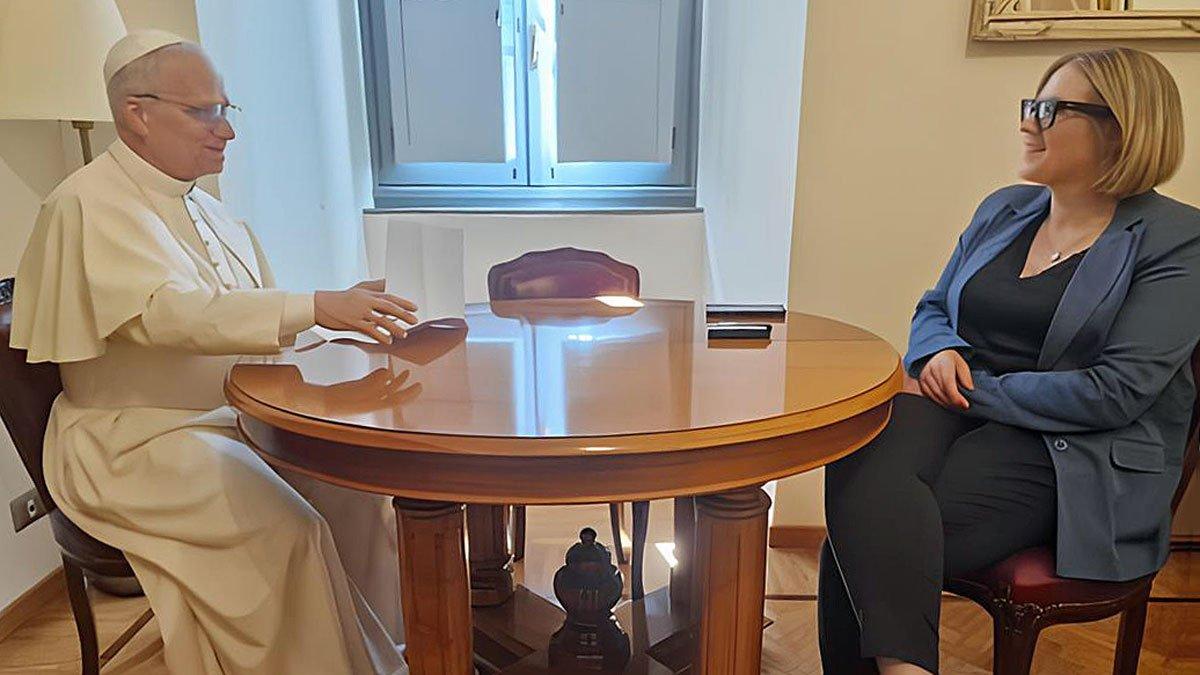
Did Pope Leo XIV hint at the erroneous notion that established Church doctrine can change?
Pope Leo XIV raised eyebrows when he prompted last week during an interview with CRUX the possibility that Church doctrine can be changed.
When asked to touch upon the LGBTQ+ situation within the Church, he said: “I find it highly unlikely, certainly in the near future, that the church’s doctrine…[will change].” And with regard to the question of women being admitted to the diaconate: “I at the moment don’t have an intention of changing the teaching of the church on the topic.” Such words certainly communicate a relativist approach by which any pope can alter, if not undo, the teachings of our Holy Mother Church at will.
It must first and foremost be made clear that no pope or bishop can ever change or modify Church doctrine because it is intrinsically connected with the truths revealed in Sacred Scripture, taught by Tradition, and defined by the Teaching Office of the Church—the magisterium.
For, as taught by the First Vatican Council(1870):
If anyone says that it is possible that at some time, given the advancement of knowledge, a sense may be assigned to the dogmas propounded by the Church which is different from that which the Church has understood and understands: let him be anathema.
The dilemma today is that, especially after the 12-year pontificate of Pope Francis when confusion was the norm, many Catholics and non-Catholics alike are under the impression that any type of papal pronouncement is an absolute norm that must be adhered to, even if it contradicts on the surface level Church teaching. And thus, when ambiguous statements are made by a pope regarding divinely revealed truths—or worse, when others like Cardinal Jean-Claude Hollerich, General Rapporteur of the Synod of Bishops on Synodality, who recently hinted that the Gospel teachings must be adapted to today’s socio-cultural expectations—the tenets of the Church become both subjective and relative.
Continue reading at Crisis Magazine