
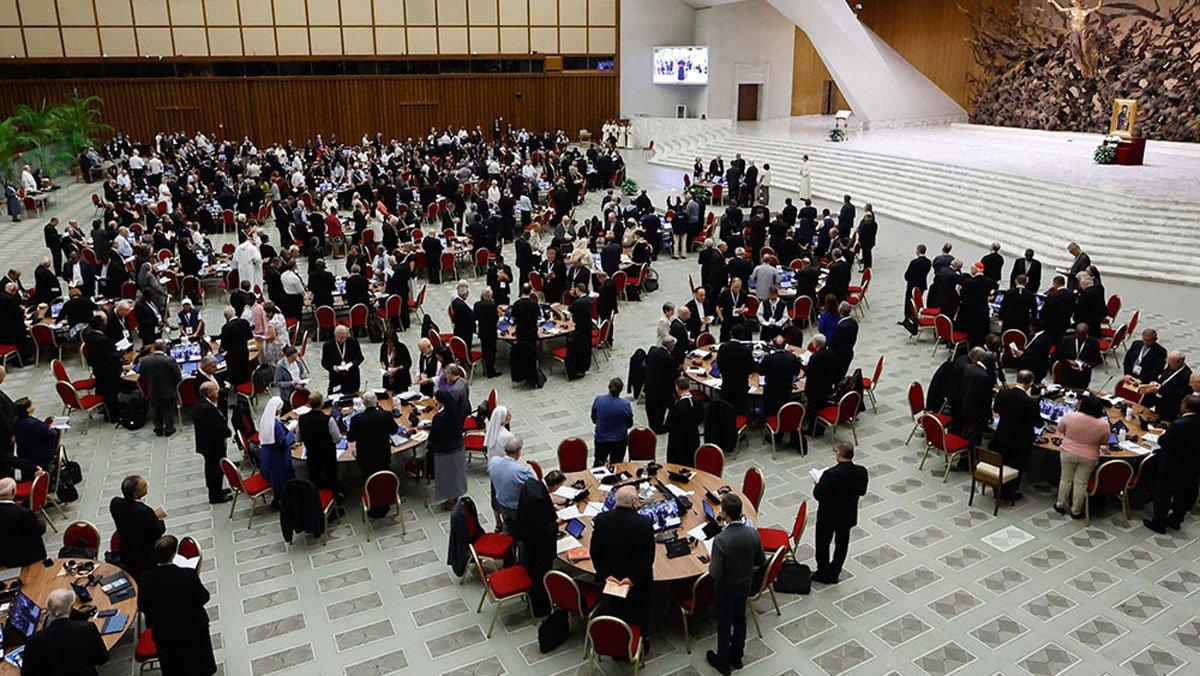
The working or study groups established by Pope Francis during the Synod on Synodality are responsible for very specific themes, to be addressed according to the “synodal method.” The first article commented on the partial report of the 10 groups, but the reports of the two commissions attached to them remain to be considered.
These structures, which were due to submit their reports by June 2025, have been granted an extension until the end of the year. However, each group has provided a preliminary report, published by the Synod Secretariat. The reports of the 10 groups have already been considered, but those of the two commissions still need to be examined: one on the canonical commission and another on polygamy.
Canonical Commission
This is without a doubt the most dangerous report of all. Here is what it envisages or proposes.
It wishes to make Pastoral Councils (diocesan and parish) mandatory. The Diocesan Pastoral Council is a consultative body composed of lay and clergy members; its role is “to assist the bishop in discerning the pastoral needs of his diocese and in implementing appropriate pastoral actions.” The Parish Pastoral Council plays a similar role at the parish level.
A subsequent proposal emphasizes “the duty of the pastor to ask the Council for indications, addresses, observations, checks, suggestions, etc. … but there is also the corresponding right-duty of each member of the body to offer his or her opinion on what is brought to attention and discernment.” In other words, mandatory democracy.
The next proposal adds that “to underline the importance of consultation in the main decision-making processes, it is considered appropriate that the word tantum (only) be eliminated from all the norms that contain this term.” This was one of the Synod’s proposals.
This means that these councils are not “merely” consultative. This site already commented on this request from the Synod’s final document: “The formula of the Code of Canon Law, which speaks of a ‘merely consultative’ vote, must be reexamined. A revision of the canonical norms … seems appropriate” to clarify the distinction and the articulation between consultative and deliberative.
In other words, there will no longer be anything “consultative,” everything will be more or less “deliberative.” And this must happen quickly: “Without concrete changes in the short term, the vision of a synodal Church will not be credible and this will alienate members of the People of God who have drawn strength and hope from the synodal journey,” warns No. 94. We will be there soon.
The next proposal calls for “a norm that guarantees that the majority of the members of the Pastoral Councils are lay people with an adequate presence of women, young people and people living in conditions of poverty or experiencing other forms of marginalization.”
And the next one calls for consideration “in the manner to be determined (e.g., as guests or invited) –that even those who live complex personal and/or marital situations can participate in these bodies,” even though this is prohibited by current canon law.
The next two proposals call for “identifying particular matters on which the request to express an opinion of such a Council is made mandatory, establishing a duty to consult the body”; so “an adequate minimum number of annual meetings must be established in order to ensure effective functioning and its pastoral fruitfulness.”
Finally, the last one calls for “the need to further enhance that ‘culture of transparency and accountability,'” which implies “‘accountability’ to one or the other Council by the competent ecclesiastical authority (bishop/eparch, parish priest) of the pastoral decisions to be taken and assumed, which means that the Council can ask for the ‘accountability’ of certain choices, and the authority to give reasons for them.”
The real question is: what young man today would want to commit himself to becoming a “co-responsible manager” of a parish with the faithful instead of being its zealous pastor? And what priest would agree to become a bishop only to be required to account to councils for his decisions, for which he is primarily responsible before God and the pope.
Imagine for a moment the holy Curé of Ars obliged to answer for his decisions before a parish council.
Continue reading at FSSPX News