
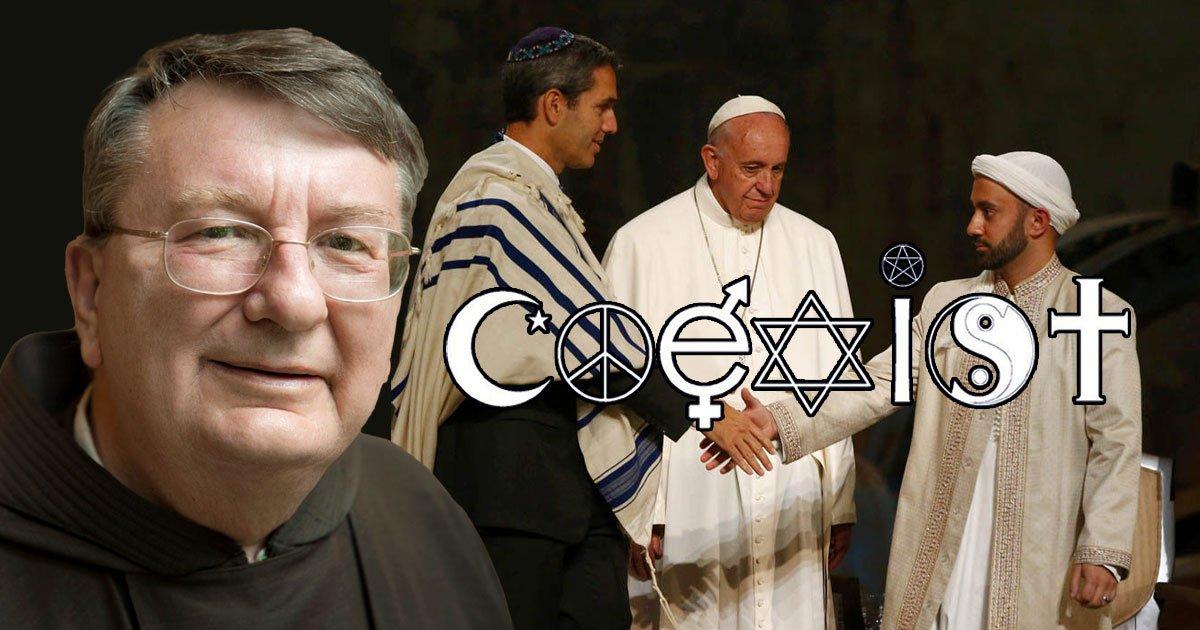
Pope Francis has made three seriously misleading statements recently. On September 13th, prior to leaving Singapore, he spoke to an interreligious group of young people at a Catholic junior college. He stated: “All religions are a path to arrive at God.” He elaborated: “I will use an analogy, they are like different languages that express the divine.”
He encouraged the young people of various religions to dialogue with one another. He noted: “There’s only one God, and each of us has a language to arrive at God. Some are Sikh, Muslim, Hindu, Christian, and they are different paths [to God].” Later, on September 17th, in a video message to an interreligious youth conference in Tirana, Albania, Pope Francis praised religious diversity as “a gift from God.”
More recently, on September 24th, the Vatican released a statement that Pope Francis sent to an interreligious gathering for peace in Paris sponsored by the Sant’Egidio Community. Here he wrote of the importance of divine inspiration. “We need to keep meeting, to weave bonds of fraternity, and to allow ourselves to be guided by the divine inspiration present in every faith.” The Italian renders it as the “divine inspiration [that] inhabits every faith.” Pope Francis wants to be pastoral and ecumenical. Nonetheless, as he is frequently wont to do, his statements are ambiguous, and can easily lead to confusion.
While Vatican II did note, in its Declaration on the Relationship of the Church to Non-Christian Religions (Nostra aetate), that “The Catholic Church rejects nothing of what is true and good in these religions,” the Council did not say that all religions were of equal salvific value. Moreover, except for Christianity and Judaism, other religions are, therefore, not inspired by the Holy Spirit. And thus, they contain error; error that locks those who hold such beliefs in darkness, a darkness from which it is difficult to escape.