
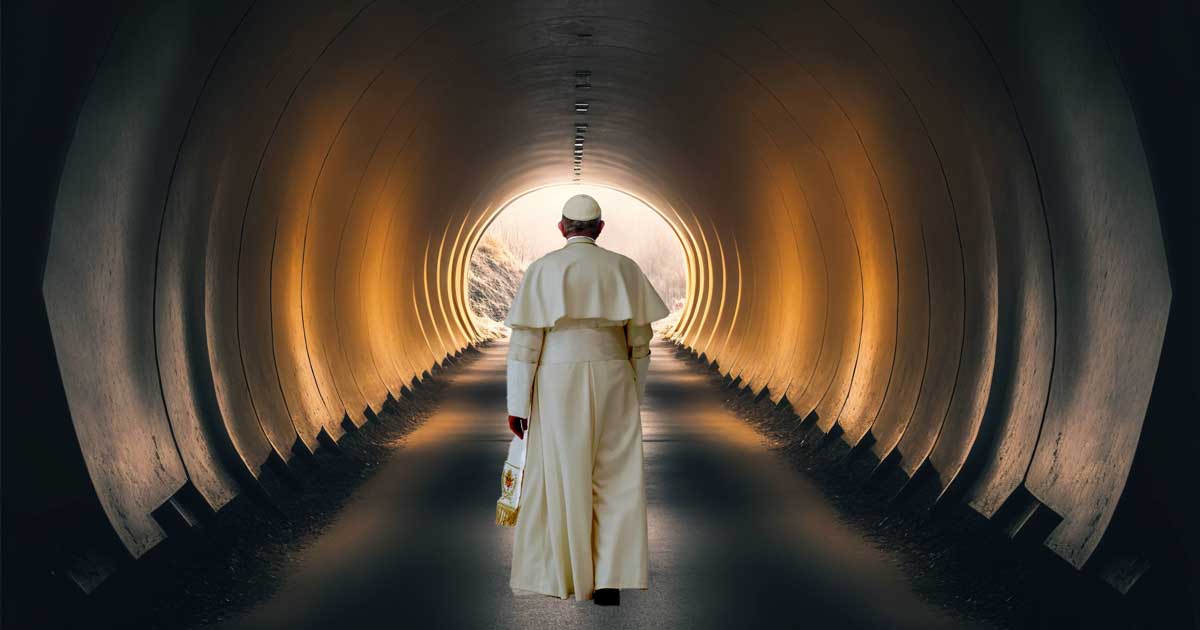
Pope Francis was completely in his element during his trip to Southeast Asia. This is because he was once again able to engage eagerly in “interreligious dialogue”. If you read the Pope’s now published speeches, this dialogue enjoys an almost sacred status of grandeur, which is fed by impressive moral claims. This is because the essence of the intended dialogue is aimed at unity, fraternity, harmony and concord. Central to the Bergoglian concept of dialogue is the “detection of what connects us”, i.e., everything that brings us together by allowing us to discover what is, in truth, always already identical—as symbolized by the underground “tunnel of friendship” between the Istiqlal Mosque and the Cathedral of the Assumption in Jakarta.
However, the Bergoglian concept of dialogue is not yet sufficiently defined by the experience of commonality in common. Not only in explicitly interreligious contexts, but in all contexts in general, Francis understands the dia-logos more broadly as a circle-of-chairs-like encounter, in the sense of the non-judgmental juxtaposition of perspectives and feelings, of what is personally important to everyone. What this is may differ fundamentally among them, but the difference is irrelevant. For it is primarily a matter of “living together, of mingling and encounter, of embracing and supporting one another, of stepping into this flood tide which, while chaotic, can become a genuine experience of fraternity” (Evangelii Gaudium, 87).
However, there is a danger here of clouding the elation. Once the moral elevation of the mind generated by the papal doctrine of harmony has subsided a little and thought is allowed to stir again, the question might arise in one person or another, for example by recalling their own Greek lessons, as to whether “dialogue” does not classically have the connotation of speech and counter-speech? However, it is precisely this connotation that is erased in the Bergoglian concept of dialogue; the central moment of the Socratic dialogue is missing, which is determined by the intellectual dispute of thesis and antithesis, i.e., by rational argumentation, because only in this way can the knowledge of truth be conveyed. Truth in itself, however, is by no means the synthesis of the logically irreconcilable, nor does it necessarily lie in the middle. If it were, there would be no need to struggle for it. It lies where it lies, and it must be discovered.
Francis explicitly excludes the basic truth-theoretical definition of dialogue: “The tunnel was built in order to create a link between two different and distant places. This is what the tunnel does: it connects, creating a bond. Sometimes we think that a meeting between religions is a matter of seeking common ground between different religious doctrines and beliefs no matter the cost. Such an approach, however, may end up dividing us, because the doctrines and dogmas of each religious experience are different. What really brings us closer is creating a connection in the midst of diversity, cultivating bonds of friendship, care and reciprocity.”
Continue reading at Rorate Caeli