
September 9, 2022
Ratzinger, Tychonius and Fatima: An Interpretive Key to the End Times
By a Marian soul
It is not easy to understand the current crisis of evil within the Church, which can sometimes seem insurmountable. Benedict XVI said Tychonius’ theology can help the Church understand how to unmask and ultimately defeat the evil of the “false brothers” hiding within it. Tychonius’ ideas intersect with the message of Fatima in various ways. If we consider Benedict XVI’s comments on Fatima in light of Tychonian end-times theology, we are offered a unique perspective on the nature of the Church and the anti-Church in their final confrontation.
“The bishops do, under the appearance of a gift from the Church, what favors the will of the devil”.
– Tychonius, Commentary on the Apocalypse , 4th century.
“The Antichrist belongs to the Church, grows in it and with it until the great discessio, which initiates the final revelatio”.
– Joseph Ratzinger, Observations on the Conception of the Church of Tychonius , 1956.
“It is not possible for the Church to survive if it passively postpones the resolution of the conflict that is tearing the ‘bipartite body’ apart at the end of time.”
– Giorgio Agamben, The mystery of evil: Benedict XVI and the End of Times , 2013.
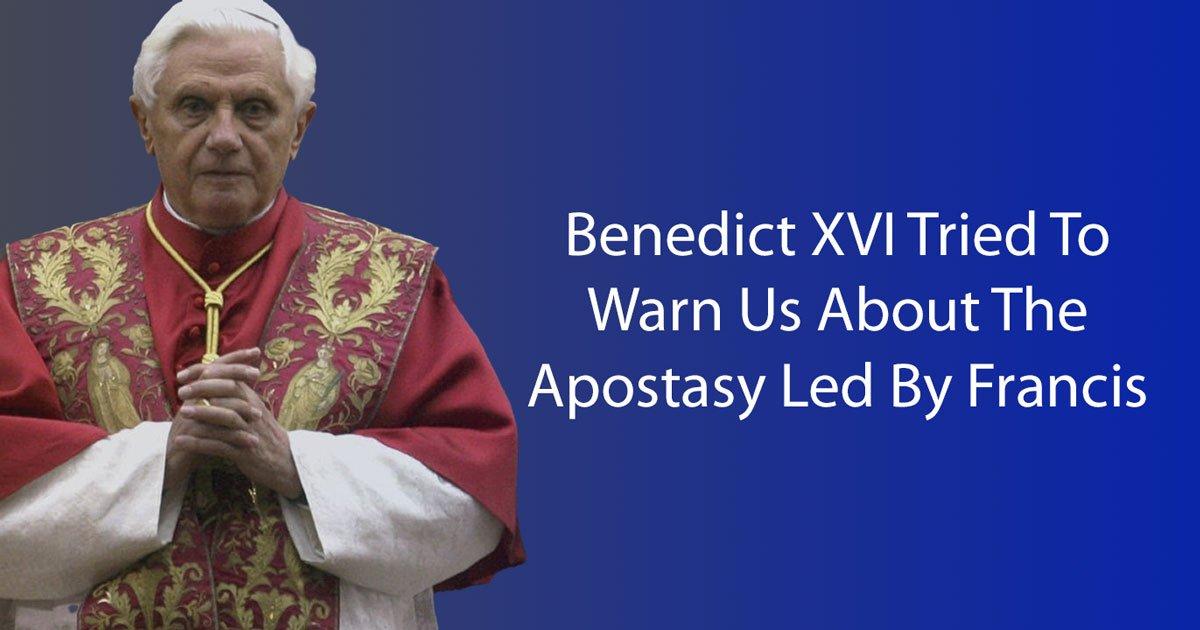
During the general audience on Wednesday, April 22, 2009, Pope Benedict XVI made a remarkable reference to an obscure Christian writer from North Africa, Tychonius. In his commentary, he [Tychonius] sees above all in the Apocalypse a reflection of the mystery of the Church. Tychonius had come to the conviction that the Church was a two-part body: on the one hand, he said, it belongs to Christ, but there is another part of the Church which belongs to the devil”[i].
For Benedict, Tychonius’s view of what will happen to the Church at the end of time constitutes an important “missing link” in understanding the unprecedented moment in the economy of salvation that the Holy Father believes the Church and the world have now reached, as well as to understand his exceptionally enigmatic “resignation”.
As early as 1956, Joseph Ratzinger had been intrigued by the fourth-century African theologian when, as a young priest and aspiring teacher, he wrote and published an essay entitled “Observations on Tychonius’ Concept of the Church in the ‘ Liber Regularum’ ”[ ii]. [The essay explores what Ratzinger calls the “paradox” of Tychonius: “the fact that a man consciously and voluntarily places himself outside of any concrete ecclesial communion while wanting to remain a Christian and believing he belongs to the true Church”[ iii].
For Tychonius, the city of the devil exists both outside and within the Church, not only among pagans but also among Christian impostors. Tychonius thus refers to a mysterious presence of evil in the history of salvation, which we find throughout Sacred Scripture and which culminates in the bipartite structure of the Church: it is made up of two distinct bodies which coexist in the same visible institution although they are diametrically opposed to each other.
The permanent confrontation of the Church with the devil is the central theme of Tychonius’ commentary, which is however more particularly interested in the war waged within the Church. The term “anti-church” is an apt designation for the body of the devil, because his body masquerades as the Church.
Tychonius identifies this enemy body that disguises itself with the external ornaments of the Church using two biblical terms that he considers interchangeable: the “mystery of iniquity”[iv] and the “abomination of desolation”.[v ] According to Tychonius, this iniquitous, abominable, and adverse entity will only be fully revealed at the time of what Tychonius calls the great discessio (2 Thess. 2:3). Many English translations render this word as “apostasy” or “revolt.” The Latin term clearly has the meaning of “fall” or “separation”. Only at the time of the “fall” will the two-part condition of the world – two cities, one of God and the other of the devil – be fully exposed and shown in what will in effect be a “tri-partite” division. ” – the true Church, the false Church and the pagan world.
For Tychonius, it is only when the “ great discessio ” occurs that the distinction between the true Church and the false Church finally becomes manifest.
Faithful Christians generally assume that the “fall” – the “separation,” the “departure” – will be brought about by masses of people “leaving” the Church, a mass exodus of unbelievers. For Tychonius, however, the opposite is true. Tychonius understands that the great end-time ‘fall’ will not be caused by unfaithful people leaving the Bride of Christ, but rather by the Bride of Christ walking away from those who are unfaithful within her. In other words, for Tychonius, it is not the unbelievers who will “turn away,” but rather the true believers, who will turn away from evil within the Church. A paradoxical inversion.
For Tychonius, it is the new Israel which must leave for its new Exodus. The true Church itself will carry out the great apostasy as a way of salvation[vi] in the face of its enemies. In a sense, the true Church will force apostasy into the light, because the body of the devil, present in the false brothers who inhabit the Church, is already, and always has been, apostate. This fact has only been hidden. As Tychonius explains, “It is necessary that the Antichrist should be revealed throughout the whole world, and likewise that he should be defeated everywhere by the Church… But now he is hidden in the Church”[vii]
How will false brothers deceive people into trusting their leadership? On this point, Tychonius is categorical: these false brothers are often found among the leaders of the Church, the bishops. “The bishops do, under the appearance of a gift from the Church, that which favors the will of the devil”[viii] The bishops offer the beast the appearance of a lamb, while it uses them as spokespersons for his agenda.
However, once the apostasy is implemented, the Bride of Christ (the true Church) will find herself fighting not only the false brothers, but also the pagan world, which will have joined the false brothers in an openly united demonic front: “the whole body of the devil was permitted by God”[ix].
Tychonius, Fatima, and the Great Apostas
In the light of Tychonian theology, Benedict XVI’s various comments on the meaning of the message of Fatima take on new meaning. It becomes clear that Benedict understands the message of Fatima in the context of Tychonius’ assertion that the greatest evil for the Church in the end times is the evil hidden within her.
During Benedict XVI’s pilgrimage to Fatima in May 2010, a journalist questioned the Holy Father:
Your Holiness, what significance do the apparitions of Fatima have for us today? And when you presented the text of the third secret to the Vatican Press Office in June 2000 – several of us and other colleagues were present at the time – you were asked if the message could be extended to- beyond the attack on John Paul II to the other sufferings of the popes. Is it possible, in your opinion, to include the sufferings of the Church today in this vision[x]?
Given that the Holy See had essentially closed the door to the Third Secret of Fatima, Benedict’s response proved nothing short of astonishing. Today, it can even be perceived as “Tychonian”:
. . . [Beyond this great vision of the suffering of the Pope, which we can firstly relate to Pope John Paul II, are indicated realities of the future of the Church which gradually develop and develop. manifest. Therefore, it is true that beyond the moment indicated in the vision, we speak, we see the need for a passion of the Church, which naturally is reflected in the person of the Pope, but the Pope is for it Church and therefore it is the sufferings of the Church which are announced. The Lord told us that the Church would always have suffered, in various ways, until the end of the world… As for the new things that we can discover today in this message, there is also the fact that the attacks against the Pope and against the Church do not only come from outside, but the sufferings of the Church come properly from within the Church, from the sin that exists in the Church. This has always been known, but today we see it in a truly terrifying way: that the greatest persecution of the Church does not come from its external enemies, but arises from the sin of the Church”[xi].
Benedict XVI’s most theologically charged statement is his comment on vision as a passion of the Church . According to Benedict XVI, the revelation made to the three young children of Fatima was primarily about this passion – the future sufferings of the Church, which have yet to be manifested and which will be “reflected in the person of the Pope”. And where will the attacks that will lead to this passion come from? He replied: “ Precisely from within the Church .”
Analyzing Ratzinger’s remarks, one author states:
When the cardinal spoke of final things he was referring to what the prophet Daniel said would happen in the end. It was referring to the end times, the last things, or as we would say in Greek, the eschata . Eschatological things, eschatological texts of Scripture. This is the third secret…”[xiii].
Evaluation of other messages of the Blessed Virgin Mary from places of apparition approved by the Church makes it possible to convincingly agree with the opinion of this author. Additionally, two cardinals who have personally read the Third Secret lend further credibility to this view. First, Cardinal Oddi, a personal friend of Pope John XXIII, who had discussed the secret with him, said in testimony to an Italian journalist in 1990: “It [the third secret] has nothing to do with with Gorbachev. The Most Holy Virgin alerted us to the subject of apostasy in the Church[xiii]. Secondly, Cardinal Ciappi, personal theologian of Popes John XXIII, Paul VI, John Paul I and John Paul II, in a communication to a certain Professor Baumgartner in Salzburg, revealed: “In the Third Secret it is predicted, among other things, that the great apostasy in the Church will begin from the top”[xiv].
In confirmation of this perspective, Father Gabriele Amorth, former chief exorcist of Rome, who knew Padre Pio personally for twenty-six years, made an almost identical verification, which he attributed to the great Capuchin saint and mystic extraordinaire . “Indeed,” he said, “Padre Pio said to me one day with great sadness: “Do you know, Gabriel? It is Satan who has been introduced into the bosom of the Church and who, in a very short time, will come to rule a false Church”.
Chronologically and theologically, what is the relationship between the “great apostasy” and the “ novissimi ” to which Ratzinger was referring? This is their pivot. In his second epistle to the Thessalonians, Saint Paul declares that the great apostasy is the triggering event for the beginning of the “last things”, the one which opens the door to the advent of the “son of perdition”/”the powerless”/ “L’
The Renunciation and “a bishop dressed in white”
Did Benedict realize that, as Pope, he must initiate the “withdrawal” of the true Church from the false to usher in the great apostasy and begin to unmask the false brethren who have infiltrated the Church at the highest? level ?
With these questions in mind, let us review the portion of the Third Secret (transcribed by Sister Lucy herself) regarding the Pope:
“And we saw in an immense light which is God: ‘something similar to how people appear in a mirror when they pass by’, a Bishop dressed in White – ‘we had the impression that it was the Holy Father’. Other Bishops, Priests, Men and Women Religious were climbing a steep mountain, at the top of which was a large cross with roughly hewn trunks, like a cork oak with its bark; before reaching it, the Holy Father limped through a large, half-ruined city, afflicted with grief and pain, praying for the souls of the corpses he encountered on his way”[xvi].
Reflecting on Sister Lucy’s vision, Antonio Socci proposes that the “bishop dressed in white” and the “Holy Father” are in reality two distinct people. He poses the following provocative question: “Does the ‘secret’ which has two figures at its center – the ‘bishop dressed in white’ and an old pope – speak to us about the present? Who are these two figures?”[xvii] Furthermore, Socci notes a truly surprising development: “On May 12, 2017, in Fatima, it was Pope Bergoglio himself who said that he was ‘the bishop dressed of white.’”[xviii]
Sister Lucy was always extremely attentive to details and to reporting exactly what the Virgin had revealed to her. It would have been very easy for him to continue referring to “the bishop in white” if it had in fact been the same person. But she didn’t do it. His words clearly indicate that there are two distinct persons: the “bishop in white” and the “Holy Father”.
Benedict was familiar with the framework of Tychonius’ end-times theology. He knew that “after unity there will be another separation in the final trial.”[xix] He also knew that “the holy people, having been clearly warned by God, will come out” of the false Church, causing the “great discession ”. Within the framework of such an understanding of “eschatological ecclesiology” – what must happen to the Church at the end of time – the two figures described by Sister Lucy would have taken on a unique meaning in the sharp theological mind of Joseph Ratzinger.
It seems very likely that at some point Pope Benedict XVI realized the overlap and intersection of the message of Fatima and the theology of Tychonius and, in doing so, carried out his own bewildering and monumental mission – that he had been called, like Abraham, to go out in faith, “not knowing where he would go”[xxi]. He had to take the Church, as Abraham took Isaac, and prepare to offer it as a burnt offering.[xxii] So that “from a single man, already marked by death”[xxiii], one day would be born a numerous descendants through the faith of Benedict. A step that could only be taken by a direct and personal call from God. A step that would have made no sense if considered in terms of human calculation or worldly prudence. But a step which would have initiated a new Exodus for the new Israel at the time of its “last Passover, in which it will follow its Lord in His Death and Resurrection”[xxiv].
Did Benedict XVI deduce from the Third Secret, in accordance with the teaching of Tychonius, that in the providential designs of God, the culmination of the confrontation between the true Church and the anti-Church could only occur when the valid successor of Peter would allow the arrival of “the bishop dressed in white”? That what was shown to the children of Fatima was exactly what Sister Lucy describes – a “mirror image” – someone who appears to be the Holy Father, but is actually just a double? Was Sister Lucia also trying to communicate and emphasize this “pope appearance” when she said: “We had the impression that it was the Holy Father”? Did she mean to emphasize the word “impression” in that sentence? – We had the impression that it was the Holy Father”. – Is it because, when “the bishop dressed in white” finally appeared, the whole world would have the same “impression”? When in reality, the bishop dressed in white would only have resembled the Pope, as an image seen in a mirror resembles reality – an imitation… an empty reproduction… a usurper. If this is the case, did this awareness lead Benedict XVI to set out in faith, like Abraham, “without knowing where he was going”,[xxv] putting practical power back on the visible structure of the Church, to a “bishop dressed in white”, to launch the “great departure “?
[i] General Audience, Ambroise Autpert, April 22, 2009, General Audience of April 22, 2009: Saint Ambroise Autpert | BENEDICT XVI (vatican.va)
[ii] Beobachtungen zum Kirchenbegriff des Tyconius im Liber regularum, J. Ratzinger, Revue d’ Etudes Augustiniennes Et Patristiques 2 (1-2): 173-185 (1956).
[iii] Id.
[iv] 2 Thess 2:7.
[v] Cf. Dan 9:27; 11.31; 12.11; and Mt 24.15.
[vi] Id., 93 (note 22).
[vii] Da virtutis meritum, da salutis exitum, da perenne gaudium (Pentecost Sequence). The salutis exitum or “exit from salvation” is an “exit” from the trials of the Church which will fulfill God’s salvific plan.
[viii] Id. 56.
[ix] Id., 135.
[x] Id, 135.
[xi] Interview granted by the Holy Father Benedict XVI to journalists during the flight to Portugal , (papal flight, May 11, 2010), Meeting of Benedict XVI with journalists during the flight to Lisbon (May 11, 2010) | BENEDICT XVI (vatican.va)
[xii] Id.
[xiii] Paul Kramer, The Mystery of Iniquity (Liberty Lake : Unmasking Iniquity Association, 2012) 132.
[Paul Kramer, The Devil’s Final Battle (The Missionary Association, Terryville, Conn., 2002) 33. Voir Fatima Center, Some Other Witnesses (1930’s-2003).
[xv] See Father Gérard Mura, “The third secret of Fatima: has it been completely revealed? », in review the Catholic , (published by the Transalpine Redemptorists, Orkney Islands, Scotland, Great Britain) March 2002. Cf. Fatima Center, Some Other Witnesses (1930-2003): https://fatima.org/some-other-
[xvi] 2 Thess 2.
[xvii] The Message of Fatima (vatican.va)
[xviii] Le secret de Benoît XVI (Rizzoli, 2018).
[xix] See also the Missal of the Apostolic Visit to Portugal , May 12, 2017: “ as bishop dressed in white [como bispo vestido de branco], I remember all those who, dressed in the white of baptism, want to live in God and pray the mysteries of Christ to achieve peace. ”
[xx] Tychonius, “ Exposition de l’Apocalypse “, 58.
[Idem, 167.
[xxi] Heb. 11, 8.
[xxii] Gen 22.
[xxiii] Hebrews 11, 12.
[xxiv] Catechism of the Catholic Church §677.
[xxv] Hebrews 11, 8.