
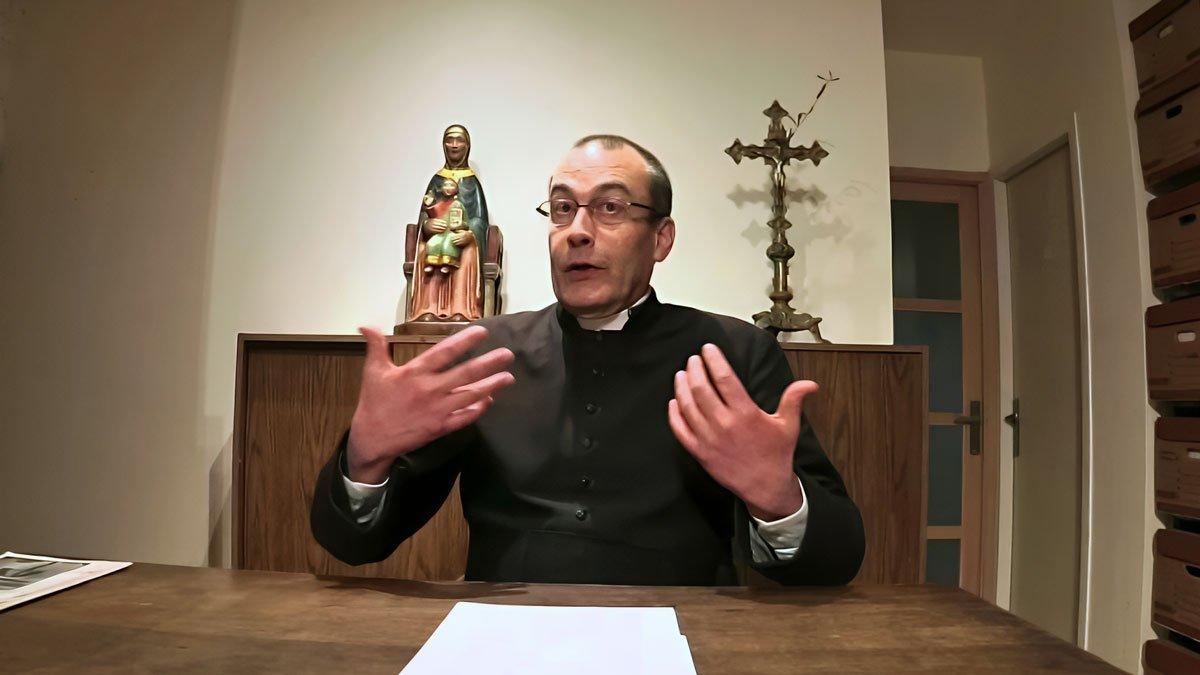
Some readers, perhaps, may bristle at the question in the title, even going so far as to dismiss it. If this is your inclination, we encourage you to keep reading. Agree or disagree, what follows is among the most potent arguments for rupture between Catholic tradition and the conciliar teaching. Assuming, arguendo, continuity could be proved, importantly according to sound methodology, the following argument of rupture would need to be sufficiently answered. In any case, the author of this critical analysis is Fr. Hervé Belmont. With his gracious permission, we are happy to present his arguments in English, where they will hopefully reach a wide Catholic audience. A sincere and intellectually curious audience, that desires to pursue and embrace Truth above all else, whatever the consequences.
Fr. Belmont is a French priest known for his commitment to preserving and teaching the traditional Catholic faith. Based in Saint-Maixant, he was ordained by the founder of the Society of Saint Pius X, Archbishop Marcel Lefebrvre. On the question of the present state of the Catholic Church, Fr. Belmont adheres to The Thesis of Cassiciacum,1 developed by the late Dominican theologian, M.L. Guérard des Lauriers.2 Fr. Belmont’s writings cover many subjects—theology, philosophy, history and spirituality—and can be found at his website Quicumque. Readers are encouraged to visit, as the site is a wealth of information.
What follows is a translated essay making, what could be termed, “the deductive argument”3 for rupture between Catholic teaching on the question of religious liberty (equivalent to unrestricted freedom of worship and conscience in the external and public forum) in relation to the 1965 conciliar declaration, Dignitatis Humanæ, on the same question.
Until the Second Vatican Council, the Catholic Church had by no means been silent on the evil of religious liberty, now commonly referred to as religious freedom, and an attendant ‘right’ to it. It was branded as a “never sufficiently to be deplored heresy” by Pope Pius VII in 1814,4 and an “absurd and erroneous proposition” by Pope Gregory XVI in 1832.5 As such, the notion of religious freedom is not only repugnant to mere reason (who would suggest that, in religious and moral matters, truth and falsehood ought to be equal before the State, even having the same rights?) but has already received condemnation by the supreme authority of the Church. The aforementioned, Guérard des Lauriers, keenly observed that Dignitatis Humanæ “deals with a doctrine received and defined by Tradition, and solemnly recapitulated by Pius IX in the Syllabus and in the Encyclical Quanta Cura.” This latter text, promulgated in December of 1864, will be the specific focus of Fr. Belmont’s analysis.
Continue reading at The Journal of American Reform