
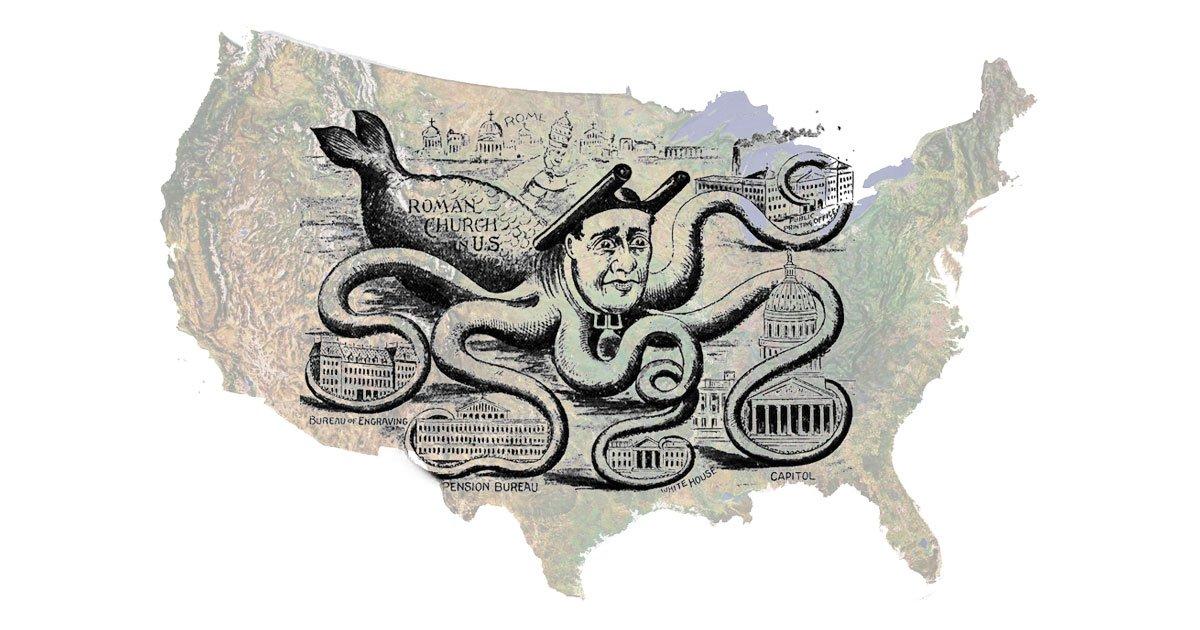
The ribald – and often insightful – 1960s comedian Lenny Bruce once quipped: “Everybody knows which church you’re talking about when you talk about The Church.” The Catholic Church reveals God, and God alone is our Judge. But the Church, as the Mystical Body of Christ, is The Bogeyman for many people.
Anti-Catholicism has deep American roots going back to colonial days. In early America, Catholics could not fully practice their faith. Catholic commissioners enacted the Maryland Toleration Act in 1649, granting religious freedom to all. But Protestants rather quickly repealed it in 1655.
Anti-Catholicism continued after the Revolutionary War, though Catholics fought alongside Washington. Priests were allowed to cross the Potomac River and celebrate Sunday Mass in Saint Mary’s Church in Alexandria. But Virginia law prevented them from spending the night. In 1844, after anti-Catholic rioters in Philadelphia torched churches, Archbishop John Hughes of New York famously invoked the specter of Russia’s scorched-earth strategy as Napoleon approached: “If a single Catholic church were burned in New York,” he warned, “the city would become a second Moscow.”
Before the Civil War, the “Know-Nothings” spread fear of Catholics as “un-American.” Yet at Gettysburg, Holy Cross Father William Corby granted general absolution to the renowned Irish Brigade before the carnage of the Wheatfield. After the victory, nonetheless, battle-weary Union soldiers suppressed anti-draft riots by mostly Irish Catholics in New York.
Well into the 20th Century, the Ku Klux Klan burned crosses on the properties of Blacks, Catholics, and Jews alike. Al Smith, the first Catholic presidential candidate, lost the election in 1928 because of anti-Catholic sentiment. John Kennedy’s jousting with anti-Catholics culminated with his mostly capitulating Houston speech to Protestant clergymen.
Continue reading at The Catholic Thing