
On August 21, the International Theological Commission published a document entitled “Caring for Our Common Home: A Responsible and Fraternal Response to the Trinitarian God.”
This document sets out the context in which theological texts have been produced at least in recent months. Within it, however, numerous extremely problematic aspects are presented. The most problematic aspect is certainly the clearing for acceptance of pantheism in its soft variant, namely panentheism.
Before dwelling on this specific problem, however, let us briefly list the other problematic points of the document.
First of all, the document proposes the theological structuring of the category of “sin against creation and against the Creator,” defining it as disobedience to the divine mandate to care for the earth.
In reality, classical Catholic morality already considers gratuitous cruelty toward the non-human world (plants, animals) a grave sin that can take various forms and can involve different kinds of sin: for example, if an arsonist sets fire to a forest, he commits a series of mortal sins against temperance and against justice: impiety toward God the Creator (cf. S.Th. II-II, q. 64-66), damage to any private property belonging to others, scandal through contempt for the law. And perhaps more.
Therefore, the proposal of a new sin must be understood differently, within that great project initiated by Bergoglio of politicizing and secularizing Catholic morality, shifting the center of gravity from personal sin and eternal salvation toward increasingly socio-political issues.
Indeed, the Commission’s discussion of this “new” sin is accompanied by constant references to scientific data on the climate, pollution from microplastics and – above all – the ecological objectives of the UN.
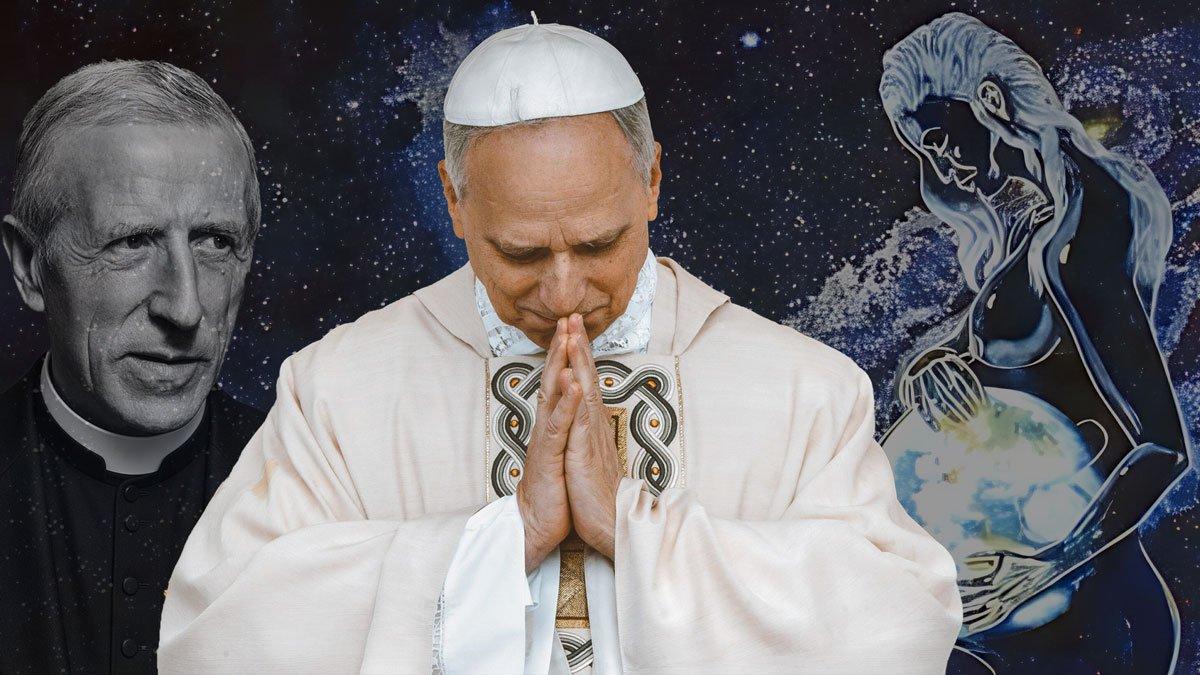
Secondly, in paragraph 107, we read: “The human being offers the creation to God in Christ and, in return, implores God’s blessing in Christ for all things. Christ is thus the axis of the world’s maturation.” In note 184 at the end of this text, the document reveals the key with which these words are to be interpreted. It reads: “In this perspective, the contribution of P. Teilhard de Chardin should be welcomed.”
Namely, the contribution of one of the most consistent neo-Modernist heresiarchs of the last century. Teilhard’s idea of the maturation and recapitulation of the world in Christ is precisely one of the Jesuit theologian’s most heretical theses.
Teilhard de Chardin (1881-1955) attempted to reconcile Catholic doctrine with modern science, believing that the distance between the two had by then become irreconcilable. The authors of the Commission are, in fact, of the same opinion: “These discoveries have radically redefined the notions of matter, energy, particles and antimatter. They call into question many of the assumptions on which both the religious and materialist understanding of the universe had been based” (p. 46).
Continue reading at The Remnant