
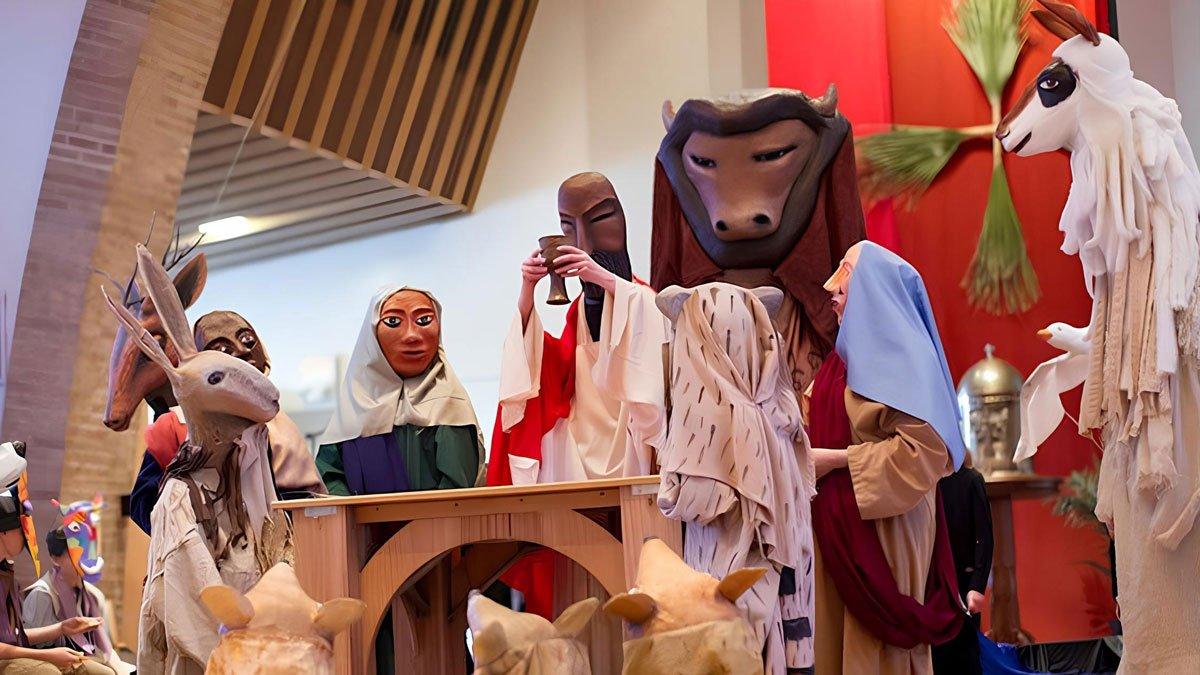
A cute liturgy projects its cuteness onto God Himself; a cute God is easily trivialized, ignored, forgotten; and a forgotten God—since human beings by nature long to worship something—will soon have some sort of idol to take His place.
Lately we’ve been exploring topics related directly or indirectly to public religious worship: the true nature of a feast, the history of Christian feast days, feasting in medieval liturgy, and bells as liturgical instruments in the Old Covenant and the New. All these discussions point in one way or another to a fundamental quality of liturgy as it was understood and practiced for centuries in the western and eastern Church. This quality draws upon such concepts as beauty, solemnity, formality, transcendentality, sublimity—but it is not equivalent to any one of these things. Is there a single word by which we might express the quality I have in mind? I believe there is, though we must accept that it is imperfect unto its task, and we must also keep its various meanings active in our minds. The word is “large.” The liturgical acts of the Church used to be, in the best senses of the term, large.
We can begin with the physical. The grand cathedrals of Europe leave no doubt that our ancestors saw immense structures and vast spaces as fitting complements to the metaphysical realities of sacred liturgy. The effect on the worshipper, as many of us know from personal experience, is compelling: we marvel at the greatness of God, and of the universe which He made, and of the promises which He renews through the sacraments; we humble ourselves before the power of divine love, of cosmic forces, of celestial beauty. Confronting both the vastitude of the interior space and the collective physical magnitude of the ministers and acolytes, we remember how very small are the human beings—from swineherd to Emperor, from pauper to President—who wend their fleeting way upon the earth.
Continue reading at Robert Keim’s Substack