
The crisis of the Catholic Church is, first and foremost, a crisis of authority. Authority does not concern only the doctrinal and moral sphere but, above all, the form and manner in which power is exercised. Every institution is sustained by a power structure that ensures its unity and continuity. In the case of the Church, this structure is a mixed regime of divine law: monarchic, because the Pope exercises supreme, full, and immediate power over the entire Church, guaranteeing the unity of faith; aristocratic, because the bishops—ideally chosen among the ‘best’ (aristoi)—govern the dioceses with real autonomy, while remaining in communion with the Pope; and ‘republican’ (in the classical sense of the term), because power does not belong to a dynasty or a caste in the Hindu style but can be conferred, through election or appointment, to anyone—regardless of social origin—who meets the conditions required for access to the hierarchy.
Moreover, it is traditionally a subsidiary regime: the higher level should intervene only when the lower level of the hierarchy is unable to provide for itself or in matters concerning the Church as a whole, transversally, as universal. Consequently, those at the top intervene far less than those at the bottom.
In recent decades, however, a different approach has progressively taken hold, a true process of subversion of the traditional regime: from a mixed regime to an increasingly democratic-parliamentary regime, from a subsidiary regime to a centralist regime.
The pontificate of Jorge Mario Bergoglio—Pope Francis—represented a genuine ‘transition dictatorship.’ The post-conciliar Church presented a model still monarchic in structure but no longer such in the perception and exercise of power; it was moving toward a new configuration that many wish to establish in a democratic sense. As often occurs in historical transitions from monarchy to democracy, this transition was marked by a power vacuum, symbolically and effectively represented by Benedict XVI’s resignation in 2013. This vacuum was filled by Francis, who exercised highly centralized authority—a ‘dictatorship’ in the Marxist sense of the term, that is, extraordinary and direct power, but temporary—to guide the Church from one model to another, effectively dismantling the previous structure.
From this perspective, Leo XIV is not in opposition to Francis’s pontificate, as many continue to assert, but in coherent continuity in the form of synthesis. It is no coincidence that Leo, from the beginning of his pontificate, repeatedly exalted the role of the Curia—the administrative apparatus of the Vatican—at times presenting it as effectively superior to the pope himself (“Popes pass, the Curia remains”), over whom it should instead exercise power in a vicariate form. Leo does not perceive himself as an authority placed above the Curia but as a figure inserted and almost ‘embedded’ and temporary within it.
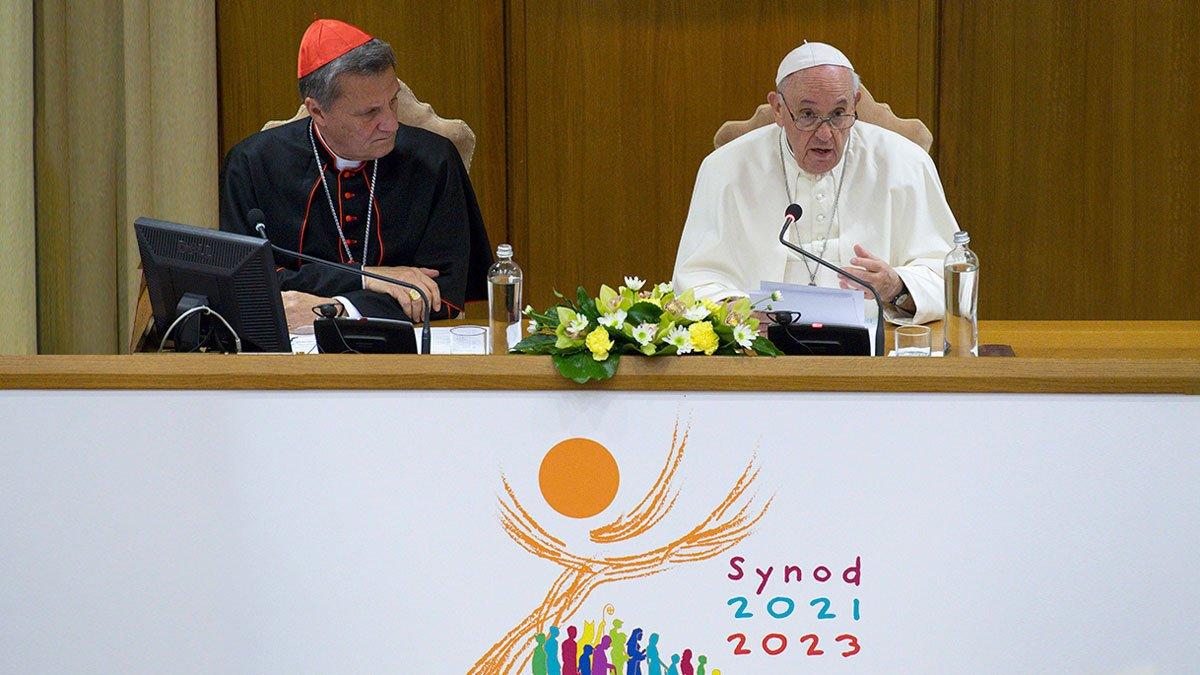
One of the main instruments of this process initiated by Pope Francis has been the paradigm of “synodality.” Formally, it is presented as a recovery of ancient practices of the Church. In reality, the implicit idea is that the entire people of God—and not only the ordained clergy—participate in determining the life of the Church, not only in pastoral or disciplinary matters but also on doctrinal and moral issues.
The method adopted is always the same. One does not proceed through an explicit revision of doctrine, which would create a friction that is difficult to manage. On the contrary, traditional principles are often verbally reaffirmed. Simultaneously, however, innovations are introduced in practice that, over time, end up normalizing principles previously considered unacceptable.
Continue reading at the European Conservative