
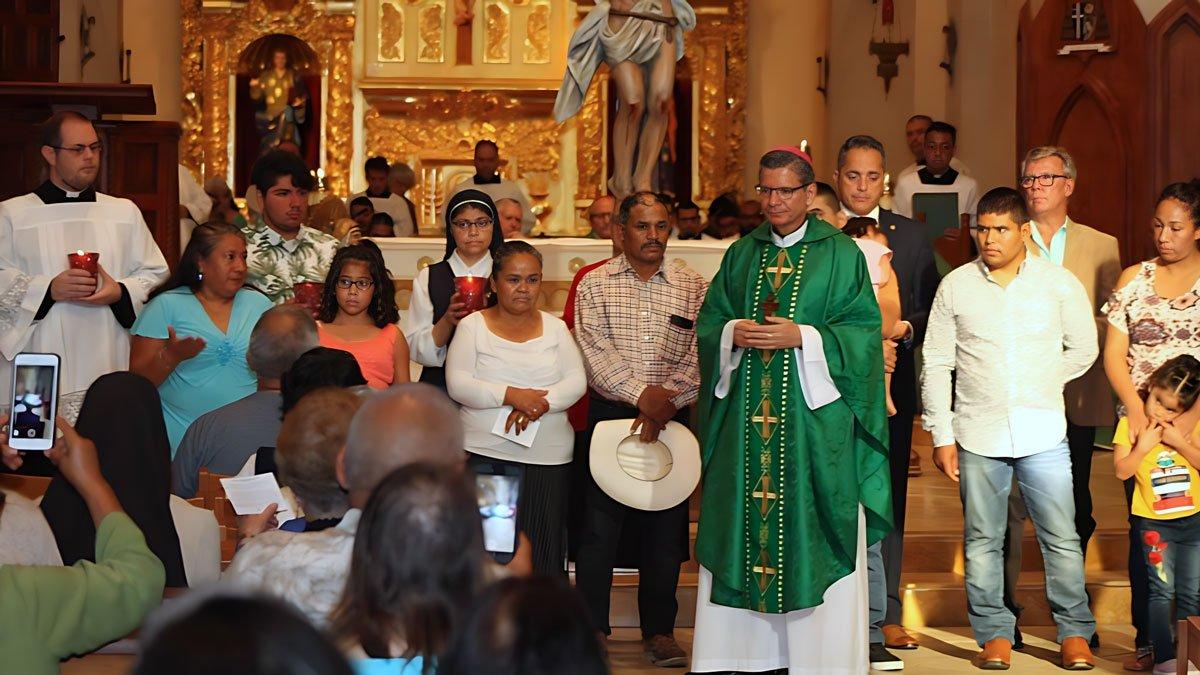
A recent study on religion in the United States shows that while the percentage of white, black and Asian adults who identify as Catholic has remained relatively stable since 2007, the percentage of Hispanic adults who identify as Catholic has declined dramatically.
The Pew Research Center’s 2023-24 Religious Landscape Study found that between 2007 and 2023-24, the percentage of white adults in the United States who identify as Catholic fell from 22% to 17%, the percentage of Black adults fell from 5% to 4%, and the percentage of Asian adults fell from 17% to 14%. Meanwhile, the percentage of Hispanic adults who identify as Catholic fell from 58% to 42%.
“The percentage of Catholics in the U.S. Hispanic population has been declining rapidly for a long time,” said Gregory A. Smith, senior associate research director at Pew, who has led studies on religion in American life. “There was a time, when we first did the Religious Landscape Study, when we could say that maybe we were headed toward a future where the Catholic population in the U.S. would be majority Hispanic, even though most Hispanics in the country were not Catholic. However, we are not at the point now where most Catholics are Hispanic, but we have reached the point where most Hispanics are not Catholic, and we have been there for some time,” he told Crux.
For context, 36% of Catholics in the United States are Hispanic.
“It’s not surprising to see those numbers,” Hosffman Ospino, a professor of Hispanic Ministry and Religious Education at Boston College, told Crux. “The larger the Hispanic population and the larger the portion that was born and raised in the United States, the more decline we will continue to see.”
Ospino explained that we are no longer in the 1990s, when more than half of the Hispanic population in the United States were immigrants, who are more likely to be religious. According to the Pew study, 58% of immigrants in the United States are Christian.
Today, approximately 64% of Hispanics were born and raised in the United States, Ospino noted. He expects that number to continue to grow, meaning more Hispanics will be born into a pluralistic and secularized culture and, therefore, will not be Catholic.
Another factor, according to Ospino, is the responsibility of the Church itself. He noted that Hispanics are moving away from the faith in the United States largely because “much of our pastoral outreach is inadequate,” meaning the second generation, those born in the country, are being neglected.
“Most of the efforts in Hispanic ministry in the United States are directed toward the immigrant population: Masses in Spanish, sacraments in Spanish, social services for the immigrant community. All of this is very important and very necessary,” Ospino said.
“However, we haven’t found a way to accompany those two-thirds of Latinos who were born and raised in the United States,” Ospino continued. “Many pastoral leaders assume they will live their faith like their immigrant parents, grandparents, and siblings, or that they will become Americanized and simply integrate into the white, English-speaking Catholic community. The truth is, neither of those things is happening.”
“We need better ways to reach out to this community,” he stressed.
To make progress in this area, Ospino said the Church must focus on the local level, with parishes providing better support to young people and families. At the national level, he noted that fewer “global” pastoral plans are needed, and more plans that strengthen local efforts, such as apostolic movements, parishes, catechesis, and family ministry.
Beyond the Hispanic aspect, the main conclusion about Catholicism in the study is that the sharp decline in the percentage of Catholics in the population, experienced in the early 2000s and early 2010s, has stabilized in the last decade.
In 2014, Catholics represented 21% of the population. In 2023-24, they represented 19%.
Still, Smith cautioned against assuming this stability will continue. In fact, he explained that for it to persist, something would have to change.
“We know that older Americans, who on average are highly religious, will represent a shrinking share of the population in the future as the oldest members of that group pass away. We also know that today’s young adults are much less religious than today’s older adults. So, if nothing changes, the decline in religiosity in the United States will continue long term,” Smith explained.
“For stability to endure, something would have to change,” he insisted. “Either today’s young adults would have to become more religious as they age, or we would have to see new generations of young adults become more similar to today’s older adults in terms of religiosity.”
The question is: how does the Catholic Church in the United States evangelize these young people? From the perspective of Archbishop Charles Thompson, it is essential to continue on the synodal path.
“When I look at these numbers, I think, ‘How does the Church transform culture by addressing these issues?’ Not necessarily by confronting them, but by following the synodal path of dialogue, listening, accompaniment, and walking together toward salvation, as Pope Francis has said,” Thompson, chair of the U.S. Conference of Catholic Bishops’ Committee on Evangelization and Catechesis, told Crux.
Tim Glemkowski, former executive director of the National Eucharistic Congress and current leader of Amazing Parish, an organization that helps parishes evangelize, told Crux that efforts to grow faith must be rooted in the local reality of the parish, and that this is where the national Church should focus its efforts as well.
“What’s the best way for the national Church, meaning the USCCB, to support the evangelization that happens in the dioceses, and then ultimately for the dioceses to support what happens in the parishes?” Glemkowski posed. “I don’t have all the answers, but I think that’s the right way to look at it.”
Source: Info Catolica