
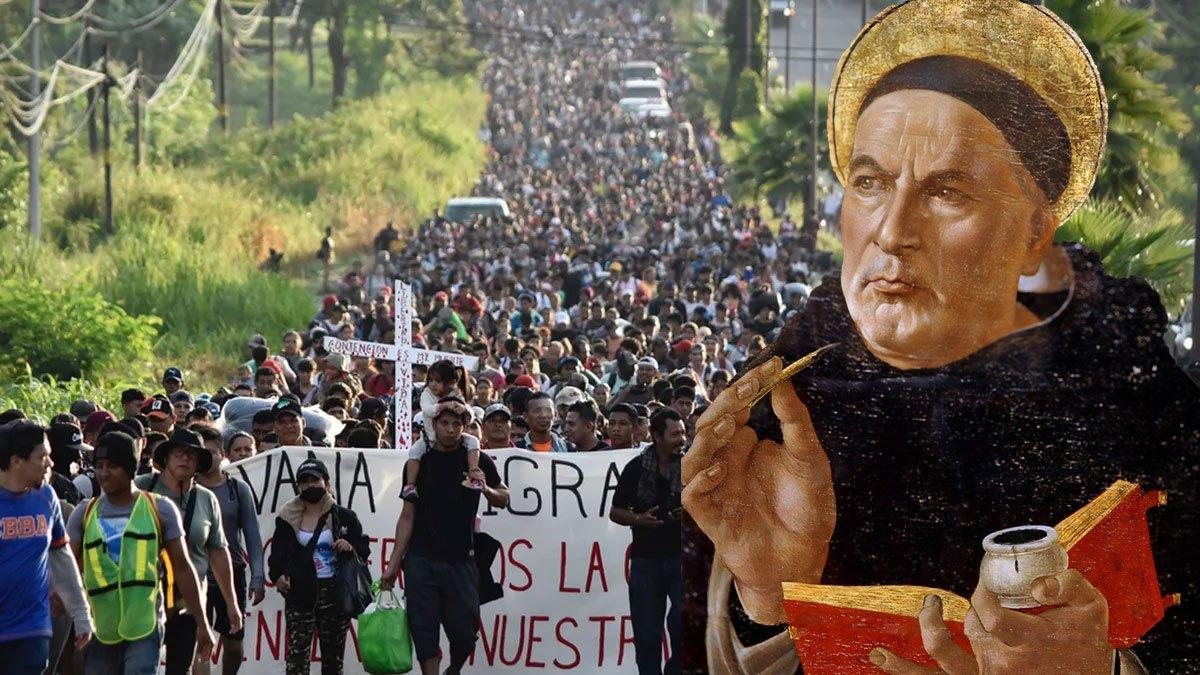
In this piece, we will challenge the USCCB’s vision on immigration with reference to the writings of St. Thomas Aquinas, the ‘social encyclicals’ of the nineteenth and twentieth century popes and the nature of civil society itself.
Is the State morally obligated to welcome all foreigners without condition? Does Catholic teaching require open borders? And, if so, at what cost—to the nation, its people, and even to the migrants themselves?
These questions have resurfaced following the USCCB’s recent statement suggesting criticism of immigration policies and deportation orders. Such criticism risks presenting a vision of Catholic social teaching that is simplistic, ideological and divorced from the perennial wisdom of the Church.
In this piece, we will challenge that vision with reference to the writings of St. Thomas Aquinas, the “social encyclicals” of the nineteenth- and twentieth-century popes and the nature of civil society itself.
Far from mandating open borders or condemning all deportations, Catholic social teaching asserts that:
- The civil authority’s primary duty is to the common good of its own people, who form the “household of the nation.”
- Hospitality towards migrants must be guided by prudence and ordered to justice, not by abstract ideals divorced from reality.
- Unchecked immigration can undermine civil society, exploit both native workers and migrants, and serve the interests of global capitalism at the expense of the common good.
Continue reading at LifeSite News