
No young woman gives her entire life to something that resembles an NGO with memories.
The Leadership Conference of Women Religious (LCWR), which brings together the superiors of approximately two-thirds of the nearly 35,000 religious sisters in the United States, is holding its annual assembly from August 11 to 14 in Orlando (Florida), coinciding with the 70th anniversary of its founding. According to National Catholic Reporter, more than 1,300 superiors and congregational leaders are participating, along with invited religious sisters and brothers from Canada and Latin America, in an expanded format under the theme “Many charisms, one Spirit, one call.”
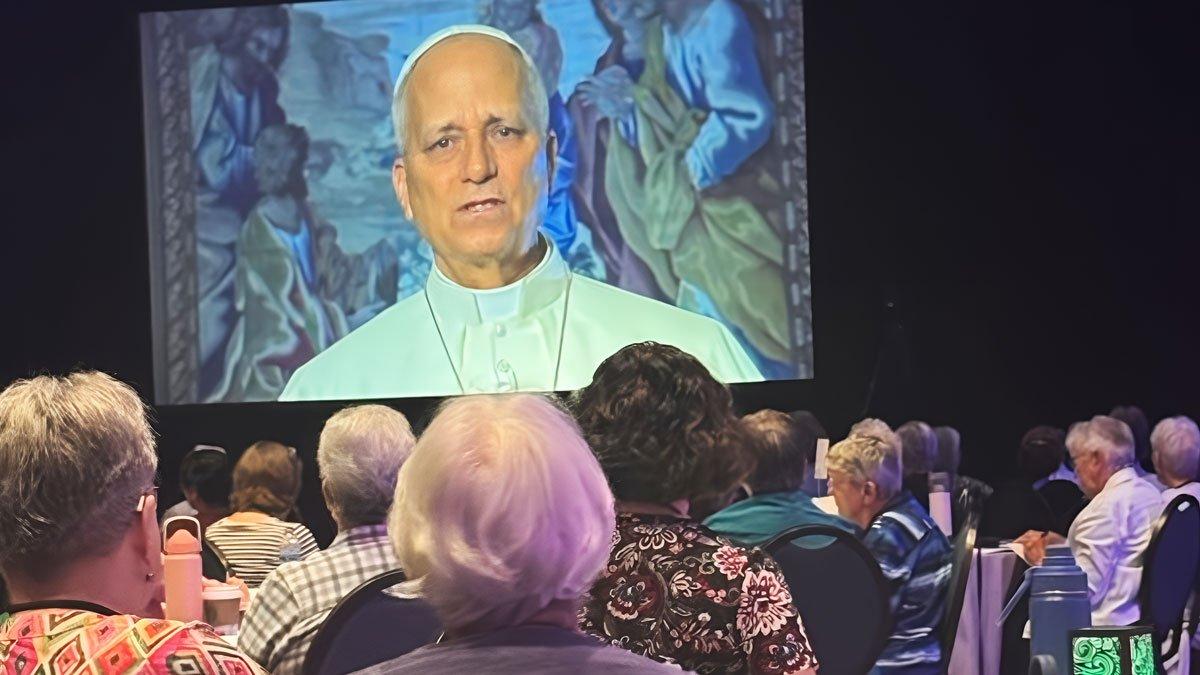
The central moment of Wednesday’s session was a pre-recorded video message from Leo XIV. The Pope thanked them for “the historic contributions of your institutes in the fields of evangelization, education, and care for the poor and marginalized,” and assured those present that “the Church needs you, with all the diversity and richness of the forms of consecration and ministry you represent, because with your vitality and the witness of a life centered on Jesus you can help awaken the world.”
The Pontiff specifically celebrated that the assembly is being conducted according to the synodal method of “Conversation in the Spirit”—listening, dialogue, and discernment—and offered the phrase that has become the meeting’s headline: “In a special way, those who live the religious life are called to become experts in synodality, because of the opportunities that community life offers for practicing it and because of the very way your congregations are organized.” He concluded by urging them to confront “the globalization of indifference and powerlessness with the remedy of Christ’s love and mercy.”
Following the video message, the assembly heard the keynote address from Xaverian Sister Nathalie Becquart, undersecretary of the Synod of Bishops, devoted—as expected—to synodality. A greeting was also read from Sister Simona Brambilla of the Dicastery for Institutes of Consecrated Life, in which she stated that “if we allow it, consecrated life can truly be a catalyst for social transformation.”
That is the chronicle. But it is enough to look at a single photograph of the Orlando hall to understand what no video message dared to say. Hundreds of white heads before a giant screen. Not a single habit in sight: floral blouses, plaid shirts, colorful thermoses on the tablecloths. A room that could be mistaken for the annual convention of any American retirees’ association, were it not for the fact that on the screen the Vicar of Christ is speaking.
This is not a subjective impression: the numbers confirm it. In 1965 there were 178,740 religious sisters in the United States; in 2025 only 33,135 remain—an 82% collapse. The average age exceeds 80. Fewer than 1% are under 40. Today in the United States there are more sisters over 90 than under 60. In 2025, across the entire country, only 74 women made perpetual profession; 82% of the institutes had none at all. These are the congregations the LCWR represents, and this is the verifiable fruit of sixty years of aggiornamento understood as dissolution: without habit, without recognizable common life, without visible sign of consecration… and without vocations.
Continue reading at Infovaticana