
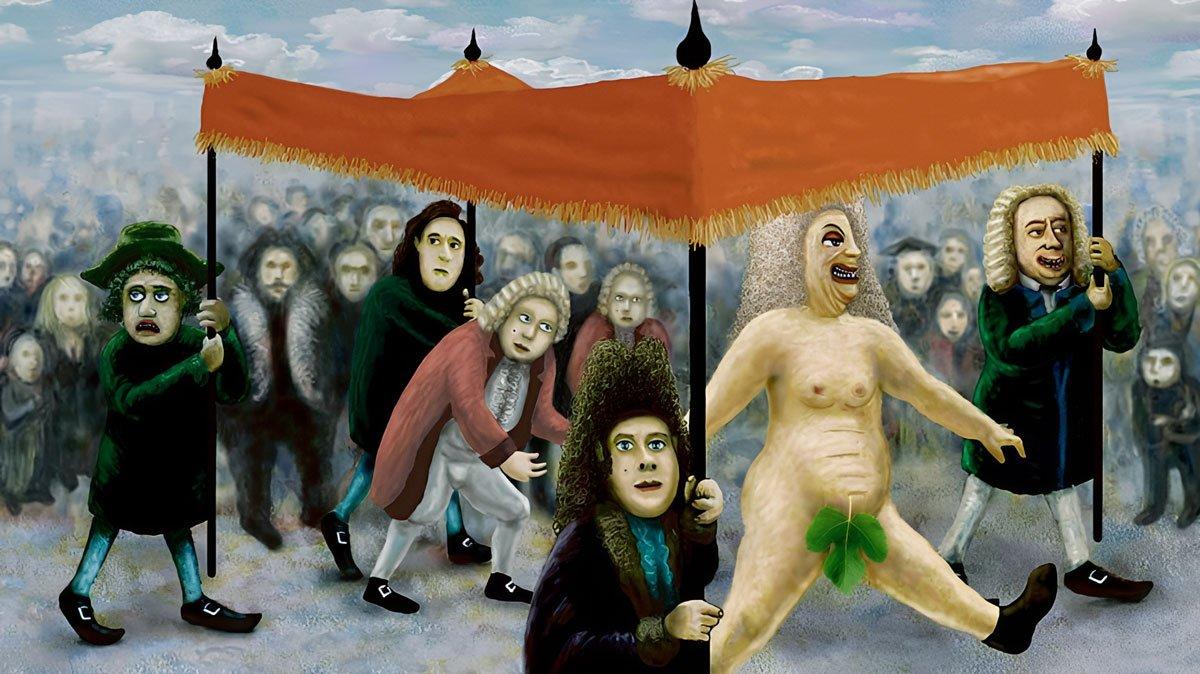
As a short commentary on our capacity for self-delusion, it’s hard to improve on Hans Christian Andersen’s tale of the emperor, the tailors, the little child, and the invisible suit.
If you recall, the ploy used by the two swindlers is to claim that the Emperor’s beautiful clothes could only be seen by those who were fit for the offices they held or were very clever. The exquisite garment could not be seen by anyone who was very stupid. As a result, the Emperor’s court advisers, and eventually, the whole town find themselves caught in a dilemma. Each one thinks, “I can’t see anything in this, but who am I to say?”
Rather than be thought very stupid or very incompetent, the entire village soon signs on to the lie—except for one small child who breaks the illusion by shouting “He hasn’t got anything on!”
Andersen’s fable has almost infinite applications, but it seems particularly suited (no pun intended) to the Catholic hierarchy’s delusional understanding of Islam—a delusion which still awaits the little child that will lead the bishops back to sanity.
Like the Emperor’s advisers, the bishops see something that isn’t there—or more accurately, they pretend to see something that isn’t there. When they look at Islam, they see a religion of peace and justice which bears many similarities to Catholicism. They also claim to see that Muslims and Catholics worship the same God, yet in the Qur’an Allah repeatedly denies the doctrine of the Trinity. For example, “They do blaspheme who say Allah is one of three in a Trinity.” (5:73). Likewise, Allah is not happy with the Christian belief in the Incarnation: “Christians call Christ the son of Allah…Allah’s curse be on them: how they are deluded away from the truth! “(9:30).
That’s fairly clear, isn’t it? It’s virtually impossible to reconcile these opposing views of God’s nature. Still, if you’re willing to replace logic with wishful thinking you may be able to fool yourself. And, like the villagers in The Emperor’s New Clothes, our bishops seem to prefer the wishful mode of thinking to the commonsense variety.
Why do so many bishops go along with this pretense? Some know little about Islam, but like the townspeople in Andersen’s story they go along with the majority for fear of being thought stupid or incompetent. In their case it’s a rational fear because the majority of bishops really don’t know much about Islam. Naturally, their inclination is to go along with the prevailing opinion, whatever it may be.
Of course, some bishops must know that the sanitized version of Islam they hold to is very far from the truth. Why do they keep up the pretense? Once again, the motive is probably fear—not only fear of being thought incompetent, but also fear of being smeared as an Islamophobe, and, above all, fear of offending Muslims and risking massive and violent protests such as those that erupted in Europe after the publication of Pope Benedict’s Regensburg Address. They correctly understand that telling the truth about Islam could have dangerous consequences.
As a result, they have substituted a fantasy Islam—Islam as they would like it to be—for the true Islam. Rather than face the naked truth about Islam, they prefer to cover-up for it—not only its violent side, but also its irrationality, its self-contradictions, the crude prose of the Qur’an, and the cruelty of Sharia Law.
Continue reading at Turning Point Project