
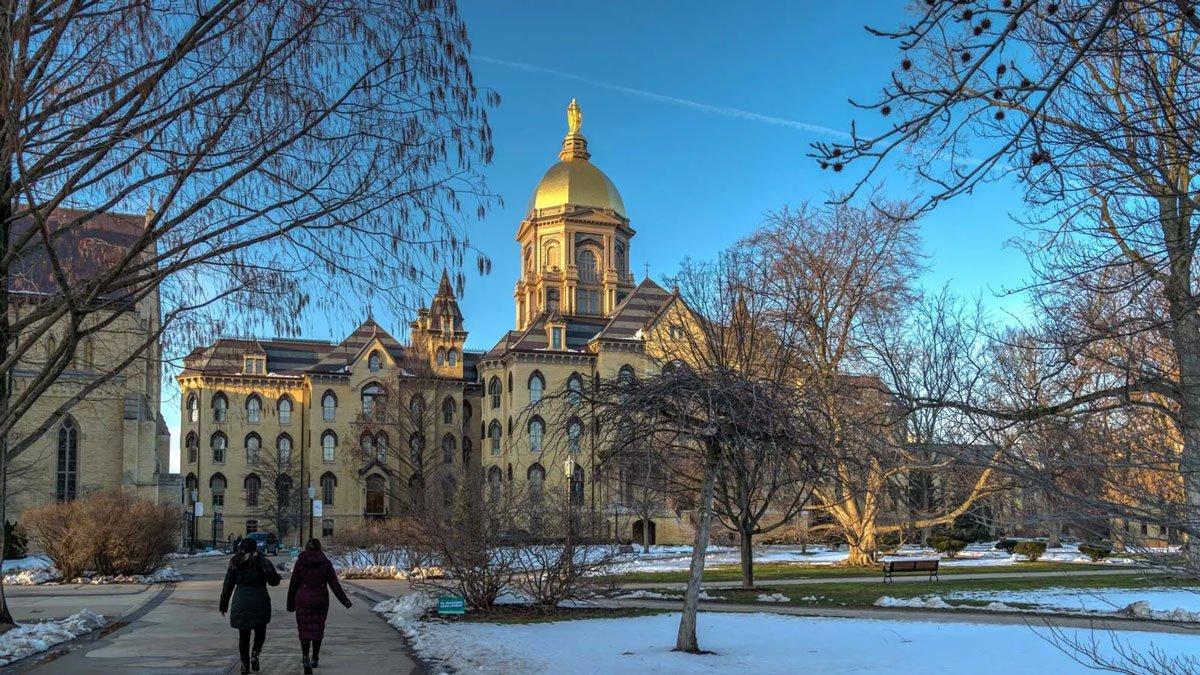
Most Catholic colleges have become essentially secular, imitating non-Catholic schools rather than embracing their distinct religious identity.
Catholic colleges and universities today are largely failing to fulfill their mission, and the bishops have an important role to play in correcting the problem, the provost of Dartmouth College said Wednesday.
Santiago Schnell, who is also a renowned mathematical biologist, spoke to the U.S. Conference of Catholic Bishops in Orlando. He offered his reflections on the state of Catholic higher education today, 25 years after the conference implemented Pope John Paul II’s apostolic constitution on education, Ex Corde Ecclesiae.
Questions of policy, leadership, and culture at Catholic universities continue to be points of contention in the United States. This past year, the University of Notre Dame appointed an outspoken abortion advocate to direct one of its academic institutes, then announced days later that the appointed faculty member would not assume the director role after widespread condemnation of the appointment by students, university donors, and bishops.
Schnell said that although Catholics are present in American public life today – making up, for example, more than a quarter of Congress and two-thirds of the Supreme Court – they lack a sufficient presence in the institutions that form ideas, language and imagination.
“The Catholic paradox is that we have a massive infrastructure of higher education, with average outcomes,” he said.
Roughly 1 in 5 U.S. adults is Catholic, and there are 230 Catholic colleges and universities in the country, enrolling more than 600,000 students, he noted.
But only 35% of adult Catholics in the country have at least a bachelor’s degree – just matching the national average among all U.S. adults. And among Hispanic Catholics, this figure is 20%.
Meanwhile, 43% of U.S. adults who were raised Catholic no longer identify as Catholic today, he continued. And those who no longer practice the faith are more than twice as likely to cite changes in belief than scandals in the Church as the primary reason.
Continue reading at The Pillar
Related Posts
- Parents Beg Pope Leo To Halt LGBT Indoctrination In Catholic Schools
- Bishop Strickland Says Catholic Colleges Are ‘Cowering’ to Woke Culture
- Catholic Education Leaders Release “Front Royal Statement” Following Inaugural Summit at Christendom College
- ‘Catholic’ Colleges Push ‘Pride’ Confusion
- ‘Catholic’ University Allows Lesbian ‘Pastor’ To Teach ‘Queer Theology’
- Benedictine College Students Receive One Year Suspension for Criticizing as Heretical Statements Made at the “Strengthening Jewish-Catholic Friendship Conference”
- Fordham President Publicly Rejects Catholic Teaching
- Minnesota Benedictine Colleges Host ‘Drag Show Olympics’
- California “Catholic” College Invites Nancy Pelosi To Be Its Commencement Speaker
- The Queering Of America’s Oldest Catholic University
- Catholic Universities Embrace Drag Queens, Shun Border Patrol Agents
- Notre Dame Trustees Grapple with Backlash to Pro-Abortion Professor’s Appointment
- Notre Dame Appoints Abortion Advocate Director of Liu Institute
- German Catholic Bishops’ Document on ‘Sexual Diversity’ in Schools Signals Deep Spiritual Crisis
- ‘Catholic’ University’s Campus Ministry Sponsors ‘Transgender Day Of Remembrance’
- ‘Catholic’ Georgetown Has Declared War on Catholicism
- WATCH: Confronting Evil on the Campus of “Catholic” Loyola University
- ‘Catholic’ University of San Diego Wants Community To Avoid Using ‘Men and Women’ Language
- An Explosive Vatican Appointment
- St. Mary’s College Facing Opposition Due To Anti-Catholic Commencement Speaker
- Cardinal McElroy’s Diocese Orders Homeschool Groups Removed From Parishes
- CATHOLIC SCHOOLS: Are We Catholic Enough to Make Enemies?
- Transgender Activist Dylan Mulvaney to Speak at Jesuit St. Louis University
- Boston Catholic Schools Foundation Hosts Lesbian/Pro-Abortion Governor Maura Healey
- Jesuit University to Host Annual ‘Drag’ Show Friday
- WATCH: The Synod Is Coming For Our Catholic Schools
- The Future of Catholic Schools – and the Priesthood
- WATCH: Does Your School Use Materials from the Catholic Curriculum Corporation?
- Catholic University Holds Workshop on ‘White Accountability’
- The Sorry Situation of Catholic Schools