
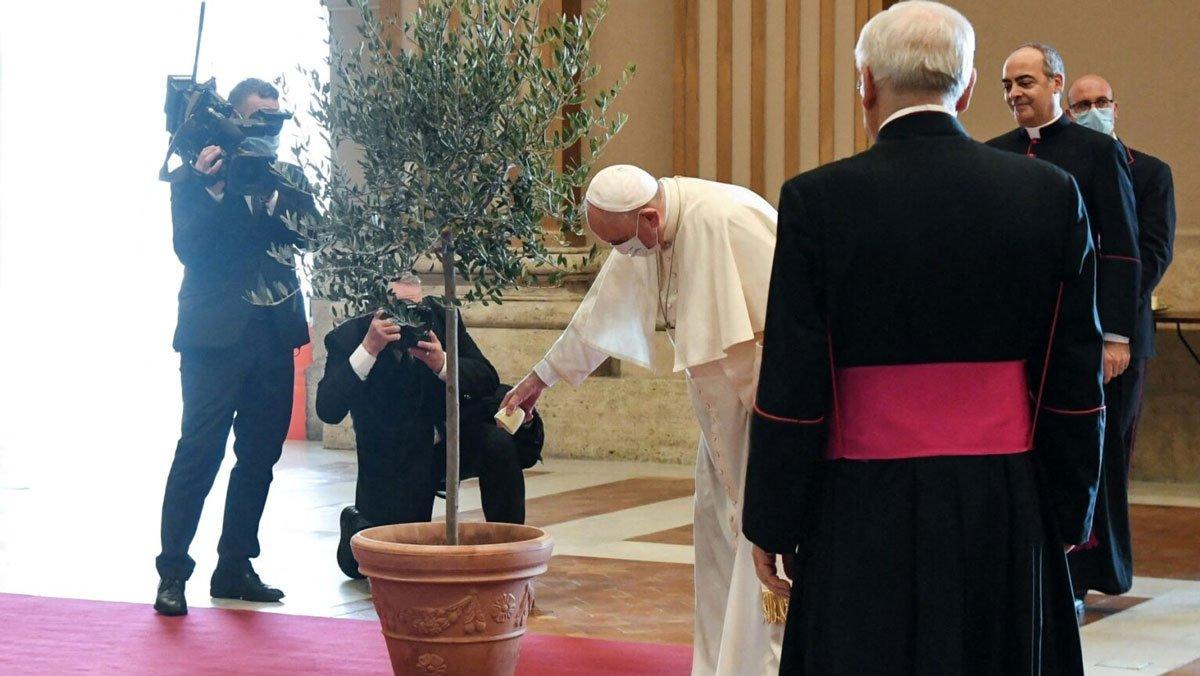
On April 27, two Vatican dicasteries—the Dicastery for Promoting Integral Human Development and the Dicastery for Laity, Family and Life—published a joint document aimed at raising awareness among Catholic families about an issue which, according to the dicasteries themselves, represents an urgent crisis both for the world and for the Church itself.
This urgent crisis for the Vatican dicasteries is the ecological crisis. For this reason, the text goes so far as to suggest that a Catholic family, in order truly to be such, cannot exempt itself from educating its members in ecological respect. Indeed, that the very concept of Catholic spirituality includes an “integral ecological” consciousness.
The authors, referring to the environmentalist magisterium of Pope Francis—particularly the manifesto-encyclical Laudato si’ and the exhortation Laudate Deum—as well as to Pope Leo XIV’s first apostolic exhortation Dilexi te, which presents itself as a development of them, maintain that the crisis in question concerns not only the natural environment but also the human one. By this, they intend to refer to the widespread economic crisis, that is, the dramatic condition of poverty affecting the majority of humanity.
The most recent estimates indicate that about two billion people—concentrated mainly in the Global North—enjoy conditions of relative well-being, while the remaining six billion live in situations of poverty, disease, and ignorance; of these, about one billion live in extreme poverty. This asymmetry generates a structural migratory pressure from the south to the north, only partly spontaneous, fueled by the idea—more ideological than real—that entry into economically prosperous societies automatically entails an improvement in living conditions.
In recent years, the Catholic Church seems to have embraced this vision. Yet the history of humanity shows that simple integration into efficient social structures is not enough to lift poor migrants out of their condition. Poverty is in fact a complex and multidimensional phenomenon: not merely economic or political, but above all mental and cultural.
This latter aspect remains a taboo, difficult to address calmly—in the West as elsewhere—because it is considered politically incorrect. Whoever attempts to discuss it is often accused of claiming, simplistically, that the poor are poor ‘by choice’ and therefore deserve to remain so. But this simplification is misleading and prevents a serious analysis of the problem.
Unfortunately, this fallacious objection seems to have entered the lexicon of the Catholic Church as well, if one considers what Pope Leo XIV states in the exhortation Dilexi te: “Nor, for most of them, is poverty a choice. Yet, there are those who still presume to make this claim, thus revealing their own blindness and cruelty.”
To understand the Catholic Church’s current position on the issue, it is necessary to look back at the teachings of Francis, who brought into Church language ideas associated with environmentalism and international governance—concepts that were largely developed in institutions such as the UN and the European Union.
Continue reading at the European Conservative