
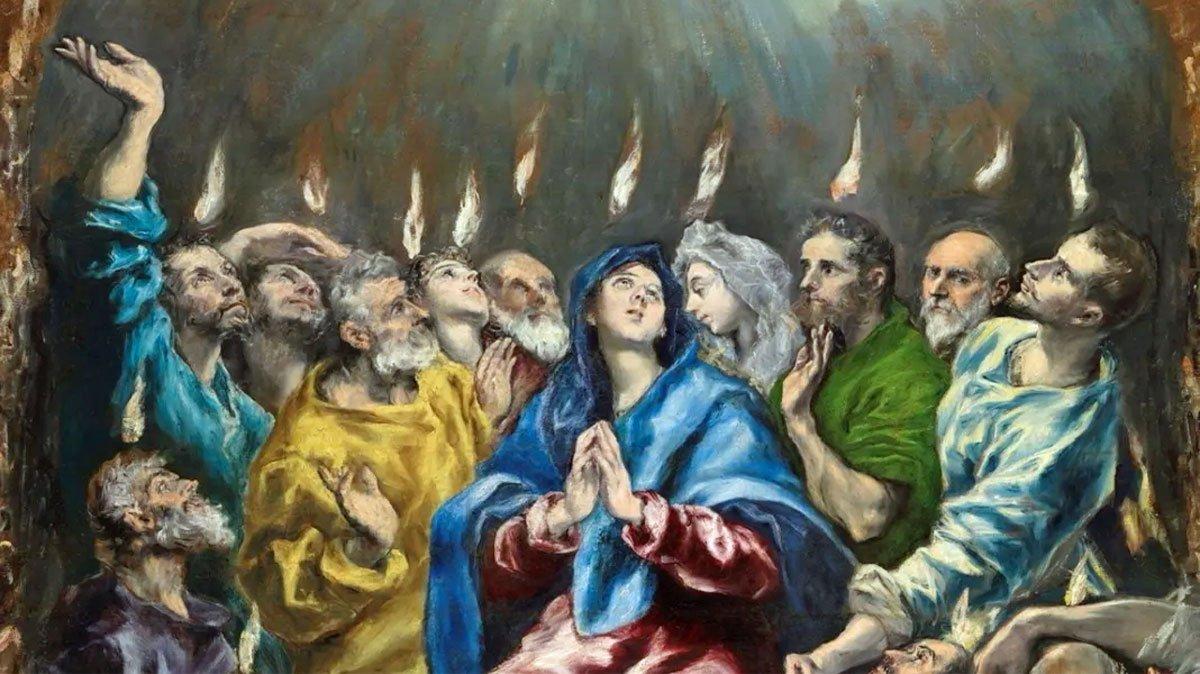
The Church places us today in a strange and holy interval. Our Lord has ascended. The Paschal candle has been extinguished. The visible presence of Christ has withdrawn from the eyes of men. Yet Pentecost has not yet come. We stand, as it were, in the Cenacle with the Apostles and the Blessed Virgin, not abandoned, not triumphant in any worldly sense, but waiting.
This is why the Introit cries out with such tender insistence: “Hear, O Lord, the sound of my call… Thy face, O Lord, I seek.” The Church does not speak here like a widow who has lost her Spouse forever. She speaks like a bride who knows He has gone to His Father and her Father, His God and her God, and who waits for the promised fire from heaven.
Goffine, in his old instruction for this Sunday, says plainly that this whole week should be used as a preparation for Pentecost, so that by good works and pious exercises we may receive the gifts of the Holy Ghost. He singles out exactly what St. Peter gives us in the Epistle: prayer, charity, the faithful use of grace, and the duties of our state in life.
Do not imagine that the Ascension is an absence in the ordinary sense. St. Augustine says that Our Lord “did not withdraw from us when He went up again into heaven.” He is in heaven by His glorified humanity, yet He remains with us by His divinity, His power, and His love. We cannot be in heaven as He is on earth, by divine nature; but in Him, by faith, hope, and charity, our hearts may already ascend.
This is why a Christian must never live as though earth were his final country. The world tells you to settle down here, to make peace with vanity, to arrange your conscience according to comfort, to be agreeable to error, to make religion useful but never sovereign. The Ascension tears that illusion away. Your Head is in heaven. Shall the members crawl contentedly in the dust?
No. If Christ our Head has ascended, then the Christian life must be an ascent. Our thoughts must ascend. Our desires must ascend. Our homes must ascend. Our work, our sufferings, our friendships, our speech, our very recreation must be drawn upward into the service of God. “The Lord is my light and my salvation; whom should I fear?”
Continue reading at Hiraeth in Exile