
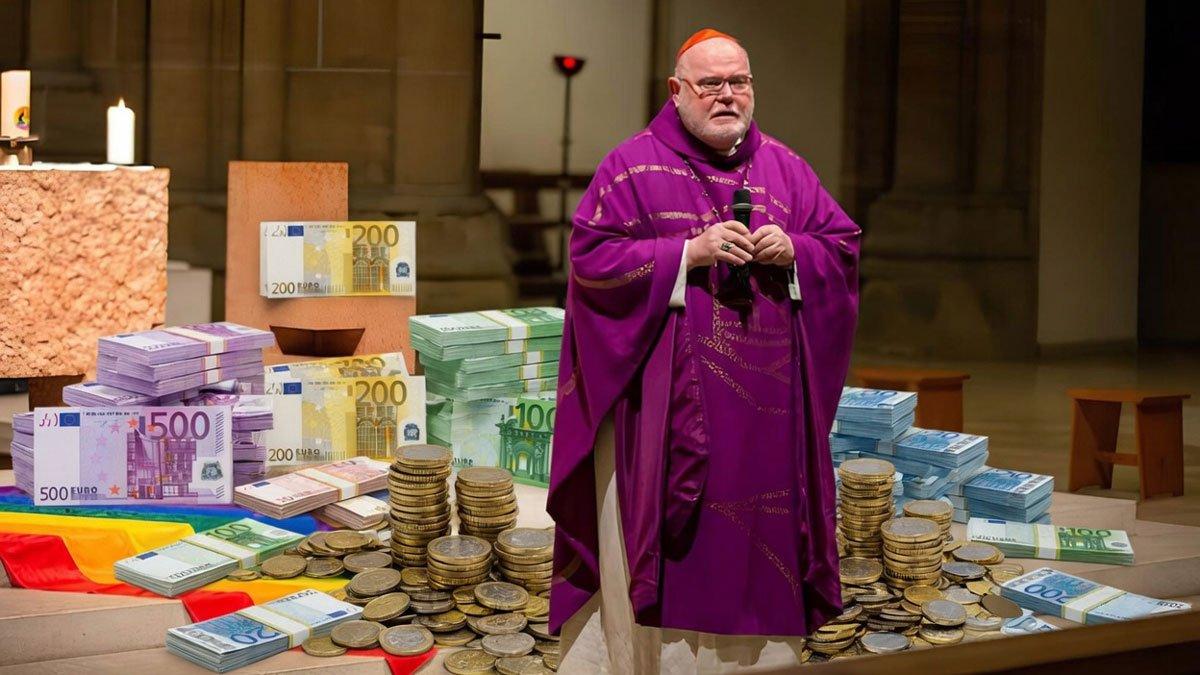
Cardinal Reinhard Marx, Archbishop of Munich and Freising, remains at the center of the latest controversy following his recent pastoral decisions—in line with the German “Synodal Way”—and the direct response from Leo XIV, but also due to an aspect that raises growing concern: the high level of income of the ecclesiastical hierarchy in Germany, sustained by a tax system unique in Europe.
A system that guarantees billions to the Church
As reported by the French outlet Tribune Chrétienne , the Church in Germany is largely financed through the Kirchensteuer , an ecclesiastical tax that the State collects directly from citizens registered as Catholics or Protestants.
This tax amounts to between 8% and 9% of the income tax and generates annual revenues of billions of euros for the German Church, making it one of the richest ecclesiastical institutions in the world.
The system not only ensures financial stability but also establishes a structural relationship between Church and State: the public administration collects the tax and transfers it directly to the dioceses, effectively integrating the Church’s economic operations into the state apparatus.
Bishops’ salaries comparable to high public officials
In this context, German bishops receive remuneration similar to that of high-ranking state officials. Salary scales place their monthly incomes between 10,000 and 18,000 euros, depending on the diocese and rank.
In the case of Cardinal Marx, at the head of one of Europe’s richest archdioceses, the German press has estimated his salary at around 14,000 euros per month, within the highest levels of this scale.
These figures are also framed within dioceses with enormous economic capacity. The German model allows certain archdioceses to accumulate million-euro surpluses, a direct reflection of the effectiveness of the ecclesiastical tax collection system.
Continue reading at Infovaticana
Related Posts
- Cardinals Praise ‘Irreversible’ Synodality And ‘Healing’ Nature Of Church Decline
- Cardinal Marx Criticizes Church ‘Nostalgia’, Rejects Rome ‘Demand List’ And Warns Over Social Media After AfD Gains
- More Reasons Why the Synodal Traitors in Rome Should Officially Change the Name of Their Diabolical “Church”
- Cardinal Marx Reconfirmed in the Curia, Despite Challenging Rome with Homosexual Blessings
- German Priests To Cardinal Marx: Homosexual Blessing Guidance Creates A Loyalty Conflict
- The Synodal Church’s Plot to Emasculate the Priesthood of Christ, Overturn the Moral Order
- Rome’s Complicity In Blessing of Homosexual Couples
- SSPX Responds To Rome’s Surrender On Homosexual Blessings
- Cardinal Marx Expands Gay Blessings, Defying Vatican Line
- German ‘Synodal Way’ Meeting Ends In Clash
- Benedict XVI Warned Marx in 2021: The “Unpublished” Letter that Alerts about the German Synodal Way
- WATCH: German Bishops Use Synodality To Embrace Sin And Decadence
- Successive Bishops Covered Up Abuse In German Diocese
- Cardinal Marx: ‘Global, Synodal Church’ Without ‘Purely Clerical Rule’ Is ‘In The Making’
- WATCH: Cardinal Marx Will Bless Homosexual Unions – Give Communion to Protestants
- US Priest Begs Cardinals to Uphold Catholic Teaching on Homosexuality
- Cardinal Marx Claims ‘The Catechism Is Not Set In Stone, One Is Allowed To Doubt What It Says’
- Catholic Chaplaincy for the Rainbow Reich
- Cardinal Marx Claims Homosexuality is ‘Not a Restriction’ on a Man’s Ability to Become a Priest
- The Cardinal Marx Charade
- Top German Catholic Cardinal Offers Resignation Over ‘Catastrophe of Sexual Abuse’
- Marxists Love Fratelli Tutti
- Cardinal Marx Says Married Priests Still Up For Debate: ‘By No Means Is It Off The Table’
- Cardinal Marx: Spreading ‘Fear of Hell’ Undermines Gospel
- No, Cardinal Marx, the Church Cannot Bless Same-Sex Couples
- Cardinal Marx: Homosexual Couples Can Get a Blessing from the Church
- Vatican Officials: Swiss Bank Suspected of Money Laundering Led to Pell Conflict
- German Synod Plan to be Vetted by Controversial Lay Group, not Vatican
- Weigel’s Open Letter to Cardinal Reinhard Marx
- Cardinal Marx Announces Binding ‘Synodal Process’ on Celibacy, Sexual Morality