
Introduction
The Indiana bishops’ recent pastoral letter, Integral Ecology: A Sacramental Vision, is earnest, well-intentioned, and in many respects beautifully written. It rightly calls Catholics to see creation as gift, to reject exploitation, and to recover a sacramental vision of the world.
All of this is true—and yet it is insufficient.
For when everything is treated as equally urgent, nothing remains properly ordered.
The Problem of Priorities
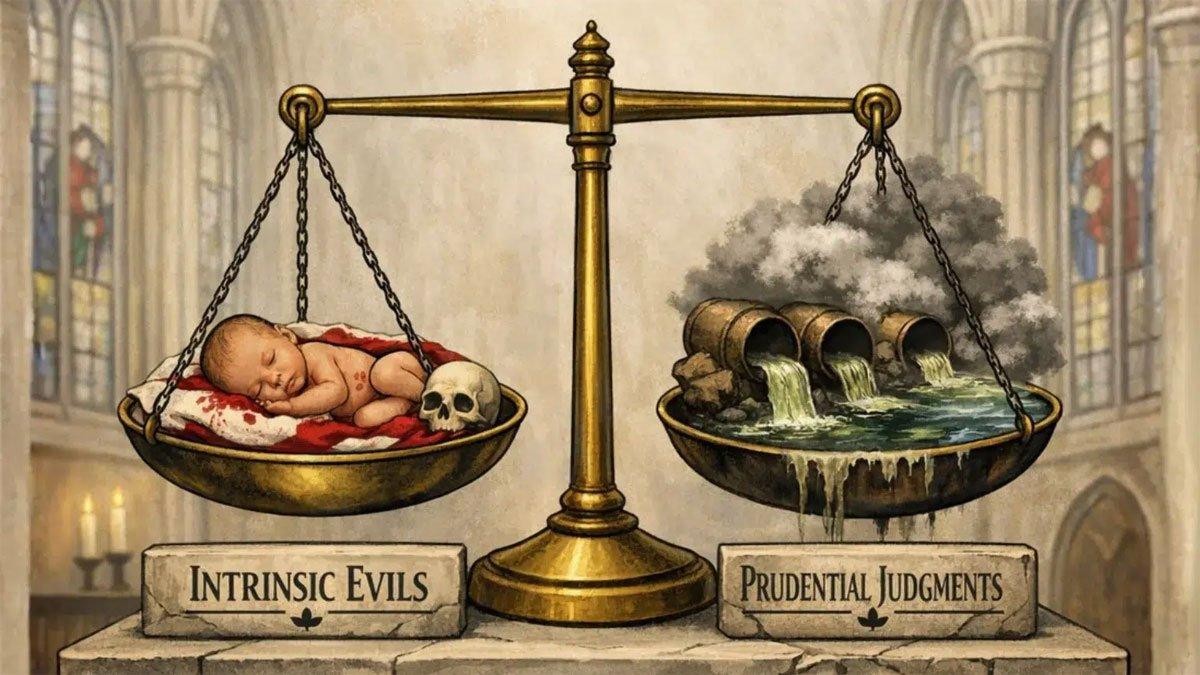
The document adopts the now-familiar framework of “integral ecology,” weaving together environmental, social, economic, and spiritual concerns. Yet in doing so, it risks flattening the hierarchy of moral truths that Catholic tradition has consistently maintained.
There is a real and objective moral distinction between:
- polluting a river
- and destroying an innocent human life
This distinction is not merely one of degree, but of kind.
At a moment when abortion is legally protected and culturally normalized, when euthanasia continues its expansion, and when reproductive technologies increasingly treat human life as a product, the absence of proportional moral clarity is not incidental—it is consequential.
The Church does not exist to echo the priorities of the age. She exists to order them according to truth.
Man Is Not Just Another Creature
Catholic teaching affirms both that man belongs to creation and that he transcends it. He is its steward, not its equal—its crown, not its peer—made in the image of God and endowed with a unique and inviolable dignity.
From Augustine to Aquinas, the tradition is unambiguous: creation is ordered to man, and man to God.¹
The contemporary emphasis on “interconnectedness,” while not false, becomes misleading when it obscures this hierarchy. When ecosystems are treated as bearing a moral weight comparable to the human person, theological clarity gives way to conceptual ambiguity.
At that point, the framework ceases to be distinctly Catholic.
The Missing Word: Sin
The most significant deficiency in the document lies not in what it affirms, but in what it omits.
It refers to a “disordered human heart.” But it stops short of naming sin.
Yet it is precisely sin that unifies the crises of our age. The same cultural logic that exploits the natural world also:
- destroys the unborn
- redefines marriage
- rejects Natural Moral Law
- and seeks to manufacture human life
These are not discrete issues; they are manifestations of a single disorder: the refusal to receive reality as given.
The ecological crisis is therefore not primarily about carbon emissions or consumption patterns. It is, at root, about rebellion—man’s attempt to assume the place of God.
Until this is stated with clarity, ecological discourse will remain superficial.
Continue reading at CUP