
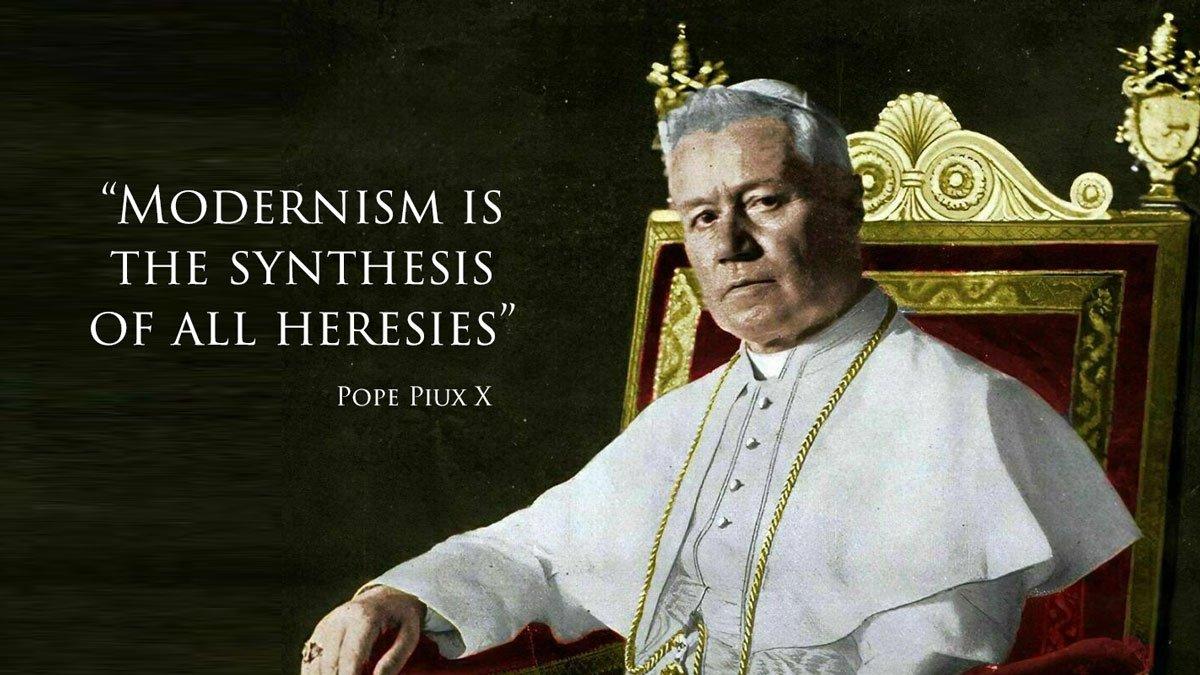
First of all, what is the heresy of Modernism? It’s important to understand that this essay refers to the formally declared heresy of Modernism—not “modernism” in the artistic, cultural, political, or purely philosophical usages of the word. Modernism in Catholic theological doctrine, however, is indeed a heresy—a heresy that progressive-minded Catholics often dally with, and that tradition-minded Catholics have always avoided like the plague.
Modernism was present in our Church for a long time before Pope Saint Pius X officially condemned it as a heresy in 1907.[1] Its presence in the Church had grown significantly during the 19th century and into the early 20th. The Church’s 1907 condemnation of Modernism as a heresy stifled its 20th century growth, at least superficially, for a generation or two, but the specter of Modernism never ceased haunting the corridors of the Vatican until Modernism itself broke forth big-time, in the open, in the Church’s teachings in the Second Vatican Council (1962-65).[2]
It is difficult to get an exact, literal handle on the content of Modernism in Catholic theological doctrine, precisely because of what theological Modernism is. When Saint Pius X condemned it as a heresy in 1907, he was condemning it in all of its manifestations, pre-1907 and on into the indefinite future. Igino Giordani, the biographer of Saint Pius X, explained the Modernism that plagued Saint Pius X’s papal reign (1903-1914) in words that apply to our present-day encounters with it:
Modernism consisted principally in a state of mind and way of life that sought to make over Christianity, rationalistically explaining away its difficulties to make the religion acceptable to the thinking of the day.[3] [Emphasis added.]
Because Modernism seeks to make “the thinking of the day” an influential criterion for discerning Catholic truths, the content of Modernist thought about Catholic truths will vary with “the thinking of the day.” Think about it: accessing the thinking of the day in order to reconcile our Church with the modern world means there can be no fixed eternal Catholic Truth at all in Modernist thought. Modernist thought changes with the times to conform to the times. It is what Cardinal Joseph Ratzinger (who became Pope Benedict XVI) was referencing when he cautioned against an unrestrained and unfiltered openness to “the wisdom of the world”[4] which (the Bible tells us) God regards as “foolishness.”[5] Thus, the very essence of the heresy of Modernism.
Continue reading at LifeSite News