
The faithful were not entertained, instructed, or encouraged at every turn; they were placed, quite deliberately, before God.
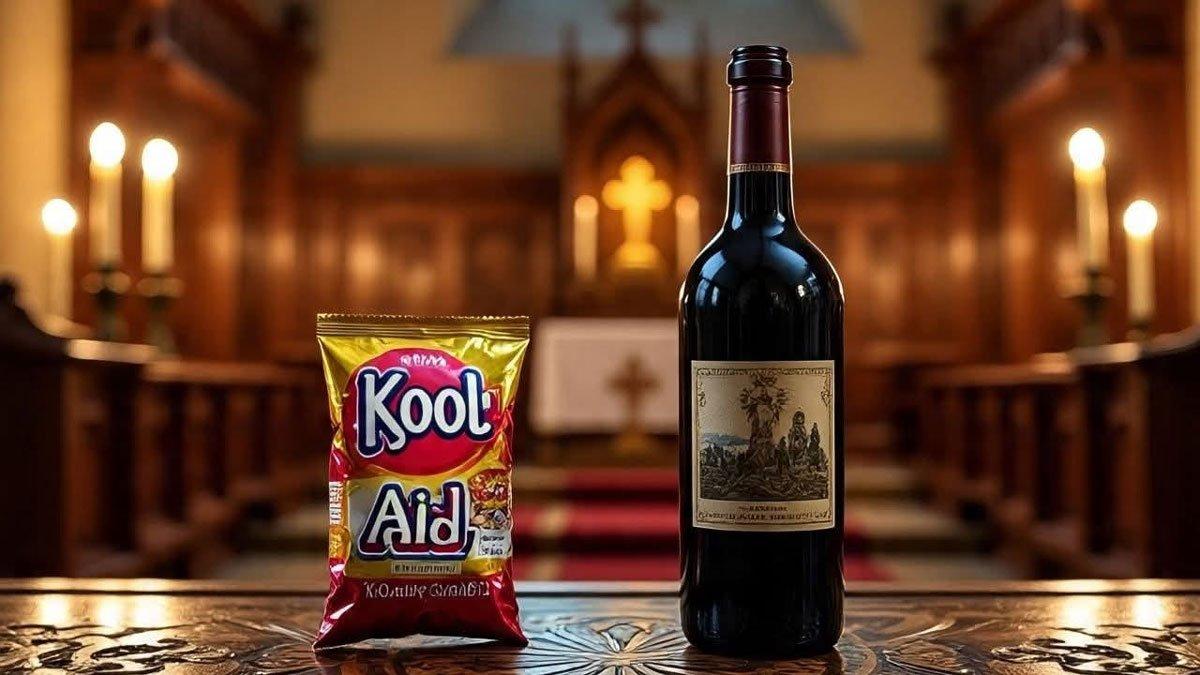
“It is a bit like the difference between Kool-Aid and a well-matured red wine,” said my beloved companion in her inimitable way as she struggled to articulate her first experience of a Solemn High Mass.
She did not mean it unkindly. In fact, there was a certain gentleness—even embarrassment—in her comparison, as though she feared it might sound irreverent. Yet it was precisely the sort of image that only someone untrained in polemics, but sensitive to reality, could produce. Kool-Aid and wine belong to entirely different worlds, not merely in taste but in origin, purpose, and depth. One is manufactured for immediacy: sweet, colorful, instantly gratifying, requiring no patience, no formation of the palate, no lingering reflection. The other is cultivated slowly, aged in silence, shaped by time, tradition, and restraint. To mistake one for the other is impossible once one has truly tasted both.
She had grown up, like many Catholics of her generation, knowing only the Novus Ordo Missae. It was familiar, intelligible, earnest, often well-meaning. She had encountered it in parish churches reordered for efficiency, accompanied by hymns she could sing after hearing them once, celebrated by priests who spoke directly, constantly, reassuringly. None of this struck her as scandalous; it was simply “Mass.” Yet when she found herself, almost accidentally, assisting at a Solemn High Mass of the traditional Roman Rite—with its chant, silence, ordered hierarchy of ministers, and overwhelming sense of gravity—she emerged visibly unsettled. Not angry, but quiet. Something had touched her, and she struggled to name it.
What she experienced was not simply a different aesthetic, nor merely a preference for Latin, incense, or vestments. She encountered a different conception of worship altogether. In the Solemn High Mass, nothing hurried to explain itself. The ritual assumed mystery rather than managing it. Meaning was not constantly verbalized but embodied—through gesture, orientation, and restraint. The priest did not address the congregation so much as lead it. The faithful were not entertained, instructed, or encouraged at every turn; they were placed, quite deliberately, before God.
This single remark—offered without agenda, without ideology—captures with disarming clarity the heart of the debate surrounding the Novus Ordo Missae. The controversy is often framed in terms of obedience versus preference, progress versus nostalgia, accessibility versus elitism. Yet these binaries obscure the deeper question: not whether one form of the Mass is valid, but whether all forms equally convey the fullness of what the Mass is. If the Mass is, as the Church teaches, the unbloody re-presentation of the Sacrifice of Calvary, the axis on which heaven and earth meet, then the manner in which this reality is expressed—ritually, theologically, symbolically—matters profoundly.
This series proceeds from that conviction. It does not argue from sentimentality or taste, but from substance. For the sake of those who are still asking what exactly is wrong with the new “Mass”, it seeks to examine, in a comprehensive and candid manner, the problems that theologians, priests, liturgists, and faithful Catholics have identified in the Novus Ordo Missae over the past half-century. The comparison between Kool-Aid and aged wine is a fitting diagnosis. And like all honest diagnoses, it demands that we look carefully—not away.
Continue reading at Radical Fidelity