
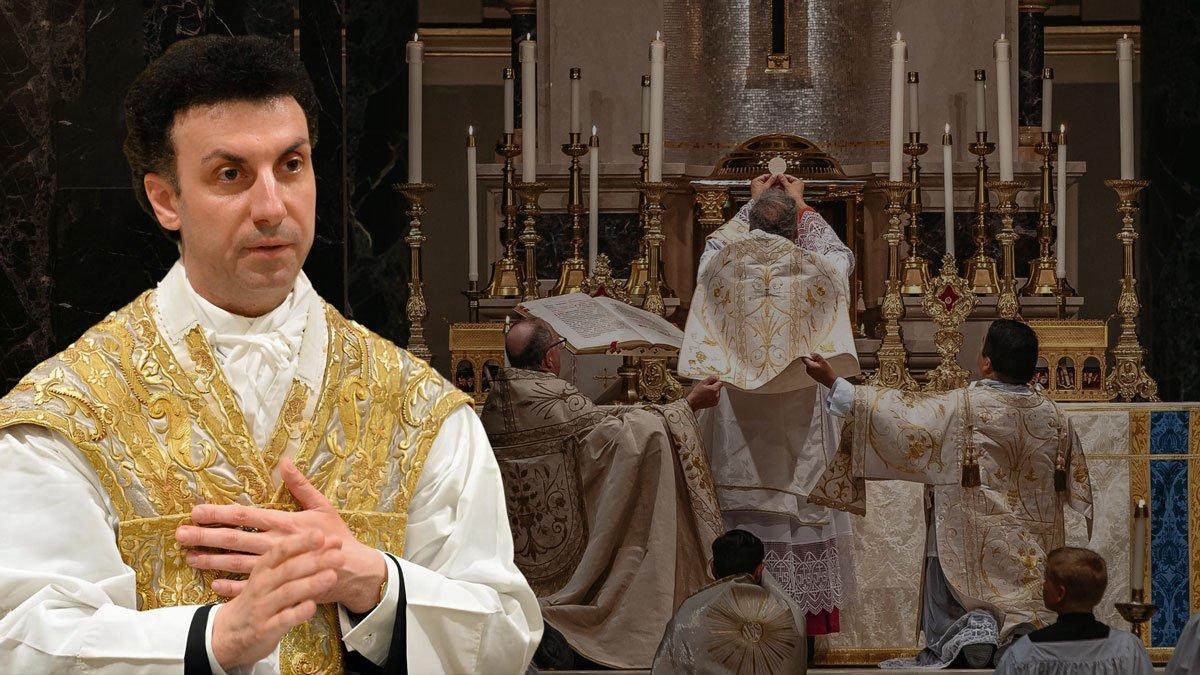
There are only a few things worth fighting for.
Whether certain state systems or modern ideologies belong to these things is questionable, even if bishops most and the Pope support it.
However, among the things worthwhile to fight for are the Catholic faith and its authentic expression in the Holy Mass.
However, it is clear that this can only be the Mass that the Church has been celebrating since ancient times.
However, it is also clear that with the so-called “new Mass” of Paul VI a new faith has come, and it is exactly here that the problem lies:, the Church has divided on the “new Mass” and the new faith, and this is by witness the bitter struggle traditional against the Mass.
No one can be Catholic if he does not agree with the traditional faith and the traditional Mass, if he rejects them or, like Pope Francis, if he even opposes them, and it is this in contradiction that is slowly being the “new Church itself”.
But what about those who remained faithful to the Catholic faith and to the traditional Mass?
Is there really a united struggle for the Catholic cause?
I wish it was so, but the contradictions within the Church have long influenced the various groups within the tradition.
The brotherhoods of St. Pius and St. Peter are a symbol of this: one follows the right Catholic way, the other believed that it is imperative to submit to the Pope at all costs, because the Pope is, after all, the Pope, and because one can be “Catholic” without the Pope, a kind of “deus in terris”. It was once so; this is true, but times are over after least the pontificate of Francis.
Since, then heresy, apostasy and idolatry have conquered have the Church and instead, of fighting for traditional faith and the traditional Mass, those who really still still Catholic turn to Rome to ask for permission for what has always been and allowed never be, prohibited the traditional Mass.
Pope Pius V granted her “eternal”, validity gave her an almost dogmatic character and bound the priests to this form of the Roman Rite once and for all.
But who would have thought that in the “eternal” Catholic Church did not mean “forever”?
And who would have thought that there was virtually no one who dared to challenge a pope who think he can dispose of the Holy Mass, imposed bans on them and created exceptions, as if he were only lord of divine worship?
Can the most sacred thing really lie in a person’s and his high office?
Hardly, and if so: what value would the sacred have?
Continue reading at Stilum Curiae