
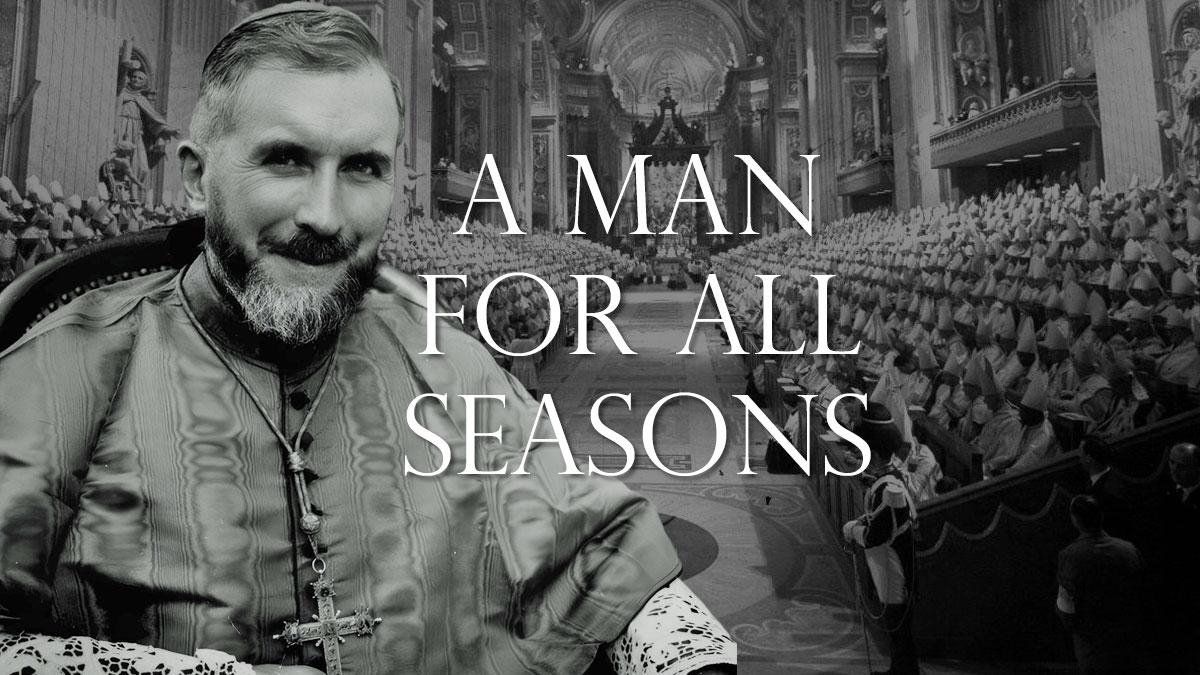
A Young Traditionalist’s Ode of Admiration for Archbishop Marcel Lefebvre, and a Short Apologia
In every age of the Church, God raises up men whose fidelity seems out of season. They speak truths that their contemporaries do not wish to hear, uphold standards that the world considers obsolete, and plant their feet where the shifting sands of public opinion offer no safe footing.
In the latter half of the twentieth century—amid a storm of liturgical upheaval, doctrinal confusion, and moral collapse—such a man was Archbishop Marcel Lefebvre.
I was born decades after his most controversial decisions. My generation has never known a Catholic world unshaken by the Second Vatican Council’s aftermath. We’ve grown up in a Church where the ancient liturgy survives only in pockets, where catechesis has been gutted, and where the sense of the sacred has been diluted almost beyond recognition.
And yet—even at a distance—the figure of Archbishop Lefebvre looms large. His life is a signpost for what fidelity can look like when the price is high.
I. The Making of a Missionary Bishop
To understand Lefebvre’s stand, one must first understand the man. Marcel Lefebvre was not born into ecclesiastical privilege. Born in 1905 in Tourcoing, France, to a devout Catholic family, his early years were marked by the deep piety of his mother and the strong moral example of his father, who would later die in a German prison for aiding the French Resistance during World War II.
From his youth, Marcel was formed by the old Catholic France—the France of parish processions, Gregorian chant, strong family prayer, and a deep awareness that the Faith was not merely a private matter but the very soul of a civilization.
He entered the French seminary in Rome, studying at the Pontifical Gregorian University and the French Seminary under the rector Fr. Henri Le Floch—a man who deeply shaped Lefebvre’s theological outlook. Le Floch emphasized the Syllabus of Errors of Pope Pius IX, the anti-modernist teachings of Pope St. Pius X, and the need to defend the Faith uncompromisingly against liberal Catholicism.
Ordained in 1929, Lefebvre joined the Congregation of the Holy Ghost Fathers and volunteered for the missions in Africa. For over three decades, he labored in French West Africa, eventually becoming Vicar Apostolic of Dakar, then Archbishop of Dakar, and finally Apostolic Delegate to French Africa. He was loved by his clergy, respected by the faithful, and admired for his ability to balance pastoral care with doctrinal clarity.
This background matters because it shatters the caricature of Lefebvre as an “isolated reactionary.” He was, in fact, a man trusted by Popes Pius XII and John XXIII with delicate diplomatic and pastoral work. He lived Catholicism on the front lines, where the faith either transforms cultures or is swallowed by them. He knew firsthand what happens when the Church dilutes her message—she loses souls.
II. The Council and the Cracks in the Wall
In 1962, Lefebvre was elected Superior General of the Holy Ghost Fathers and became a Council Father at Vatican II. He arrived with the mind of a man who trusted that the Church would speak with the same clarity she always had.
But Vatican II was not like the councils before it. From the opening days, there was a clear and concerted push by liberal theologians and bishops to set aside the preparatory schemas drafted under Pope John XXIII’s mandate. These early drafts were solidly traditional, defending the Faith against modern errors. They were discarded in favor of texts drafted in a looser style—pastoral rather than dogmatic, ambiguous rather than precise.
Lefebvre saw danger in this shift. Ambiguity, he knew, is the Trojan horse of error. If a document could be interpreted in an orthodox way or in a heterodox way, the modernists would take the heterodox road every time.
As the Council went on, he witnessed the deliberate sidelining of Latin, the introduction of ecumenical language that blurred the Catholic Church’s claim to be the one true Church, and a new approach to religious liberty that seemed to contradict earlier papal condemnations.
This was no minor adjustment in style. It was, to Lefebvre, a breach in the wall of Catholic orthodoxy—small enough to go unnoticed by many, but wide enough for the floodwaters of modernism to pour through.
Continue reading at Matthias Sevigny Substact
Related
- Archbishop Lefebvre: An Open Letter to Confused Catholics
- Archbishop Marcel Lefebvre’s 1961 Letter That Explains the Entire Crisis