
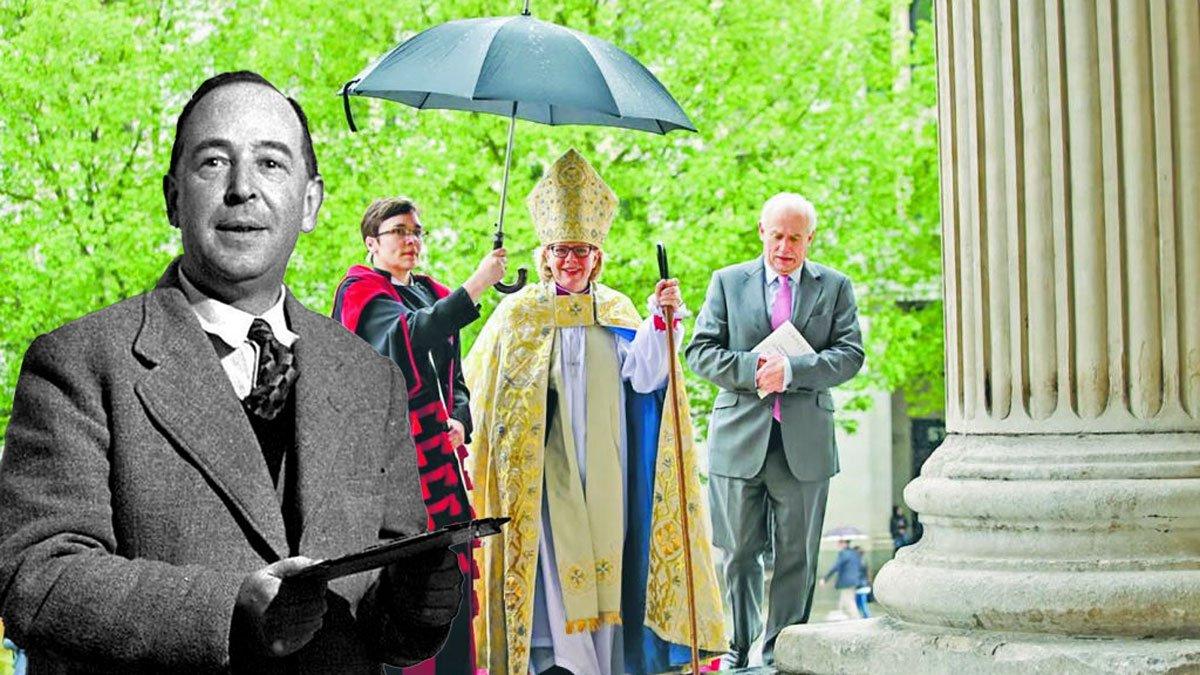
The announcement of the appointment of Sarah Mullally as the 106th Archbishop of Canterbury marks a historic first for the Church of England (CoE), which traces its origins back more than 1,400 years to the time of Saint Augustine of Canterbury. In addition to being the head of the CoE, the Archbishop of Canterbury also serves as the spiritual leader of the world-wide Anglican Communion, whose thriving churches of the Global South have become increasingly alienated from the mother church due to the latter’s long-term drift toward theological liberalism. This appointment will surely widen that breach.
Already in the 1940s proposals were circulating in the CoE in support of the ordination of women priests. Those early efforts provided the impetus for a 1948 essay by the well-known Anglican writer, C.S. Lewis. The arguments he lays out in “Priestesses in the Church?” are worth revisiting and seem as relevant today as when he first penned them – and for Catholics as well as Anglicans.
As Lewis makes clear at the outset, his opposition to women’s ordination is not based on the claim that women are any less capable than men with respect to the many qualifications associated with priestly ministry: “No one among those who dislike the proposal [for the ordination of women priests] is maintaining that women are less capable than men of piety, zeal, learning and whatever else seems necessary for the pastoral office. . . .[Women] may be as ‘God-like’ as a man, and a given woman much more so than a given man.”
Lewis further asserts that the Church’s historical opposition to the practice of female ordination could not possibly have been rooted in a contempt for women’s religious capacities. And that, for one simple reason. As he writes, “the Middle Ages carried their reverence for one Woman to a point at which the charge could be plausibly made that the Blessed Virgin became in their eyes almost ‘a fourth Person of the Trinity.” Despite this, Lewis continues, never “in all those ages was anything resembling a sacerdotal office attributed to her.”
Lewis lays out four arguments for his opposition. The first concerns the nature of the priestly office. In the more traditional understanding, the priest is seen primarily as a representative; in fact, he is a “double representative, who represents us to God and God to us.” The latter function, in which the priest represents God to us, is something that only a man can perform: “Only one wearing the masculine uniform can (provisionally, and till the Parousia) represent the Lord to the Church: for we are all, corporately and individually, feminine to him.”
Continue reading at The Catholic Thing