
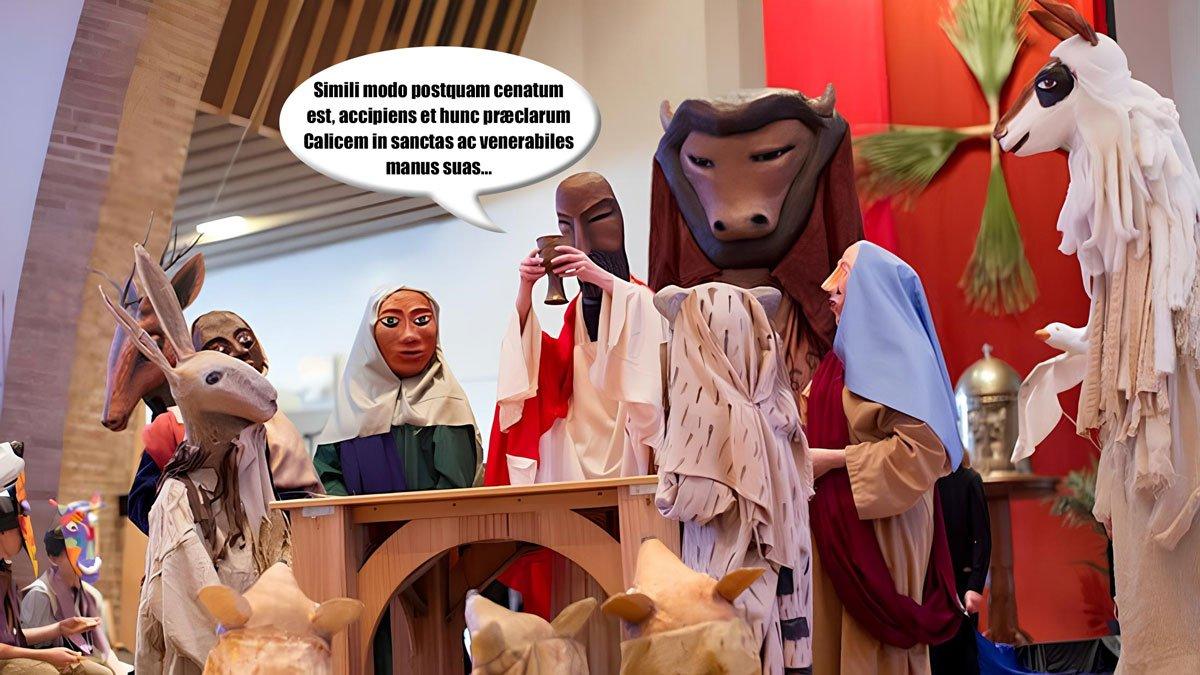
In the wake of Traditionis Custodes, it seems that not a month passes without some presumably well-intentioned prelate or pastor suggesting that a satisfactory substitute for canceled traditional Latin Masses is “doing the Novus Ordo in Latin.” Most recently, we saw this proclaimed in a humiliating homily from the pulpit of a basilica in Chattanooga.
Well-meant or not, this idea is an absolute non-starter, for several reasons.
First, the old and new missals have surprisingly little overlap. All one has to do is compare them side-by-side to see that both the Order of Mass and the Propers of the Mass are largely divergent. The classic article here is Matthew Hazell’s, demonstrating that only 13% of the orations of the old missal are found intact in the new one (and not 17%, the already-low figure at which Fr. Anthony Cekada had arrived, but which turns out on closer inspection to be too generous).1
As I demonstrate in The Once and Future Roman Rite, we are dealing here not with two versions of the Roman rite but with two rites: the Roman rite and whatever one must call the other: let us say, the “modern rite of Paul VI.” If someone happens to enjoy the modern rite in Latin, by all means let him have it; but that’s not an adequate substitute for the TLM, and no one who is even a little bit familiar with the TLM would be able to perceive it to be such.
RELATED: Novus Ordo and TLM Side-By-Side
An acquaintance of mine explained to her ten-year-old son, an avid altar server, that the local bishop, when he announced the end of the TLM, offered to substitute for it a Novus Ordo in Latin, ad orientem, with chant. The boy replied: “Ohhhh, so they’re trying to pretend!” It’s insulting to be offered something that kinda-sorta looks like the TLM but isn’t, as if experienced attendees are ignorant of the fact that the TLM and the Novus Ordo are two separate rites — indeed, as if all we care about is eye-candy.
A virtuous man looks for a wife who is beautiful on the inside as well as on the outside, with the former — the internal character — valued most of all. He’s not interested only in the externals, and neither are traditional Catholics. Speaking and acting as if we were is a not-so-subtle disparagement.
At the same time, we understand that the externals ought to match the internal reality — Mosebach says there is no shame in being “one of those naïve folk who look at the surface, the external appearance of things, in order to judge their inner nature, their truth, or their spuriousness”2 — and we object to any rite that disconnects them, leaving their relationship to free choice, as if we we ought to be reliant on the chance intersection of local politics and subjective good taste. (I will return shortly to the question of aestheticism.)
Continue reading at Tradition and Sanity