
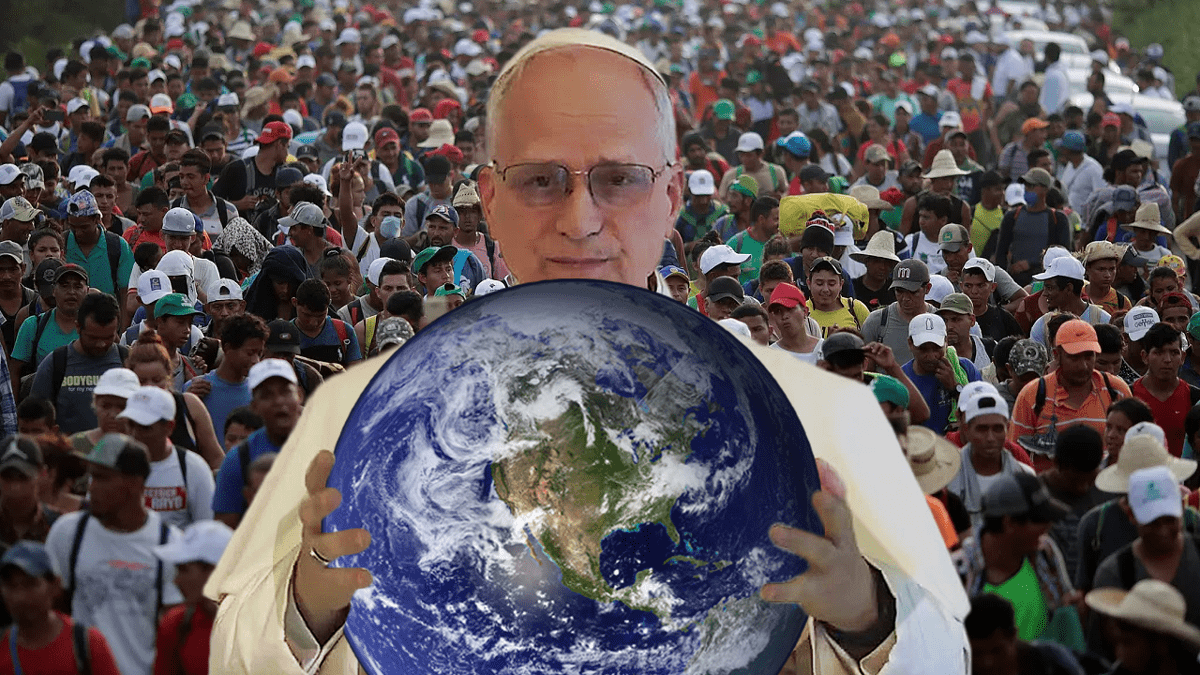
It is one thing to see the Vatican issue social-justice platitudes in a passing speech. It is quite another to watch the Bishop of Rome weave a seamless ideological tapestry across multiple addresses, each reinforcing the next, each recasting the Church’s supernatural mission into a humanitarian program of borderless inclusivity, syncretistic memory, and geopolitical pacifism. That is exactly what we see in three addresses delivered by Leo XIV in late July: (1) his Message for the World Day of Migrants and Refugees, (2) a video message to Vietnamese catechists, and (3) his greeting to Pax Christi USA.
Together, they form a remarkably consistent catechesis; not of Catholic doctrine, but of the neo-Vatican religion that calls itself Catholic while draining the term of everything it once meant.
1. Migration Is the New Pentecost
Leo XIV’s 111th World Day of Migrants and Refugees message does not merely express concern for displaced persons. That would be expected and just. Instead, it pushes a spiritualized globalist narrative in which migration is both the source and sign of the Church’s vitality. We are told that “migrants and refugees stand as messengers of hope,” that they are “missionaries” by virtue of crossing borders, and that their physical journey somehow reactivates the Church’s “pilgrim dimension.”
That term “civitas peregrina,” the pilgrim city, is hijacked here. Leo XIV doesn’t use it to refer to the supernatural journey of the Church from earth to Heaven. No, he applies it to the migratory upheaval of modernity, framing those forced by war, climate, or economics to relocate as living signs of the eschatological Church. The exodus of Abraham becomes a proof-text for UN Resettlement Programs. The wandering of Israel becomes a spiritual metaphor for the undocumented laborer.
Most revealing is Leo’s warning against “sedentarization,” a neologism meaning the state of having settled somewhere. He claims the Church “ceases to be ‘in the world’ and becomes ‘of the world’” when She stops being nomadic. But it is hard to imagine a more “of the world” ecclesiology than this: a doctrine of mission as uprooting, witness as resilience, and evangelization as cross-cultural integration.
The biblical citations flow like stage lighting over a propaganda set. Psalm 91 is invoked to describe illegal migrants crossing deserts and seas, because apparently “the snare of the fowler” and “pestilence that stalks in darkness” now apply to smugglers and border enforcement. Zechariah’s peaceful vision is conflated with the policy goals of globalist NGOs. And of course, the promise of Christ in Luke 17, “the Kingdom is within you,” is transmuted into the goal of multilateral cooperation.
One would think the role of the Church is to baptize migrants, teach them to renounce error and false religion, and form them in the life of grace. But Leo has another idea: “Catholic migrants and refugees can become missionaries of hope” who “initiate interreligious dialogue” and “revitalize ecclesial communities.” This is the spiritualized logic of population replacement, where declining Western churches are not reformed but simply re-seeded with devout Third Worlders. The Mass becomes a vehicle for cultural fusion, and the parish becomes a refugee intake center with an altar.
What of the migrants’ own beliefs? Are they expected to convert? No mention. Leo’s gaze never reaches that far. He is not concerned with the salvation of souls, but with the therapeutic “integration of persons” and the appearance of “welcome.” The Gospel he preaches is not that of Christ crucified, but of resilience, movement, and multicultural enrichment.
Continue reading at Hiraeth In Exile