
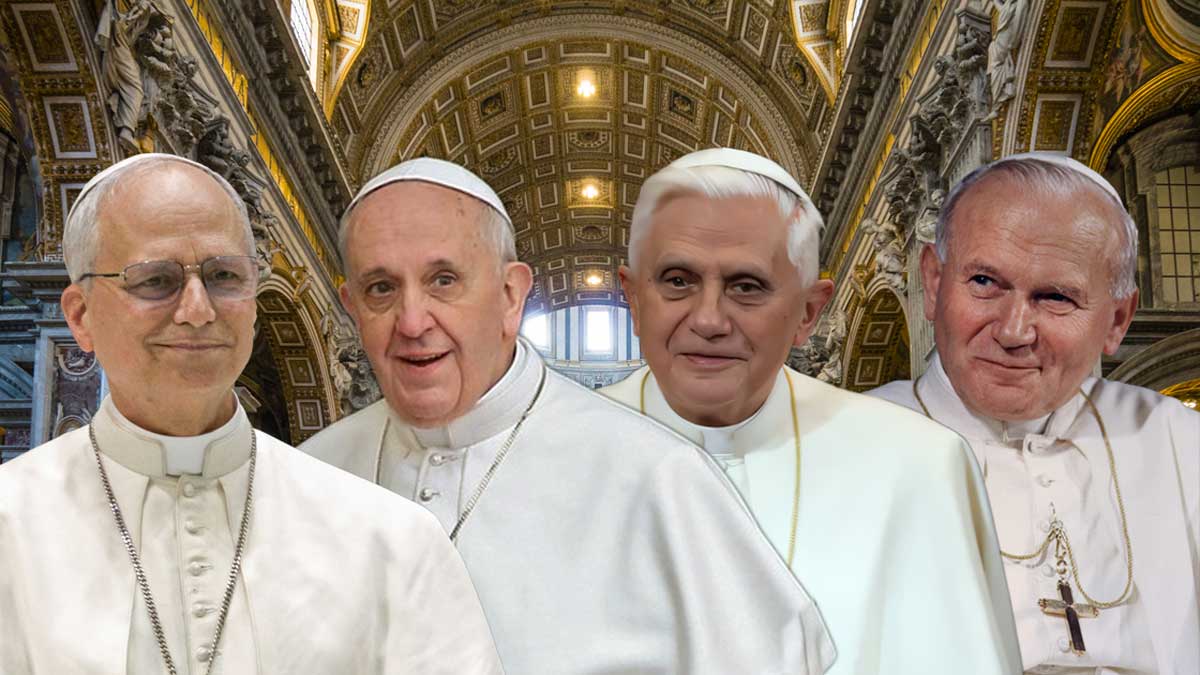
The tumultuous and exhausting 12-year pontificate of the Argentinian Jorge Bergoglio, better known to the world as Pope Francis, came to an end in April. Francis was a paradoxical pope if there ever was one. He openly promoted disruption in the Catholic Church, which he did not hesitate to call causing “a mess,” as if unclarity about doctrine and the Church’s moral teaching could somehow serve constructive purposes. He spoke endlessly of mercy and the Church as an immense, nonjudgmental “field hospital” for the lost and broken. But Pope Francis rarely called for the repentance that is the crucial prerequisite for the healing of the soul. He occasionally criticized abortion and gender ideology, and in no uncertain terms, even as he tolerated and promoted those inside and outside the Church who indulged these grave evils.
Francis repeatedly called for patient listening and an ill-defined “synodal Church,” even as he was far more autocratic than any of his immediate predecessors. He seemed to have more than a little sympathy for left-wing regimes and ideologies (think Marxist regimes in Cuba, Nicaragua, and China) that openly persecute his co-religionists. He oozed contempt for more traditional-minded Catholics—and especially adherents of the Traditional Latin Mass, the most faithful of the faithful—while tolerating rank heresy from a German Church in open rebellion against Rome, Christian orthodoxy, and the unchanging moral law. He promoted the kitschy, vulgar religious art of the serial sexual abuser Father Marko Rupnik, who specialized in seducing and abusing nuns in a crude and truly sacrilegious manner, and inexcusably protected him from prosecution right to the bitter end (something that thankfully seems to be coming to an end under Pope Leo XIV).
Promisingly, Francis occasionally warned about reducing the Christian Church to the status of an NGO. But he then endlessly opined as if he were the CEO of a predictably progressive NGO informed by equally predictable ideological clichés. The pope was prone to utopian effusions about world affairs, and acted as if support for open borders and peace at any price were prerequisites of the Christian faith. Some of his ecclesiastical boosters even bizarrely spoke about Francis having his own “magisterium” distinct from that of the historic Church. He had no obvious affection for Western civilization, and spoke not at all about the “dictatorship of relativism” that threatened it from within. He showed little or no realism about external threats to it, such as the one arising from militant Islam. In the manner of a woke-adjacent academic or intellectual, Francis saw Islam always and everywhere as a “religion of peace” (for a paradigmatic example, see the 2013 apostolic exhortation The Joy of the Gospel). His Christian affirmation was humanitarian in emphasis and focus, and he was extremely reluctant to challenge the progressivist shibboleths of our age.
Continue reading at The American Mind