
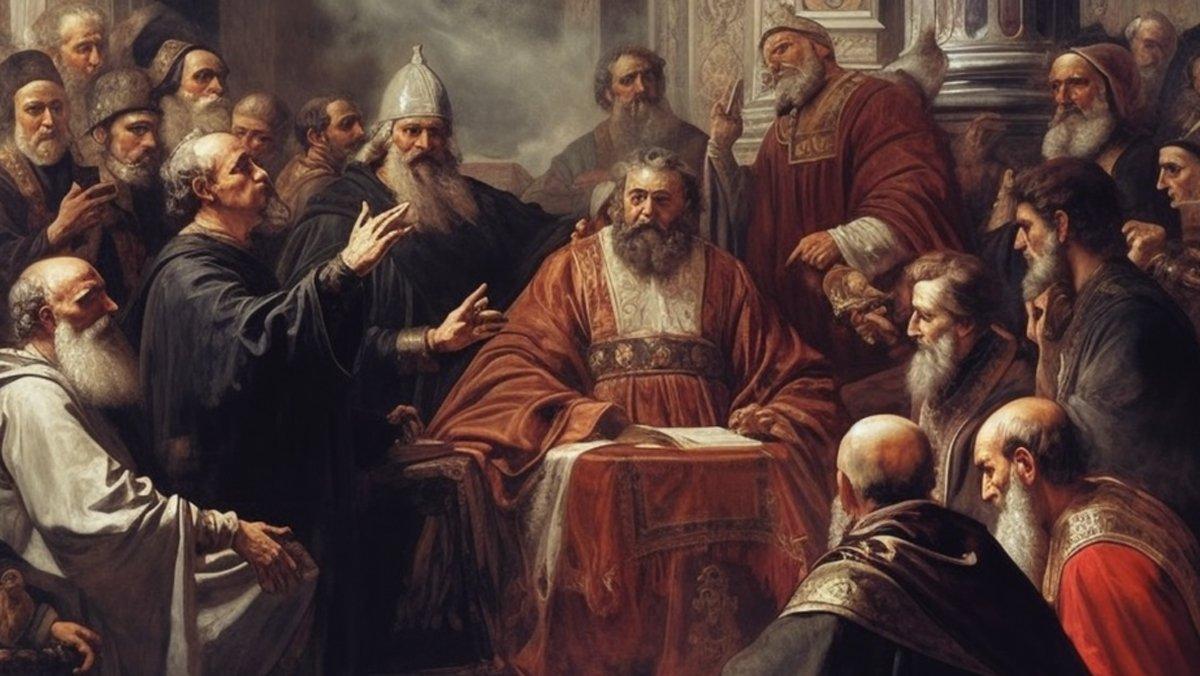
One of the most famous stories about the Council of Nicaea is the legend that St. Nicholas slapped the heretic Arius in the face for his impudence and heretical teaching. Whether this event actually happened or not is a matter of debate. Some Catholics love it, while others do not.
Either way, the Council of Nicaea — whose 1,700th anniversary we celebrate this year — remains deeply relevant to the Christian Church today, as its ancient controversies still echo in the divisions we see now. At its core, the divide is between the Church of Nicaea and the Church of “Nice.”
To understand what I mean by this contrast, we have to check the history. In the fourth century, the heresy of Arianism was rampant. It was part of the great, long-running debate over the divinity of Christ and therefore the definition of the Holy Trinity. At the core of Arianism was a denial of orthodox Christology. Put simply, the Arians believed that Jesus was not the Second Person of the Holy Trinity who took human flesh of his blessed mother. He was, instead, a created being — a demigod — and therefore subordinate to God the Father.
Arianism was not just a theological problem — it developed into a major schism. The Arians had their own churches, appointed their own bishops, and even had the support of temporal powers like Emperor Theodoric. St. Athanasius, who famously battled against Arianism, noted that the Arians were subtle theologians. They used ambiguous language and spoke in vague terms. They were more interested in pastoral care than dogma. They were also, for the most part, better educated and largely drawn from the ruling classes.
Arianism, with its subtler understanding of the Incarnation, seemed like a much nicer and more believable religion. The idea of Jesus as a created being, subordinate to the Father, was a more intellectually palatable solution to the mystery of the Incarnation — a solution that avoided the complexities of the doctrine of the Trinity.
Today Arianism has taken a different form, creeping back into the Church under the guise of secular humanism. By “secular humanism,” I mean the pragmatic belief system that takes man as the measure of all things. This humanism is a conglomeration of different modernistic beliefs, but the summary of it all is that this physical world is all there is, that human history is all that matters, and that the advancement of the human race in this physical realm is the only thing worth fighting for.
Arianism today is an interpretation of Christianity according to this materialistic, humanistic philosophy. Consequently, Jesus Christ as the divine Son of God and the co-eternal Second Person of the Holy Trinity doesn’t fit with this worldview. Instead, the Arians of our day have concocted a nicer, more palatable version and treat Jesus as a noble soul, a spiritual teacher, a wise rabbi, a beautiful example, or a martyr for a lofty cause. At most, they see Jesus as a human being who is “so fulfilled and self-actualized that he has ‘become divine.’” In other words, “he reveals to us the divine image in which we were all created — and therefore shows us what God is like.” There is a sense in which this “divinization” happened to Jesus as a result of the graces he received from God, the life he led, and the sufferings he endured.
This sentimental Christianity is our modern form of Arianism. The cultural context of the heresy and its expression are different, but the essence of the heresy is the same as it always was: “Jesus Christ is a created being. His ‘divinity’ is something that developed or was added to his humanity by God.”
Continue reading at National Catholic Register