
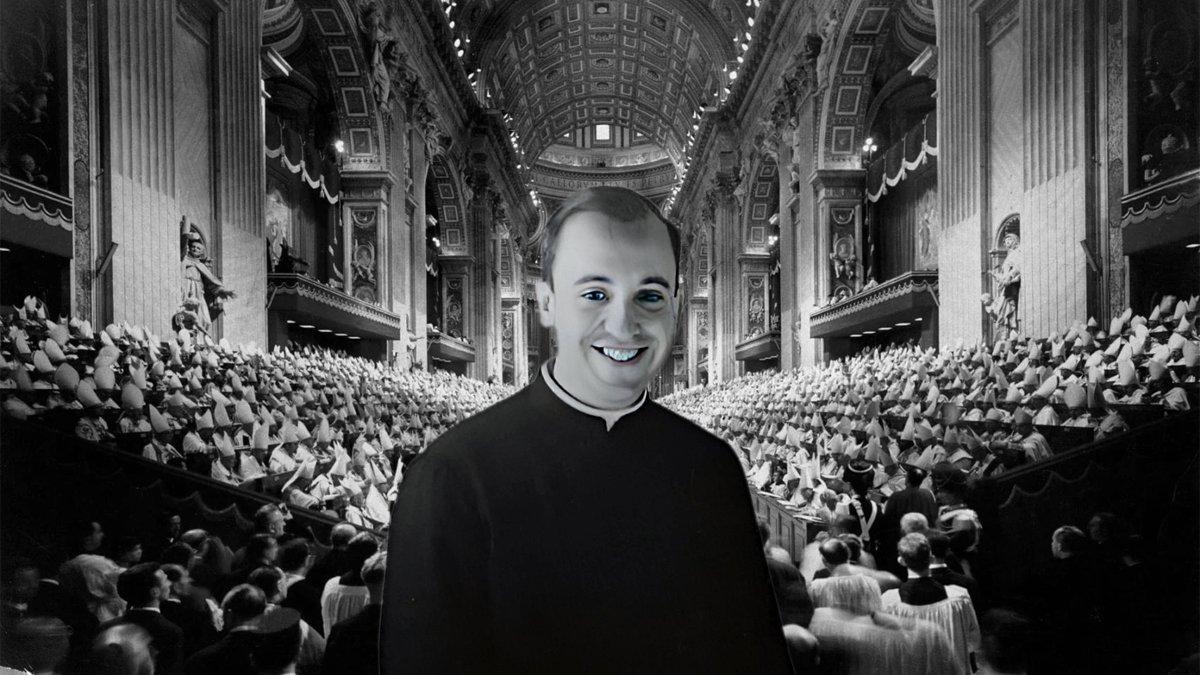
Jorge Bergoglio was ordained to the priesthood on December 19, 1969, four years after the close of Vatican II. His immediate predecessors — John Paul II and Benedict XVI — had been influential experts at the Council, but Francis was the first claimant to the papacy to have been formed in the priesthood during the period of revolutionary change propelled by Vatican II. While this does not absolve him of responsibility for his actions, it should help form our assessment of Francis’s role in Church history and learn the lessons that God wants us to learn from the harms he caused.
In his 1968 book about the Council’s aftermath, Is It the Same Church?, Frank Sheed introduced his topic by describing the way in which the Catholic world changed after the Council:
“My own feeling is that all the changes ushered in by Pope John XXIII were made possible by the forty years which preceded him. But how fast and furiously they have come. Consider how things would strike a Catholic wrecked in 1957 on a desert island and only just now brought home. His Catholic friends have him in their houses. In all of them he finds the conversation beyond him. It circles, sometimes heatedly, around two words which mean nothing to him — Ecumenism and the Pill.” (p. xi)
Sheed was of course referring to debates among Catholics about contraception (which would become the subject of Paul VI’s Humanae Vitae) and the false ecumenism that animated Vatican II. Sheed continued:
“The weeks that follow are full of shocks. The priest facing the congregation takes some getting used to. And Mass in English even more. He remembers arguments with Protestants in which his trump card had been the use of Latin as proof of the Church’s Catholicity — ‘one language everywhere in the world.’ . . . Whichever way he looks, the Catholic world he knew seems to have turned upside down — and so quickly: after all, he was only away ten years. He hears of priests getting married, with other priests performing the ceremony. He hears of nuns in picket-lines, nuns marching with Negroes and communists in Alabama; of seminarians picketing Cardinals, refusing daily Mass, declaring the Pope unfitted for his primacy.’ (pp. xi-xii)
This is what Jorge Bergoglio would have known during his priestly formation. It was not simply a matter of new beliefs, practices, and disciplines — all around him the Catholic world was unstable, with the only certainty being a radical departure from what had been standard in the eyes of most Catholics prior to the Council.
Continue reading at The Remnant