
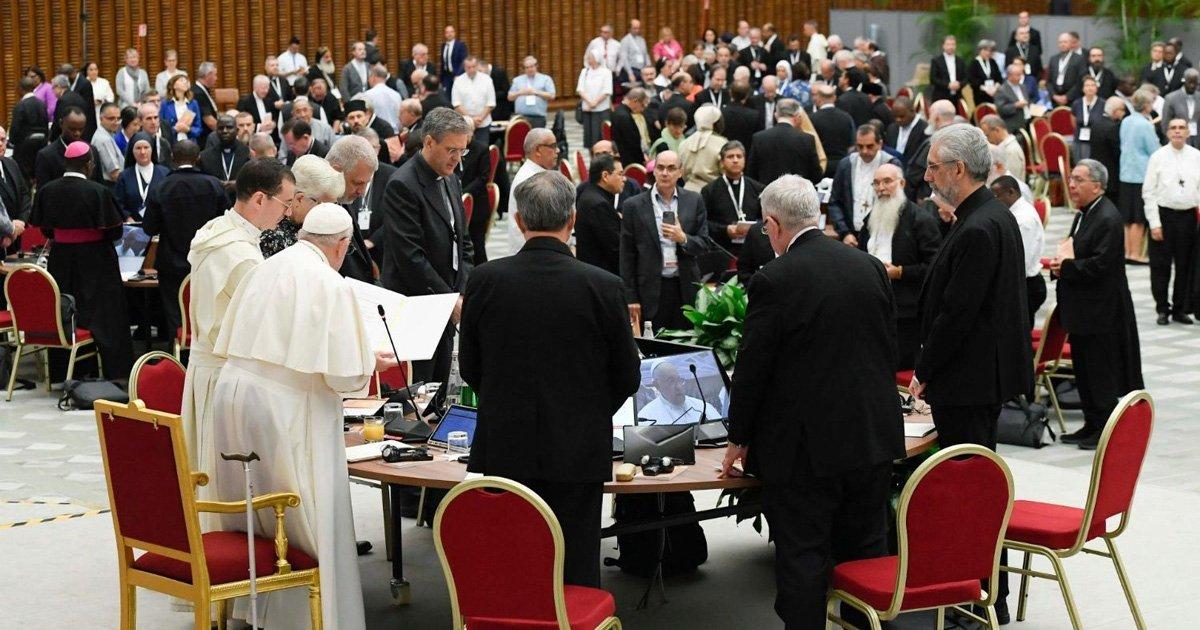
Today’s diary entry is a bit of a grab bag of topics: all of which, it seems to me, are related on a foundational level. And their connection is a view of the Synod as a revolutionary opportunity to reinvent the Church from the ground up. I might even go so far as to suggest that one of the dynamics at work in Synod-2024 is an attempted coup d’église by Catholic progressives, a coup aimed at changing Catholic teaching on a range of moral and sacramental matters without the messiness of transparency or the meddling interference of collegial collaboration with the world’s bishops.
This would be the final assault on the hill that was John Paul II/Benedict XVI, via the pathway of press conferences and the secretive study groups run by apparatchik sock puppets of the Roman Curia and the Synod General Secretariat.
One had hoped that this would not be the case, since the Instrumentum Laboris had nothing in it concerning these “hot-button issues” which, as just noted, had been assigned by the pope to extra-synodal study groups whose work will not be done until the summer of 2025. But now we see Synod members publicly commenting on the study group that dealt with women’s ordination and openly questioning its negative findings, which may or may not be what the pope wanted to happen. But this entire flap raises a more basic question: Why else have yet another study of an issue that many had thought to have been settled? One does not talk to death a topic that one thinks is closed. As we approach the 1,700th anniversary of the First Council of Nicaea, shall we have a study group to explore whether Arius was right after all?
The Synod members have indicated that they wish a fuller report from all the study groups, and so will devote the afternoon of October 18 to getting a broader briefing on their “tentative” findings thus far. So much for the idea that the Synod will not get bogged-down in the muck of debates over hot-button issues. So much for the idea that the Synod is about a more synodal Church of shared collegial governance between the pope and the bishops—the only true teaching of Vatican II on the topic—and that all it seeks is a less centralized Church. So much for the idea that the Synod is not a “parliament” of political factions all jostling for the inside rail. Instead, this begins to seem like the long-dreamed-of “Vatican III” (although this would be “Vatican III Lite”), where the Church is to be “unburdened by what has been.”
Continue reading at Gaudium et Spes 22