
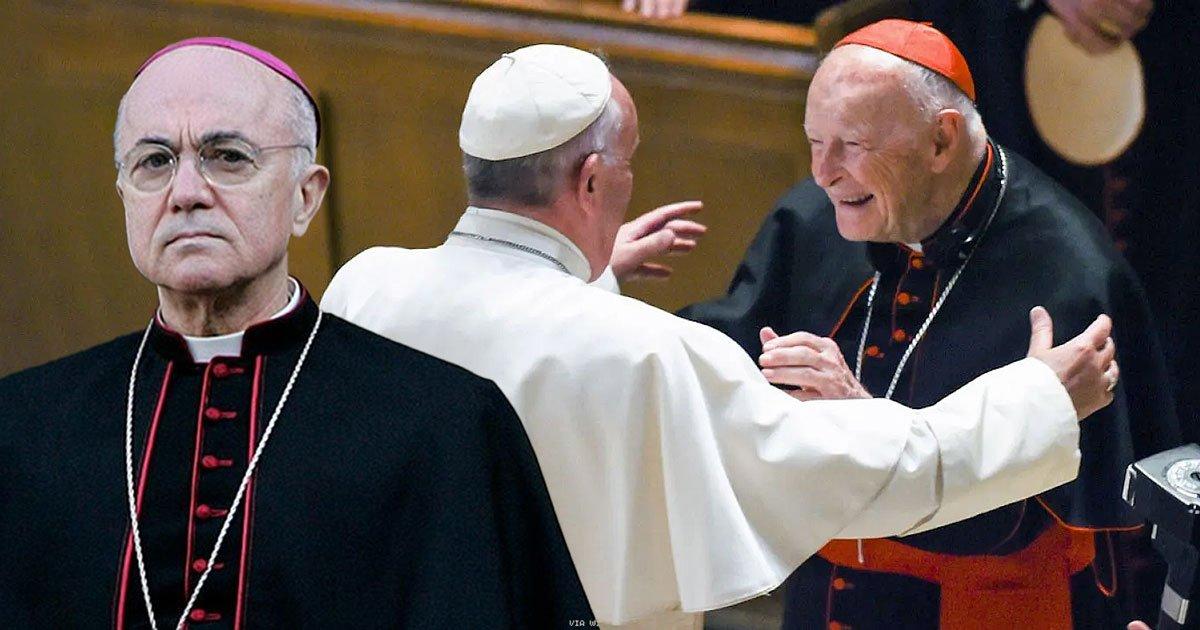
Recently, Pope Francis excommunicated Archbishop Carlo Maria Vigano, the man who blew the proverbial whistle on Ted McCarrick’s many proclivities. He helped make the attainment of justice possible for me, and I am grateful. Ted McCarrick was my rapist. Vigano opened dialogue on an area that had, up until that point, been whispered about, and even then, only in the corridors of the Holy See’s most exclusive residences and offices. Whatever you may or may not think about Vigano’s takes on theology and morality, the man, at enormous personal risk, stepped forward and said, “enough.”
Francis thanked Vigano by excommunicating him from the Catholic Church. The Pope who has claimed to be open to every sort of dialogue relating to ecumenism, diversity, equity, and inclusion, silenced one of his most significant critics in a way that denies him the rites of the Church which he has served for decades.
Pope Francis has been a disaster for victims of clerical sexual abuse. Upon his election to the Throne of St. Peter, he promised reform, justice, and a no-holds-barred examination of everything the Holy See has done to aid and abet sex offenders in Roman Collars. Instead, what we got was smoke and mirrors.
Rather than establishing lay boards to investigate bishops credibly accused of abuse or cover-ups, the Pope came up with Vos estis lux mundi, a totally ineffective method of complicit bishops investigating other complicit bishops. Dr. Adam A. J. DeVille of the University of St. Francis in Fort Wayne, IN, is wise to point out how “Pope Francis denounces clericalism, but his new motu proprio enables it.”
After being accused by Vigano in his August 2018 “Testimony” of covering up for McCarrick, the Pope commissioned a report (the infamous whitewashed “McCarrick Report”) that brought many of McCarrick’s sins to light, but magically exonerated the Pope, and essentially exonerated his predecessors, despite the fact that courts have taken evidence into consideration that popes dating back decades knew about McCarrick.
Francis promised one thing, and then provided something else: a vicious campaign of institutional defense, cover-ups, and lies that are worse than any of his modern predecessors. The cover-ups and lies predate his papal election when, writing in his book, On Heaven and Earth, he declared, “It [sex abuse] never happened in my diocese.” Imagine, an archdiocese of 2.85 million Catholics and not one case of abuse! Argentine abuse victims who allege that Francis, when he was their archbishop, covered up their abuse, may need to be counseled that what they reported only occurred in their minds.
The world cannot believe a single word Francis says, because he says one thing and does another. After he tells Italian bishops that gay men should not be allowed to study for the priesthood because there is too much faggotry (frociaggine) in seminaries, he then counsels a gay man who was rejected from a seminary to “go ahead with your vocation.”
As the poet laureate Maya Angelou was fond of saying, “when someone tells you who they are, keep watching. When someone shows you who they are, believe them.” Francis has shown us who he is, and what he’s about. Francis has made clear that his extreme liberal agenda is all that he cares about, and that the real work of reform is something he perceives as a threat to his agenda, his papacy, and the institutional Church that has propped him up for far too long.
It is time, right now, for Francis to pack it in, and resign for the good of the Church. There is nothing else he can do that would benefit the Church; his only option now is to get out of the way. For the long-term survival of the Church, we should hope and pray that he takes the next flight to Castel Gandolfo sooner than later.
John Bellocchio, M.Phil., Ed.S., C.A., CCDT, PPG, NALA, NALS